$160 Million Affordable Complex Rises in Mount Vernon as Downstate Rent Pressure Pushes North
QWest Towers will bring 229 income-restricted apartments to a lot beside the Mount Vernon West Metro-North station, at a cost of nearly $700,000 an apartment, more than three-quarters of it public money.
By Aspen Yang · August 13, 2026 · 3 min read
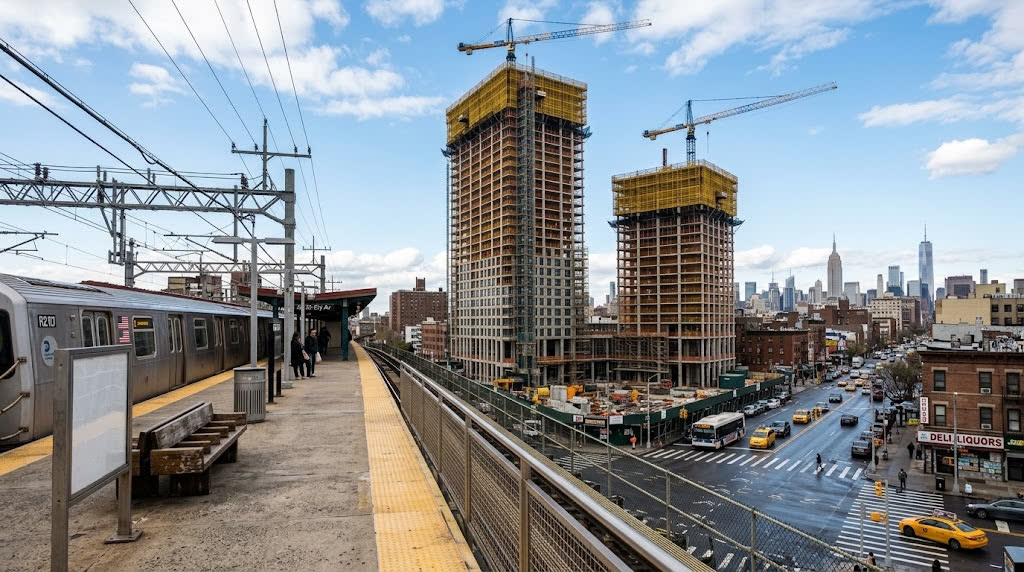
NEW YORK, Aug. 13, 2026 — Two towers rising beside the Mount Vernon West Metro-North station hit a milestone this week that says as much about the cost of building affordable housing as about the need for it.
Gov. Kathy Hochul announced Tuesday that construction is underway on QWest Towers, a $160 million development that will create 229 apartments at 1 and 25 North MacQuesten Parkway. The developers — Simone Development Companies, the Stagg Group and Rev. Dr. L'Judie Matt-Simmons — held a topping-off ceremony at the site the same day, attended by Mayor Shawyn Patterson-Howard and Westchester County Executive Ken Jenkins. The project replaces several vacant and dilapidated buildings.
The larger building, at 25 North MacQuesten, rises 15 stories with 115 apartments; the second is 12 stories and 114 apartments. The state describes the units as affordable to households earning up to 80 percent of Area Median Income; filings by the developers' project counsel and an analysis prepared for the Mount Vernon Industrial Development Agency both put the income band at 40 to 80 percent.
It is the kind of project state planners argue answers the downstate housing shortage: dense, income-restricted and a short walk from a commuter rail platform. As city rents keep setting records — the citywide median asking rent hit $4,200 in June, the highest in StreetEasy's data going back to 2010 — demand has pushed outward into lower Westchester.
"To combat the housing shortage impacting all New Yorkers, we need to build more housing — full stop," Hochul said.
The financing is where it gets complicated, and the public record does not tell it in one voice. The governor's office puts the project at $160 million; project counsel Goldstein Hall describes a $158 million development; an impact analysis prepared for the IDA in November 2024 put costs at $157.6 million across 228 apartments — differences consistent with a budget measured at different points over more than a year.
The shape of the capital stack is consistent. Federal and state Low-Income Housing Tax Credits allocated by New York State Homes and Community Renewal are expected to generate more than $69 million in equity. HCR is adding $32.5 million in subsidy loans through its Housing Finance Agency. Westchester County is contributing more than $19 million, and Empire State Development $5 million through the Mid-Hudson Momentum Fund. Construction is carried by roughly $76 million in HFA bonds backed by a Bank of America letter of credit — financing of a type typically retired as tax credit equity is paid in, which is why it does not appear in the state's list of sources.
Against the state's own $160 million figure, that is about $125.5 million in public support, or 78 percent. Divided across 229 apartments, the total works out to roughly $698,700 per home, about $548,000 of it public money.
The subsidy does not end at the closing table. The Mount Vernon IDA granted the project a 30-year payment-in-lieu-of-taxes agreement under which the owners pay 10 percent of shelter rent instead of ordinary property taxes, savings valued at $8.2 million in present terms. In exchange, the project committed $1.4 million to the city school district and $2.1 million in payments and projects for the city. None of that appears in the governor's announcement.
"Mount Vernon is proud to be a pro-housing community," Patterson-Howard said. The city is one of 450 municipalities certified under Hochul's Pro-Housing Community program, which unlocks access to discretionary state funding — Albany's main lever for getting suburbs to accept density.
The open question is arithmetic. At roughly $700,000 an apartment, with public capital covering more than three-quarters of the cost and a three-decade abatement on top, the QWest model delivers high-quality, transit-adjacent, income-restricted housing — 229 units at a time.