5G Small Cells Pop Up on Midtown Lampposts, Prompting Privacy and Aesthetics Debate
City permits have accelerated deployment across Manhattan, drawing praise from carriers and criticism from preservationists.
By Kira Sato · January 6, 2026 · 4 min read
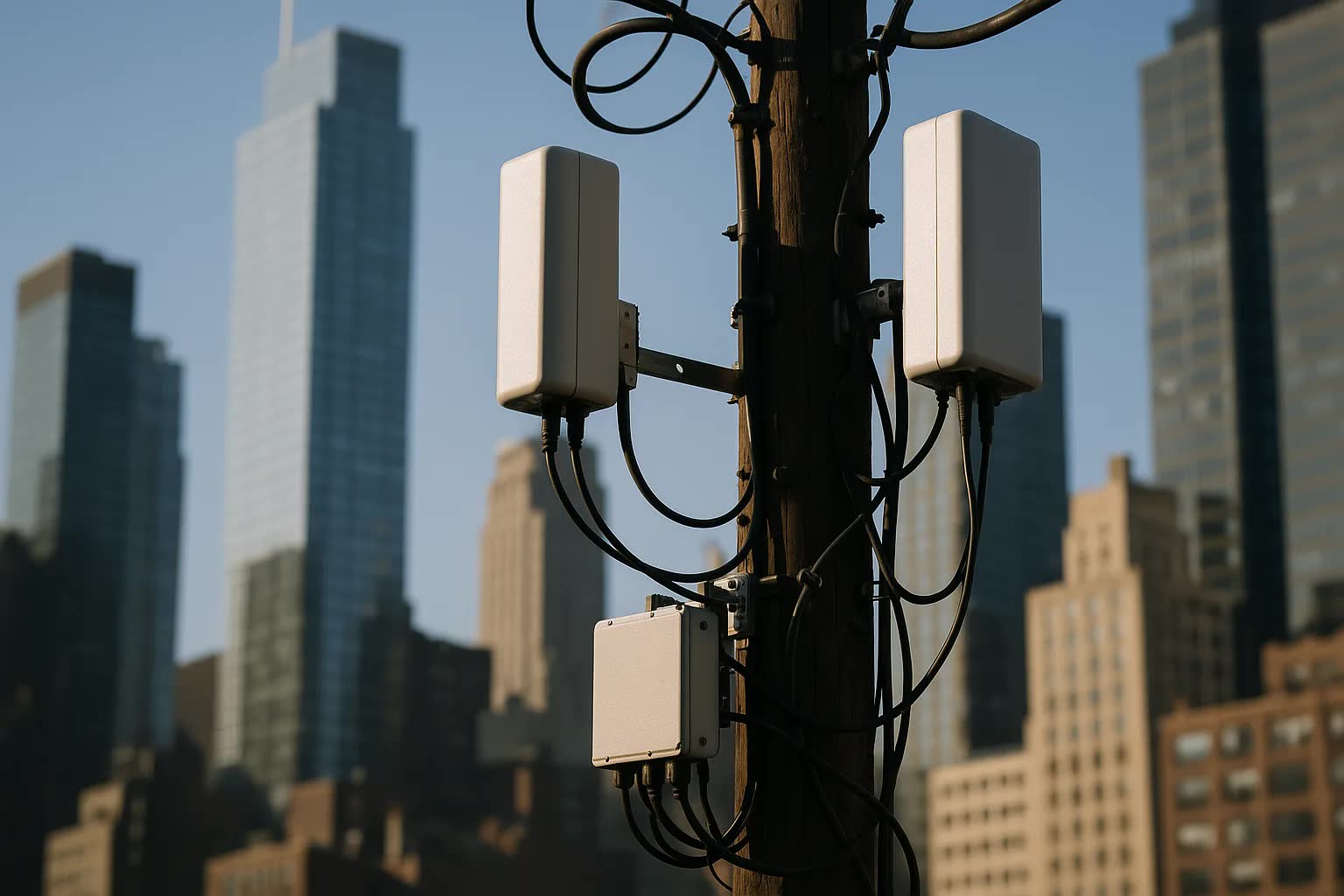
NEW YORK — Jan. 6, 2026 — A new crop of 5G small cell antennas has begun appearing on lampposts across Midtown Manhattan, threading high-capacity wireless gear through the theater lights of Times Square, the cast-iron posts along Fifth Avenue and the tree-shaded sidewalks by Bryant Park, and prompting a fresh debate in the city over privacy, visual clutter and who gets to decide what the streetscape looks like.
Street crews working for three major carriers and several third-party infrastructure firms have in recent weeks bolted compact radio units and small equipment cabinets to poles on Broadway, on 42nd Street near the Port Authority Bus Terminal, and along Madison Avenue outside Rockefeller Center, citing a city permitting process that officials say has been streamlined to accelerate the rollout.
The devices are about the size of a shoebox or smaller, mounted at roughly 12 to 15 feet above ground and linked to fiber backbone lines behind manhole covers, according to engineers and permit filings. Carriers say the deployments are meant to fix chronic indoor coverage gaps in office towers and subway-adjacent retail corridors; critics counter that when those boxes include edge-computing modules the installations can do more than simply relay signals, raising novel questions about what data is processed at street level.
"We are focused on improving reliability and capacity for New Yorkers and small businesses who depend on uninterrupted mobile service," said Maya Chen, director of network engineering at MetroWave, a fictional carrier that has installed hundreds of the units in Manhattan. "These cells reduce latency for emergency communications and enable more consistent connections in dense areas where traditional macro towers struggle to serve indoor customers."
Preservationists and neighborhood groups have been blunt from the outset. "They are sticking boxes to historic posts and calling it progress," said Carlos Rivera, president of the Midtown Preservation Society. "On Fifth Avenue and around Bryant Park you can now see an array of mismatched enclosures and cabling that undermine the character of the street. We accept upgrades, but not at the expense of the landmarks and the public realm."
The municipal numbers underscore the scale of the change: between Sept. 1 and Dec. 31, 2025 the Department of Transportation and the Department of Buildings issued 1,243 small-cell permits in Manhattan, with 2,780 individual nodes installed citywide during the same period, according to permit records obtained by NYDailyWatch. City staff say average permit turnaround has fallen from about 62 days in 2024 to 13 business days in late 2025 after procedural changes; carriers report that post-installation measurements show median indoor throughput in affected corridors rising by an estimated 2.7 times compared with pre-deployment baselines.
City officials say rules require unobtrusive placement, color-matching and setbacks where possible, and that installations in landmarked districts remain subject to additional review. "We have tightened aesthetic standards and require carriers to submit concealment plans for every node in a historic district," said Elena Ortiz, assistant commissioner for telecommunications policy at the fictional New York City Office of Digital Infrastructure. "But we also have a responsibility to keep the city connected for public safety and commerce."
Retailers and commuters on some blocks report tangible benefits. At a sandwich shop across from Penn Station, owner Rita Soto said foot-traffic orders placed through mobile apps are completing more reliably since a nearby node was activated. "We had customers who said their maps and payment apps kept dropping; now the orders go through and the line moves faster," said Soto, a longtime Hell's Kitchen merchant. Developers and commercial landlords in the Garment District and along Herald Square have quietly negotiated access agreements with carriers to prioritize busy retail storefronts and to subsidize certain stealth enclosures.
Privacy advocates and civil liberties lawyers, however, warn that design rules alone may not address broader data concerns. Groups such as Citizens for Digital Privacy and the Fifth Avenue Heritage Alliance are preparing information requests and exploring legal challenges to force clearer disclosure about what, if any, edge processing or sensor integration accompanies the radios. "We are not fighting technology; we are asking for transparency about data collection, retention and access," said Daniel Park, director of Citizens for Digital Privacy. The city Department of Law has advised carriers to keep logs and to provide redacted audit trails to municipal oversight bodies upon request, but no uniform reporting standard has been publicly adopted.
The debate is likely to continue through the spring as the City Council schedules a public oversight hearing on municipal permitting procedures and the Landmarks Preservation Commission prepares guidance specific to telecommunication attachments. Several carriers have proposed a pilot program that would test unified, modular enclosures designed to fit ornamental poles along Fifth Avenue and inside historic districts, with a review deadline expected in June. For now, Midtown commuters will pass under an evolving skyline of small cells, and the clash between modern connectivity and conservation will play out on the city’s busiest sidewalks.