A New Push to Connect Hudson River Trails Is Turning Weekend Riders Into All-Season Cyclists
Regional planners from Yonkers to Poughkeepsie are coordinating to fill gaps in the waterfront network and add commuter-focused amenities.
By Julian Alvarez · March 22, 2026 · 5 min read
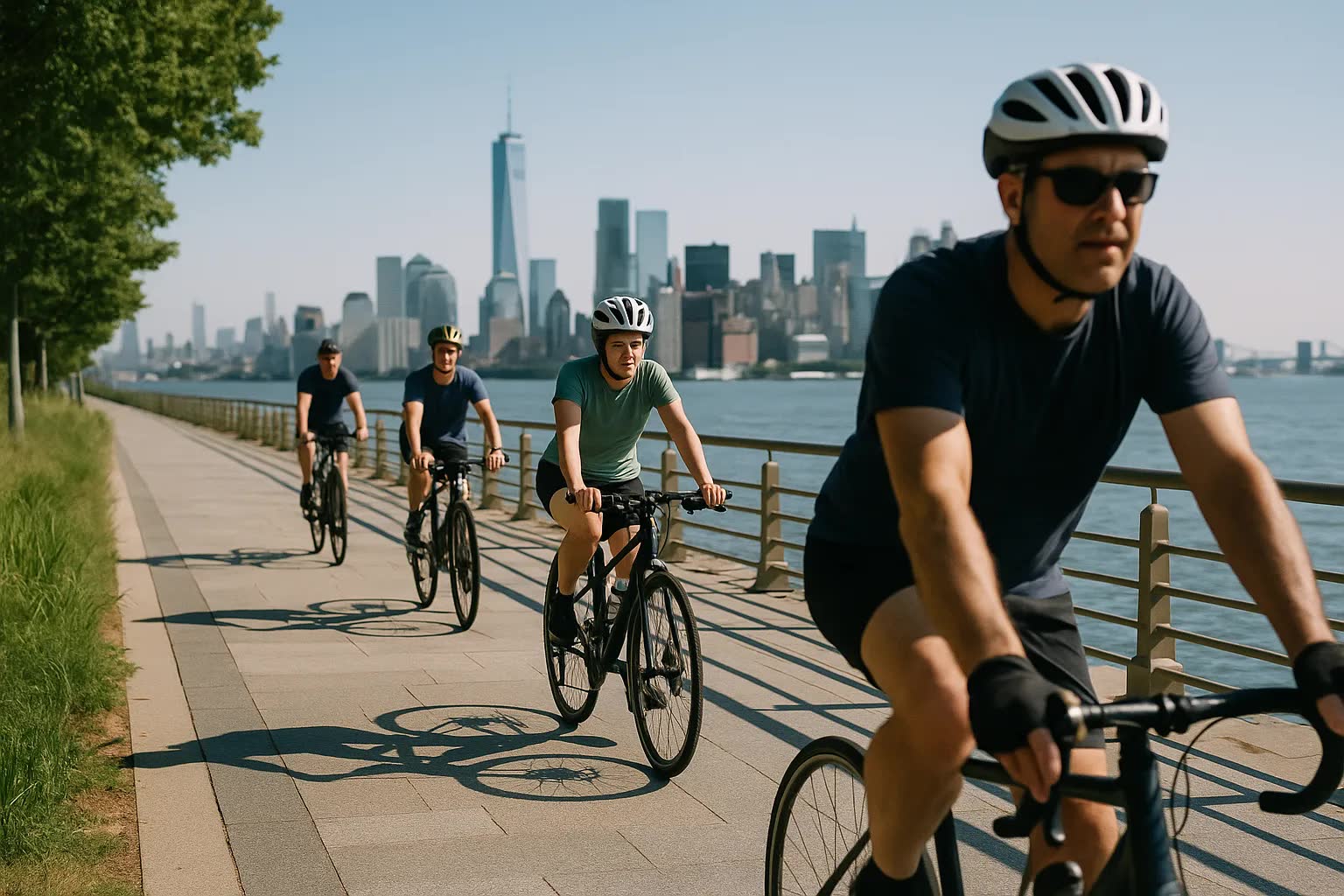
NEW YORK — On a bracing late-winter morning, riders in bright jackets coast down the Hudson River Greenway past Chelsea Piers, their breath steaming in the air as commuter cyclists pass weekend riders who linger to watch the tugboats slip by. What was once a network of pleasant recreational loops has become the frontline in a new regional push to knit together waterfront trails from Yonkers to Poughkeepsie, turning days-of-the-week cyclists into year-round commuters with a string of practical upgrades and policy changes aimed at making the riverfront viable in snow and sleet as well as sunshine.
The Hudson River Waterfront Collaborative, a consortium of municipal planners, county transportation agencies and nonprofit trail groups, has emerged in the past year as the coordinating body charged with filling gaps along roughly 60 miles of shoreline north of Manhattan. Its agenda blends capital projects — new bridges, boardwalk repairs and paved connections — with a campaign to add commuter-focused amenities such as secure bike parking at transit hubs, real-time wayfinding and winter maintenance contracts that prioritize cleared lanes. "We're trying to think like a transit agency, not a park department," said a senior MTA planner who requested anonymity, "because people need reliability more than they need scenic views when they are getting to work in January."
The physical work will be visible in familiar New York City places: widened paths near 72nd Street that better accommodate passing bikes and runners, brighter LED lighting under the Henry Hudson Parkway for later commutes, and redesigned intersections at 125th Street to ease the lane changes that now force many riders into traffic. Across the river in Yonkers, engineers have started a study on a missing mile of riverside trail between Getty Square and the Hudson River Museum, while in Poughkeepsie planners aim to tie the downtown River Street promenade directly to the Walkway Over the Hudson with a bike-friendly connector and a covered, heated waiting area where ferries cross in winter months.
Local advocates say the difference will be more than cosmetic. "For years our community's relationship with the waterfront has been seasonal — in the summer you see families and casual riders, but in November it's empty," said Marisol Vega, director of the Westchester Trails Coalition. "If you give someone a heated shelter, reliable lighting and a safe place to lock a bike at the train station, they'll start choosing the bicycle for Monday, not just for Sunday." Vega's group has been piloting winter plowing on weekends in Yonkers and coordinating with municipal crews to expand weekday clearing during the initiative's first two winters.
The plan lays out concrete targets and budgets to back those ambitions. Officials say work to close roughly 22 miles of discontinuous shoreline could cost about $150 million over the next six years, financed by a combination of state grants, federal transportation dollars and local matching funds. Planners estimate approximately 7,200 weekday bicycle commutes currently occur along the combined Hudson corridor between Yonkers and Poughkeepsie; with the proposed upgrades they project a 60 percent increase to roughly 11,500 daily rides by 2030. The collaborative expects to complete three demonstration projects by the end of 2027 and to have the bulk of physical gap closures underway by 2029.
At the neighborhood level the proposals read like a mosaic of micro-interventions: a secure bicycle hub with capacity for 120 bikes at the Yonkers Metro-North station near Getty Square; resurfacing and better drainage on the stretch of trail that runs along Riverside Park in Inwood; and a new signalized crossing where the route meets Market Street in downtown Poughkeepsie. Small features — motion-sensor lights, salt- and sand-free gravel blends for winter traction, repair kiosks stocked with pumps and basic tools — are being prioritized because planners say they deliver immediate utility to commuters who otherwise might opt for the train or a car when the weather turns sour.
Business owners and bike shop operators along the river say they have already noticed a shift. "We used to sell mostly summer gear, but in the last two seasons we've sold more winter tires and lights than ever," said Amaya Ruiz, co-owner of Riverside Bike Shop on West 125th Street. "People who would come in for a Sunday ride are now asking about commuter locks and subscriptions for secure parking at stations. That tells you they are thinking about biking through the shoulder seasons, not just looking for a weekend fix." Ruiz's shop has partnered with a nonprofit to host free winter-commuter clinics in Mount Vernon and Hastings-on-Hudson.
Equity and access have been central to the initiative's outreach, planners said; workshops in Washington Heights, Morrisania and Yonkers' Crestwood neighborhood were held to solicit input on where the missing connections matter most to low-income commuters. Planners acknowledge the risk that improved trails can accelerate property values and have floated community benefit agreements and anti-displacement funds as part of development packages. Advocacy groups, meanwhile, are pushing for a commitment to leave at least 30 percent of secure bicycle parking free or low-cost for lower-income riders and for priority routing that serves neighborhoods that historically lacked waterfront access.
Not everyone is convinced the upgrades will solve deeper problems such as riverfront privatization or seasonal municipal budgeting. Some civic groups in rural stretches north of Peekskill expressed skepticism about maintenance contracts, noting that plowing a 10-foot-wide bike lane along a two-mile marsh boardwalk is expensive and logistically complex. But the collaborative points to its multi-jurisdictional governance model — a rotating steering committee and a shared maintenance fund — as a way to pool resources and spread costs between counties and cities without putting the burden solely on small towns.
Summer pilots are slated to open in sections of Yonkers, Croton-on-Hudson and Poughkeepsie in 2027, with further construction rolling through 2030 and full corridor connectivity anticipated by the early 2030s. For cyclists who once treated the river as a weekend refuge, the longer-term pledge is a different kind of relationship: the Hudson as a commuting spine, a flood-resilient public amenity and a practical artery for everyday life. Planners say the success of the effort will be judged not by ribbon-cutting photos but by whether commuters are still rolling along the river during the first snow of January.