Alan Greenspan, Longtime Federal Reserve Chairman Who Guided America Through Booms and Crises, Dies at 100
The central banker who steered the US economy through Black Monday, the 1990s expansion, and the early 2000s served under four presidents and became one of the most recognized figures in modern financial history.
By Renee Yu · June 22, 2026 · 5 min read
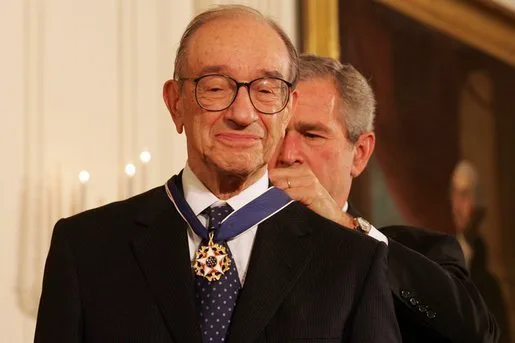
Alan Greenspan, the longtime chairman of the Federal Reserve whose influence stretched from Wall Street trading floors to family mortgage payments across America, has died at age 100. His wife, journalist Andrea Mitchell, confirmed that Greenspan died from complications related to Parkinson's disease. For nearly two decades, Greenspan sat at the center of the American economy — a position of quiet authority that made him, in the estimation of many, the most consequential economic official of the late twentieth century.
Appointed by President Ronald Reagan in 1987, Greenspan remained Federal Reserve chairman under four presidents — Reagan, George H.W. Bush, Bill Clinton, and George W. Bush — serving until 2006. His tenure covered some of the most consequential moments in modern economic history. Just two months after taking office, he faced the stock market crash known as Black Monday, when the Dow Jones Industrial Average plunged more than 22 percent in a single day. The new Fed chairman moved quickly to reassure financial markets, flooding the system with liquidity and issuing a brief but decisive statement of support for the banking sector. Many economists credit that response with preventing a broader financial panic from metastasizing into a full recession.
Over the years that followed, Greenspan became one of the most recognizable figures in Washington. Investors tracked his public appearances with unusual intensity. Financial reporters parsed every sentence of his congressional testimony, looking for clues about future interest-rate decisions. His briefcase attracted photographers outside Federal Reserve meetings. Television networks interrupted programming to cover his remarks. A generation of investors came to view him as the person most capable of keeping the economy on track — a reputation that, for better and worse, would define both his celebrated years and his contested legacy.
During the economic expansion of the 1990s, Greenspan earned his highest standing. Unemployment fell, inflation remained relatively low, and the technology boom helped fuel rising stock prices and consumer confidence across a decade that, for much of the country, felt like an era of genuine prosperity. His decision in 1996 to warn of "irrational exuberance" in asset markets, while ultimately not followed by the rate increases that would have punctured the tech bubble, became one of the most quoted phrases in the history of central banking — a phrase that captured both his perceptiveness and his ultimate caution about using the blunt instrument of monetary policy to restrain market enthusiasm.
Not everyone agreed with that assessment. Some economists warned that markets had become too dependent on the expectation that the Federal Reserve would step in whenever trouble emerged — a phenomenon that came to be called the Greenspan Put. Critics argued that low interest rates and a hands-off approach to financial regulation encouraged excessive risk-taking throughout the financial system. Those criticisms intensified after the 2008 financial crisis. Although Greenspan had already left office by the time major financial institutions began collapsing, many analysts pointed to policies adopted during his tenure — including permissive regulation of the mortgage-backed securities market and an unwillingness to use the Fed's supervisory authority to rein in predatory lending — as contributing factors to the housing bubble that preceded the crisis.
In congressional testimony after the crash, Greenspan acknowledged that some of his long-held assumptions about how financial markets functioned had been wrong. "I found a flaw," he told the House Committee on Oversight and Government Reform in October 2008. "I don't know how significant or permanent it is. But I've been very distressed by that fact." The admission stood in sharp contrast to the confidence that had defined much of his public career and was received by supporters and critics alike as a moment of genuine reckoning.
Born in New York City in 1926, Greenspan studied economics after initially pursuing a career in music, attending the Juilliard School before enrolling at New York University. Before entering public service, he built a successful consulting business and became closely associated with the free-market philosophy promoted by novelist Ayn Rand, whose circle he joined as a young man and whose influence he later partially disavowed. Even after leaving the Federal Reserve, Greenspan remained a frequent commentator on economic policy, government spending, inflation, and financial markets. His views continued to draw attention long after his final Fed meeting. The debate over his record began long before his death and is unlikely to end with it — the measure of a central banker being, ultimately, not the years of calm he presided over, but whether the system he shaped proved durable when tested.