How New York City Is Anchoring the Nation's 250th Birthday Celebration This Fall
From a tall ships parade in New York Harbor to a free concert on the Great Lawn, the city is mounting a months-long program that aims to be inclusive, international, and honest about American history.
By Sarah Chen · August 16, 2026 · 5 min read
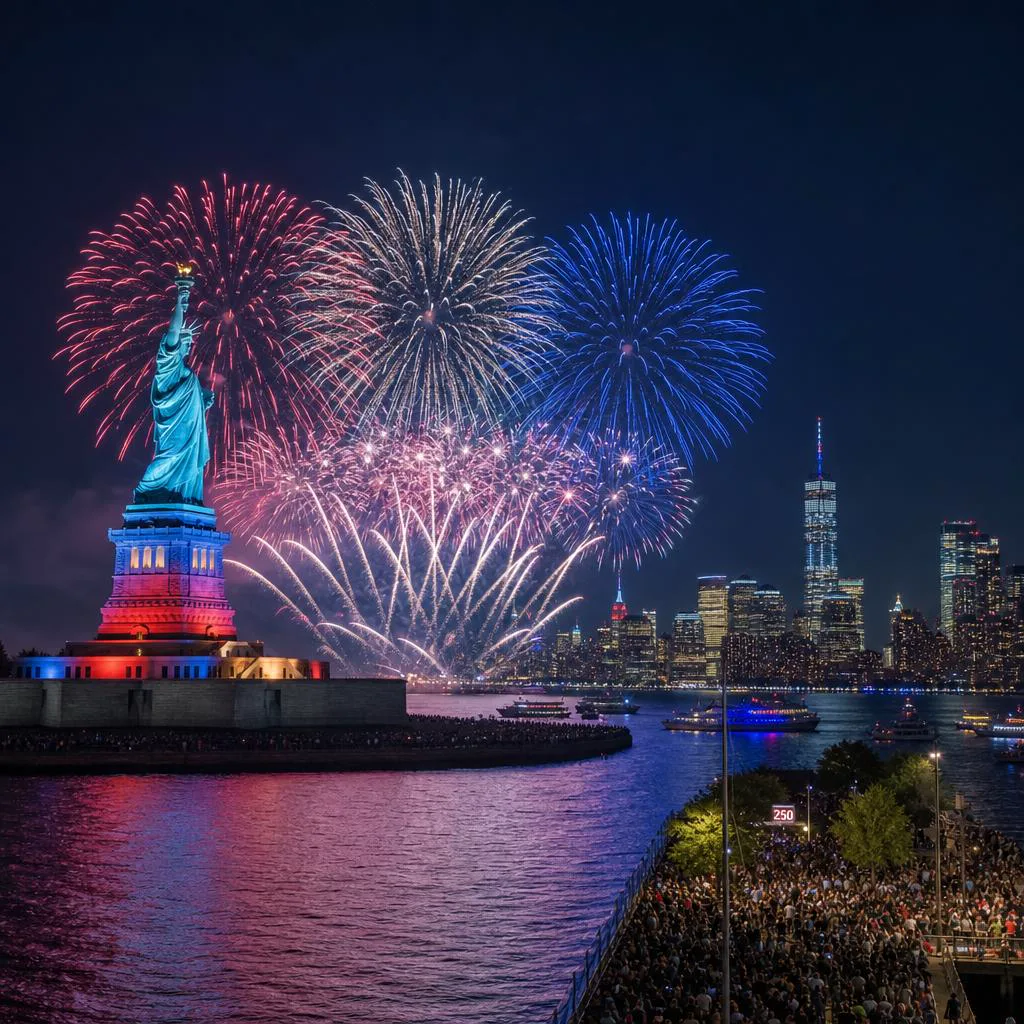
When the United States marks its 250th birthday this fall — the official Semiquincentennial commemoration runs from September through the end of the year, with a national climax on November 25, the date in 1783 when British forces evacuated New York — no city in the country has invested more in the celebration, or argued more publicly about what exactly should be celebrated, than New York.
The city's America 250 program, overseen by a mayoral commission that has been meeting since 2023, includes more than 200 events across all five boroughs: museum exhibitions, public art installations, educational programs in every public school, free concerts, and a centerpiece maritime parade through New York Harbor on September 27 that organizers say will be the largest gathering of tall ships in the United States since the Bicentennial in 1976.
The harbor parade, dubbed "Sail Into History," has confirmed participation from vessels representing 34 countries. The Dutch tall ship Stad Amsterdam, the Portuguese Sagres, and the Japanese Nippon Maru will join American ships including the Coast Guard barque Eagle in a procession that will pass the Statue of Liberty, circle Governors Island, and conclude with a 22-minute fireworks display. Viewing areas will be free and open to the public along the Brooklyn Bridge Park, Hudson River Park, and Staten Island's St. George waterfront.
But even as the logistics come together, the commission has found itself navigating the charged politics of American historical memory. Several community groups in the Bronx and upper Manhattan pushed back against early programming that they said presented the nation's founding in uncritically triumphalist terms, pointing out that New York in 1776 was a city where roughly one in five residents was enslaved. After a contentious series of public hearings last year, the commission revised its core programming to include a parallel track of events, titled "The Whole Story," focused on the experiences of enslaved people, Indigenous nations, and immigrant communities during the revolutionary period.
"We spent a long time arguing about whether this was about celebration or reckoning," said Dr. James Okafor, the commission's co-chair and a professor of American history at City College. "We eventually decided that the most honest thing we could do was refuse to choose. American history is both. A 250th birthday party that pretends otherwise is a lie, and New York is not a city that tells comfortable lies."
The centerpiece cultural event is a free concert on the Great Lawn in Central Park on October 18, featuring the New York Philharmonic, the New York City Ballet, and a lineup of popular musicians to be announced next week. The city expects more than 100,000 people to attend. The program will conclude with a new commissioned work by composer Valerie Coleman, written for the Philharmonic and a 200-voice community choir drawn from all five boroughs, titled "The River Keeps Moving."
Museums across the city have mounted exhibitions timed to the commemoration. The New-York Historical Society's "Revolution and Its Discontents" traces the war's impact on the city's diverse communities; the Museum of the City of New York has opened "250 New Yorks," a participatory installation inviting residents to submit objects representing their own family's arrival in the city. The Brooklyn Museum, characteristically, is taking the sharpest angle: its contribution, "Whose Revolution?," examines the Haitian Revolution alongside the American one, arguing that the two are inseparable.
Mayor Myrie, speaking at a press conference Friday to announce the final fall programming schedule, said the city had chosen to lean into its complexity rather than smooth it over. "New York is 8.3 million people who came from everywhere and are still arguing about everything," he said. "That is not a problem to solve. That is the point. That is what we are celebrating."