Astoria Microgrid Project Advances to Reduce Queens Power Outages
Local officials tout battery storage and rooftop solar pilots as a hedge against storms that have repeatedly darkened the neighborhood.
By Aaron Feldman · April 19, 2026 · 5 min read
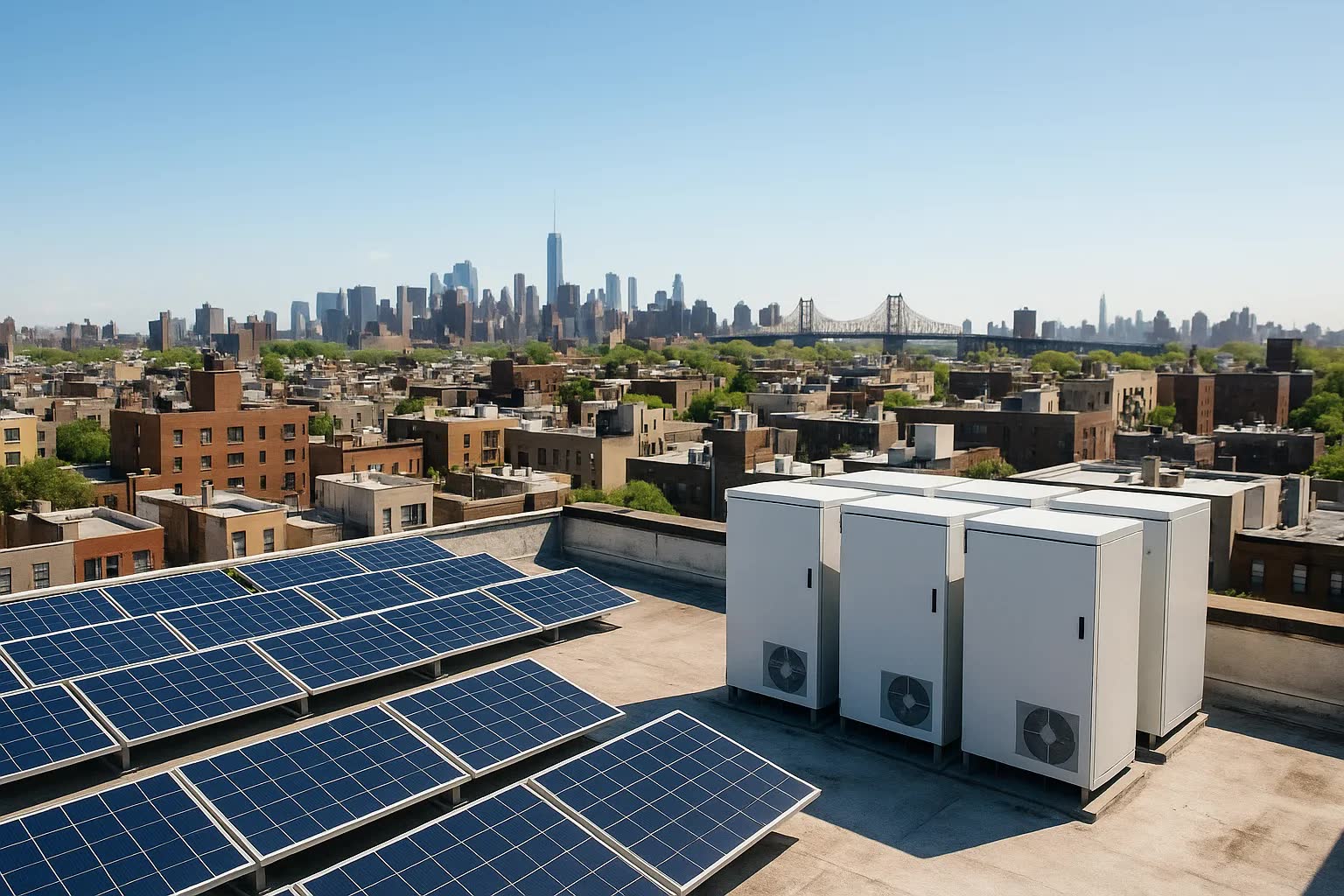
For decades, the Astoria neighborhood in northwestern Queens has been one of New York City’s most reliable harbors of small business and immigrant life — and one of its most frequent victims of summertime and winter storm outages. City officials and community leaders said on Sunday that a long-awaited microgrid pilot for a stretch of the neighborhood has cleared a final layer of permits and will soon begin construction, a development they hope will shield residents and storefronts along 30th Avenue and the Ditmars corridor from the recurring blackouts that have snarled the area since Superstorm Sandy and more recent nor’easters.
Repeated failures across aging infrastructure have left cafes, bodegas and medical clinics in Astoria without power for hours at a time, with losses concentrated between Steinway Street and Shore Boulevard and along the waterfront near Astoria Park. “When the lights go out on 30th Avenue, it’s not just inconvenient — it’s an economic hit to families who rely on weekly paychecks,” said Eleanor Jensen, executive director of the Astoria Neighborhood Energy Coalition, a community organization that has lobbied for local resilience projects for five years. Jensen said the pilot reflects years of neighborhood organizing and technical planning.
The pilot, the agencies said, will combine rooftop solar installations, a community battery array and a localized control system to allow the area to operate independently — or in 'island mode' — from the main grid during outages. The initial footprint covers roughly 21st Street to Shore Boulevard and from 30th Avenue south to the East River, encompassing residential blocks, small manufacturing sites and several community service centers. MetroGrid Labs, a Brooklyn-based microgrid contractor, will lead design and construction under a public-private arrangement with the city-backed NY Energy Resilience Agency, a municipal entity created in 2024 to streamline such projects.
Engineers say the system is designed to keep critical loads running when the big grid goes down: refrigeration in food markets, medical equipment in small clinics, traffic and safety lighting and power for a community cooling center near Astoria Park. “The batteries and controls will be able to detect a grid fault and switch to island mode in seconds, preventing the extended outages that shut down businesses,” said Dr. Kamal Patel, lead engineer at MetroGrid Labs. He added that the software will prioritize life-safety and community functions if storage is limited during a long storm event.
Project figures presented at a community meeting on Saturday laid out the scale: a 2.4-megawatt battery system with 2.0 megawatt-hours of storage capacity paired with roughly 420 kilowatts of rooftop solar across approximately 85 buildings; an expected service population of about 3,200 households and 40 small businesses; and a capital budget of $9.2 million, funded by $5.6 million in city resilience grants and $3.6 million in private investment from GreenBlock Capital. Officials estimated the microgrid could reduce outage hours in the pilot zone by as much as 70 percent during storm-related events and provide six hours of backup at peak demand levels for the most critical facilities.
Local merchants who have lost refrigerated inventory and work hours welcomed the news but stressed the need for rapid implementation and clear rules about who would benefit. Maria Lin, owner of Ditmars Grind, a coffee shop on 31st Street, said intermittent power has cost her thousands in spoiled goods and lost sales. “If this keeps my lights on and my fridge running when the city is hit, that means I can keep my staff employed and my doors open,” Lin said. At the same time, she voiced skepticism about lease negotiations for rooftop panels: “We need protections so landlords don’t kick long-term tenants when rooftops get repurposed.”
City officials said that safeguard language was included in the pilot’s memorandum of understanding: participating landlords will receive standardized lease templates and a portion of revenue from solar generation, while low-income households in the microgrid zone will be eligible for preferential allocation of backup power to ensure equitable benefits. The Department of Buildings fast-tracked permitting in a program officials described as a test case for quicker deployment in dense urban neighborhoods. “We intentionally selected a corridor with mixed-use buildings and a high density of small businesses to test operational models that can be scaled,” said Sofia Alvarez, deputy borough planner for Queens, who is overseeing the city’s role in the project.
Not everyone is convinced the pilot is a panacea. Some energy-policy analysts warned at the community meeting about long-term maintenance costs, data privacy and the potential that wealthier properties within the microgrid footprint could capture most of the benefits. “Microgrids are powerful tools, but governance structures determine whether they reproduce existing inequities,” said Dr. Laila Moreno, an energy policy fellow at the Harborbrook Institute. She pressed officials for public reporting requirements and community oversight mechanisms to ensure transparency on operations and billing once the system enters commercial service.
Project leaders say they have already built cybersecurity protections into the control architecture and will publish performance data quarterly during the pilot. MetroGrid Labs will operate the system for an initial 36-month period before transferring operations to a community trust led by local stakeholders, the city said. Construction crews will begin staging equipment near 21st Street in May, with rooftop work scheduled for late summer and commissioning tests planned for the winter storm season. If all goes according to the schedule presented to residents, partial backup service could be available by December and full operation by June 2027.
Advocates and officials framed the Astoria pilot as a proof of concept for other waterfront and flood-prone neighborhoods across the city, from Red Hook to the Rockaways, while acknowledging the hard work ahead to balance technical, financial and social objectives. “This pilot is about more than batteries and panels,” Jensen said. “It’s about building a local system that neighbors can steward together.” City planners said they would evaluate the project’s performance against outage reduction, emissions avoided and equity metrics before deciding on wider deployment, with a final public report due at the end of the pilot period next year.