Atlantic Avenue Merchants Test Smart Parking to Reduce Delivery Congestion
Sensors and curb apps aim to free loading zones and speed turnover for deliveries along a busy Brooklyn corridor, but enforcement remains a sticking point.
By Leo Wang · March 12, 2026 · 4 min read
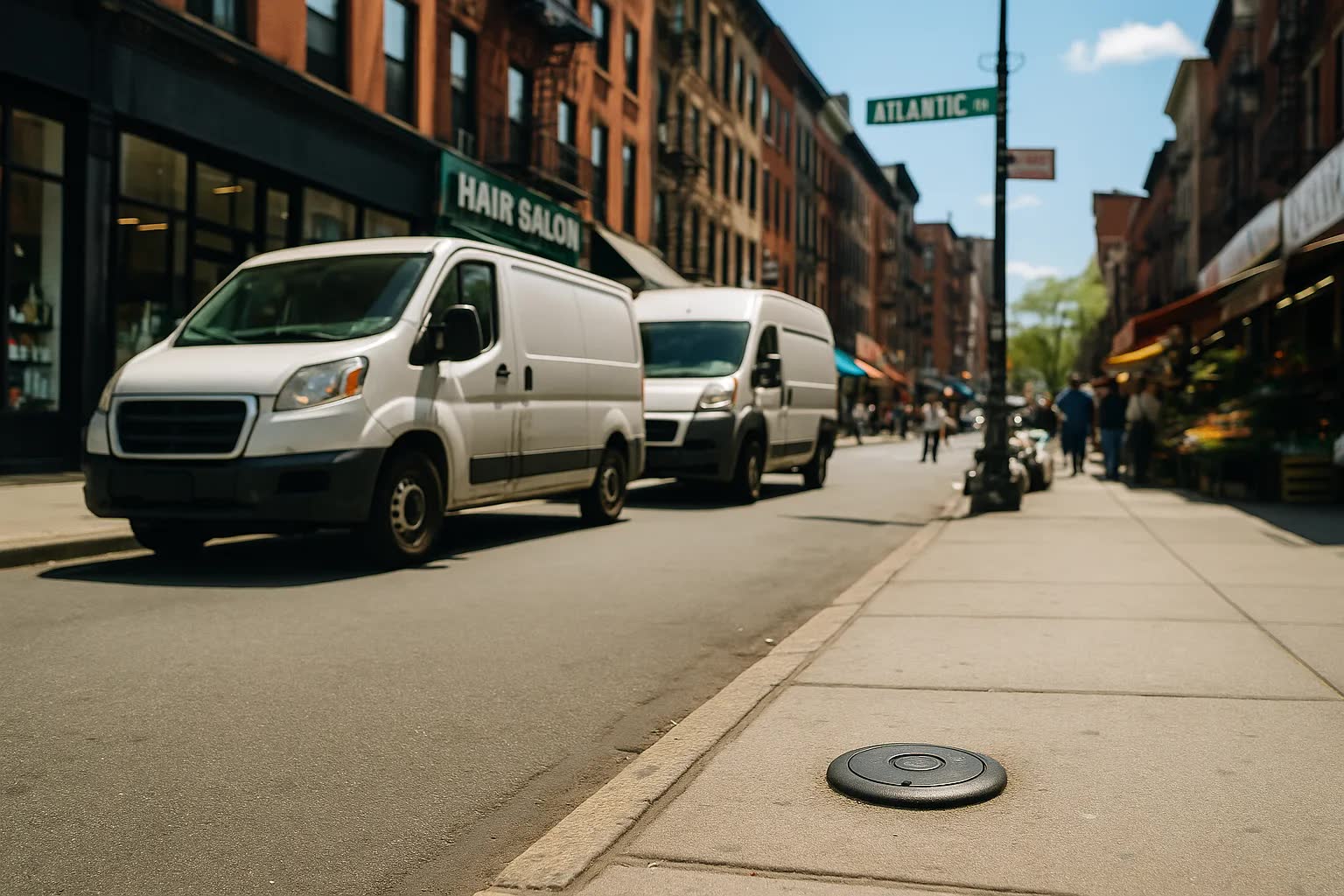
Atlantic Avenue in Boerum Hill and the stretch through Downtown Brooklyn has long been a study in clogged curbs: delivery vans double-parked outside bodegas and hardware stores, restaurants losing time and customers to blocked loading zones, and shoppers circling for a curb cutout. This month, a coalition of Atlantic Avenue merchants, a local tech startup and the city Department of Transportation opened a six-month pilot testing sensors and curb-management apps intended to free loading areas and speed turnover for deliveries along the busy corridor, from Flatbush Avenue to Court Street.
The pilot couples roadbed sensors that detect whether a parking space is occupied with an app called LoadRight that signals drivers where permitted loading bays are available in real time. The project is run by the Atlantic Avenue Merchants Association in partnership with Curbly Labs, a Brooklyn-based startup backed by Harbor Ridge Ventures, and the DOT’s Curb Management Unit. Merchants say the goal is to reduce the informal jockeying for space that can turn midday deliveries into hourlong operations that ripple into evening rush hours.
"We used to have drivers waiting outside The Green Crate for 20, 30 minutes because there was nowhere to legally pull over," said Maria Chen, owner of The Green Crate, a produce seller on Atlantic Avenue near Hoyt Street. "Now the app pings nearby loading spots and drivers can stage for two minutes while they get the boxes. It's not perfect, but our evening rush moved faster the first week."
Curbly Labs founder Samir Patel said the system aims to blend live curb occupancy with incentives. "The sensors are inexpensive capacitive units that sit under the asphalt and report occupancy every 10 seconds," Patel said. "We use a bid-pricing layer in the app so commercial drivers see short-term reserved windows, and merchants get prioritized slots without having to call six different places. The big technical lift is integrating that signal with dispatch systems used by the larger carriers."
Early operational data from the pilot show measurable shifts in curb use. The initial deployment installed 120 sensors across 12 blocks and enrolled 35 merchants; participating delivery drivers made 2,700 logged stops during the first four weeks. Curbly Labs and the merchants association report an average decline in double-parking incidents of 14 percent in those blocks, and a reduction in average delivery dwell time from 18 minutes to 9 minutes for app-registered stops. The pilot was seeded with $1.8 million in venture and municipal grant funding.
Despite the early numbers, enforcement and compliance remain the most stubborn hurdles. Merchants and drivers say inconsistent ticketing and different interpretations of permitting rules undercut the technology. "If a truck blocks a loading zone under the wrong sign, an app can't make the fine go away," said Elena Morales, president of the Atlantic Avenue Merchants Association. "We need clear, consistent enforcement from the city so the market signals created by the app are meaningful on the street."
That enforcement inconsistency is something DOT officials acknowledge but say requires careful rollout. "Technology can improve curb turnover, but without an enforcement strategy that aligns signage, permits and patrol patterns, gains will be temporary," said a senior DOT enforcement lieutenant who requested anonymity because the pilot is ongoing. The lieutenant added that the agency is testing targeted patrols and automated violation capture in coordination with Traffic and Environmental Control officers before moving to routine ticketing tied to the app.
Not everyone in the neighborhood is convinced technology alone will solve the problem. Community Board 2 members have raised concerns about equity in curb allocation, arguing that dynamic pricing for loading windows could favor larger businesses that can pay for priority. "We support pilots, but we don't want the curb privatized so that small independent merchants are priced out," said Aaron Bloom, an adjunct urban planning professor at Brooklyn City University who sits on the board’s transportation committee. Bloom urged stronger protections for local businesses and better data-sharing agreements so residents can see how curb space is allocated.
Drivers and carriers raise their own objections. Several delivery workers who spoke on the condition of anonymity said extra app steps slow them down, particularly for multi-stop routes where the dispatch system and LoadRight are not fully synced. Larger carriers have signaled interest in pilot data but say full integration will require software changes and contractual adjustments. Harbor Ridge Ventures, which led Curbly Labs’ most recent funding round, views the Atlantic Avenue pilot as a test case for scaling to other congested corridors in the city and beyond.
The DOT and the merchants association plan to collect data through the end of the pilot and present findings to local stakeholders in June, with an eye toward expanding the program if the metrics hold. Merchants and the startup say their next steps will be ironing out enforcement agreements, building stronger links to carrier dispatch systems and exploring subsidized priority windows for small businesses. For busy stretches like Atlantic Avenue, where every curb space is contested, participants say the pilot is not a silver bullet but a rare attempt to marry technology, local commerce and municipal policy — with the hope that a refined model can be replicated on other corridors across the city later this year.