Bank Branch Closures Create New Banking Deserts in the Bronx
Recent regional bank exits are leaving small businesses and elderly residents with limited access to in-person services.
By Maya Singh · January 6, 2026 · 4 min read
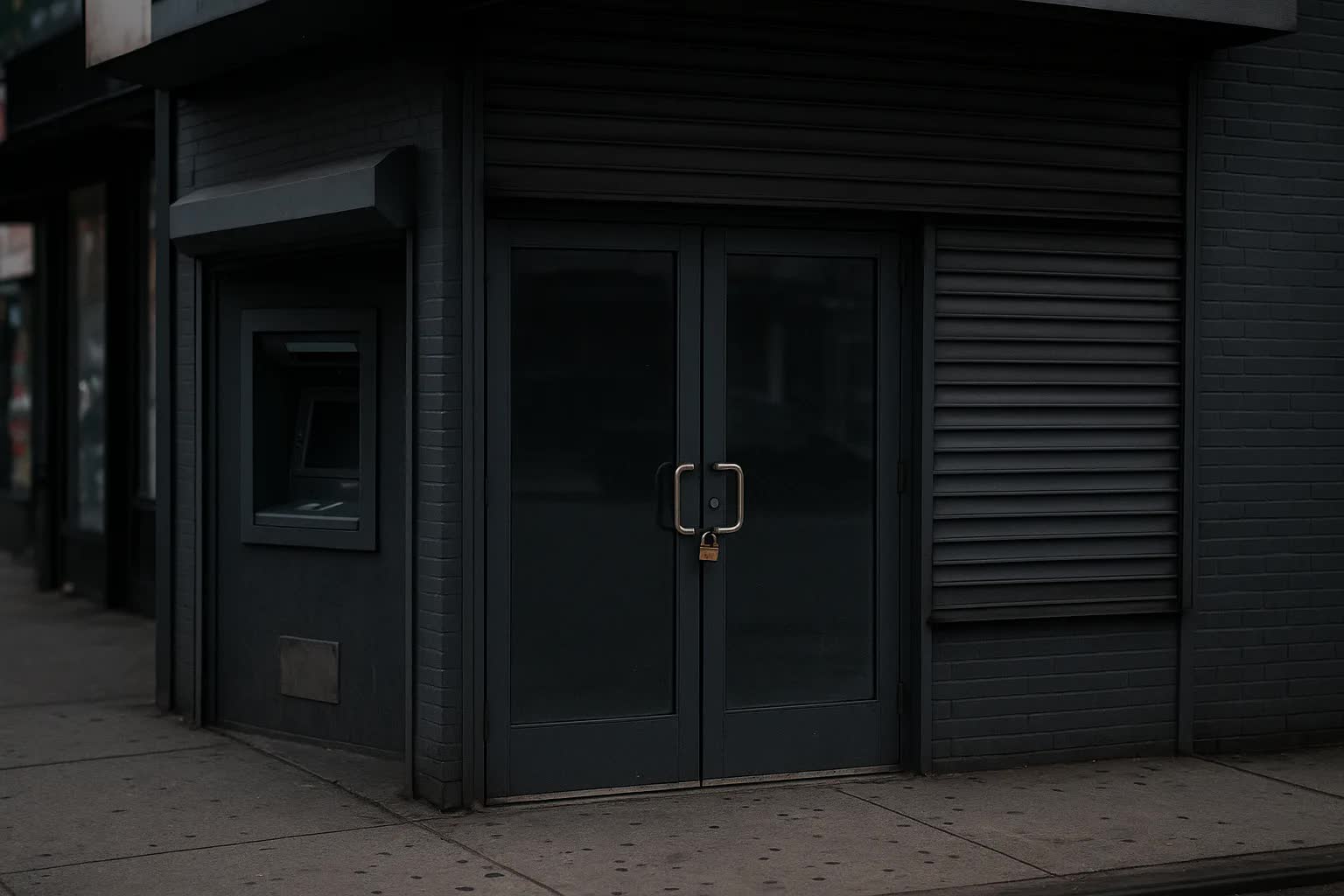
NEW YORK — Bank branch closures across the Bronx are reshaping access to everyday financial services, leaving stretches of the borough from Fordham Road to Hunts Point with long walks, higher costs and fewer options for seniors and small business owners who rely on in-person banking, community leaders and entrepreneurs say.
On a rainy Tuesday morning on Third Avenue in Mott Haven, Lena Ortiz, owner of Ortiz Grocery, counted receipts and sighed as she explained how the nearest branch used to be on 149th Street by the 4 train, a quick trip for many of her elderly customers. "My regulars used to deposit checks and take out cash between buying bread and coming home; now they go to check-cashing places that charge 5 percent or more," said Ortiz, 54, who has run the store for 22 years, touching on a strain that neighborhood retailers say is becoming routine.
The trend has accelerated as several regional banks consolidated operations and shuttered low-traffic branches, executives have said, while national banks narrowed footprints in costlier markets. "Banks are responding to customer behavior moving online, but the shift has outpaced the ability of many communities to adapt," said Evan Park, director of the Bronx Community Banking Initiative, a nonprofit that advises local residents on financial access. "That leaves a lot of people — especially older adults and small-business owners — stranded without reliable in-person options."
Since the start of 2024, five regional lenders and two smaller local institutions announced a combined 24 branch closures within Bronx county limits, a shrinkage that reduced the borough's full-service branch count from 96 to 72, according to a compilation of bank filings and municipal records reviewed by this newspaper. The losses mean roughly one full-service branch now serves about 19,700 Bronx residents, compared with one per 14,800 residents two years earlier; the median walking distance to a branch has increased from 0.9 miles to 2.1 miles in the hardest-hit census tracts, local data show.
The closures are especially acute in neighborhoods such as Soundview, Morrisania and parts of the South Bronx near Hunts Point, where public transit routes are slower and residents report difficulty carrying paperwork across multiple bus connections. "I banked at the branch near the Bronx Zoo for decades, but after it closed I had to rearrange my whole week to go to Riverdale, which is not practical," said Harold Reed, 78, who lives in Van Nest. "I don't trust doing everything on a phone. I need a teller sometimes."
Small-business owners describe cash-flow headaches when downtown branches close. Laundry business owner Maritza Gonzalez of Belmont said her customers increasingly leave cash tips, and with fewer branches accepting coin and cash deposits, she faces costly armored-car fees or long detours to River Avenue. "We pay rent in cash sometimes; small banks used to take our deposits in the afternoon, but now we line up at one machine and hope it doesn't eat our envelope," Gonzalez said, speaking outside her shop near Arthur Avenue.
Banks defend the closures as part of a necessary modernization plan and point to investments in mobile apps and increased ATM networks. "Riverside Trust Bank is reallocating resources to digital platforms and enhancing our ATM presence while keeping a core set of branches in high-traffic locations," said Olivia Ramirez, regional communications manager at Riverside Trust Bank. Yet community groups say ATMs cannot replace services such as notarizations, small-business cash handling and face-to-face help with fraud and mortgage questions.
City and nonprofit responses are emerging but remain limited. The Bronx Financial Justice Coalition has launched a pilot with three mobile banking units that will visit neighborhoods on scheduled days; the program received a $2.5 million grant from a combination of city funds and philanthropic donors to subsidize operations for 18 months. "Mobile units can provide a stopgap, but they are not a substitute for accessible, permanent branches," said Nora Castillo, deputy director at the coalition. "We need policies that incentivize banks to keep a physical presence in high-need areas."
Community development lenders and credit unions are being pressed to fill gaps, but capacity is constrained. Marcus Chen, executive director of the South Bronx Small Business Alliance, noted that loan officers at CDFIs are overextended. "We are seeing a spike in microloan requests and cash-management needs from bodegas, barbershops and childcare providers," Chen said. "Without more capital and regulatory encouragement, community lenders cannot scale quickly enough to replace mainstream banking services."
Looking ahead, local leaders say they will press city and state regulators to require impact assessments before planned closures and to expand support for community banks and mobile solutions. A series of town-hall meetings is scheduled over the next two months in neighborhoods from Riverdale to Mott Haven, and advocates expect to present a package of proposals to City Hall and the state banking department that includes incentives for co-locating services, subsidies for teller staff in low-income corridors and tech assistance for older residents. "This is not just about convenience," Evan Park said. "It is about how neighborhoods remain economically healthy, and the next year will determine whether these banking deserts deepen — or whether policymakers and institutions step in to restore access."