Battery Storage Pilots Pop Up on Brooklyn Rooftops to Cut Peak Power Use
Local utilities and private operators are testing rooftop batteries to stabilize the grid during summer demand spikes.
By Ezekiel Harris · January 11, 2026 · 4 min read
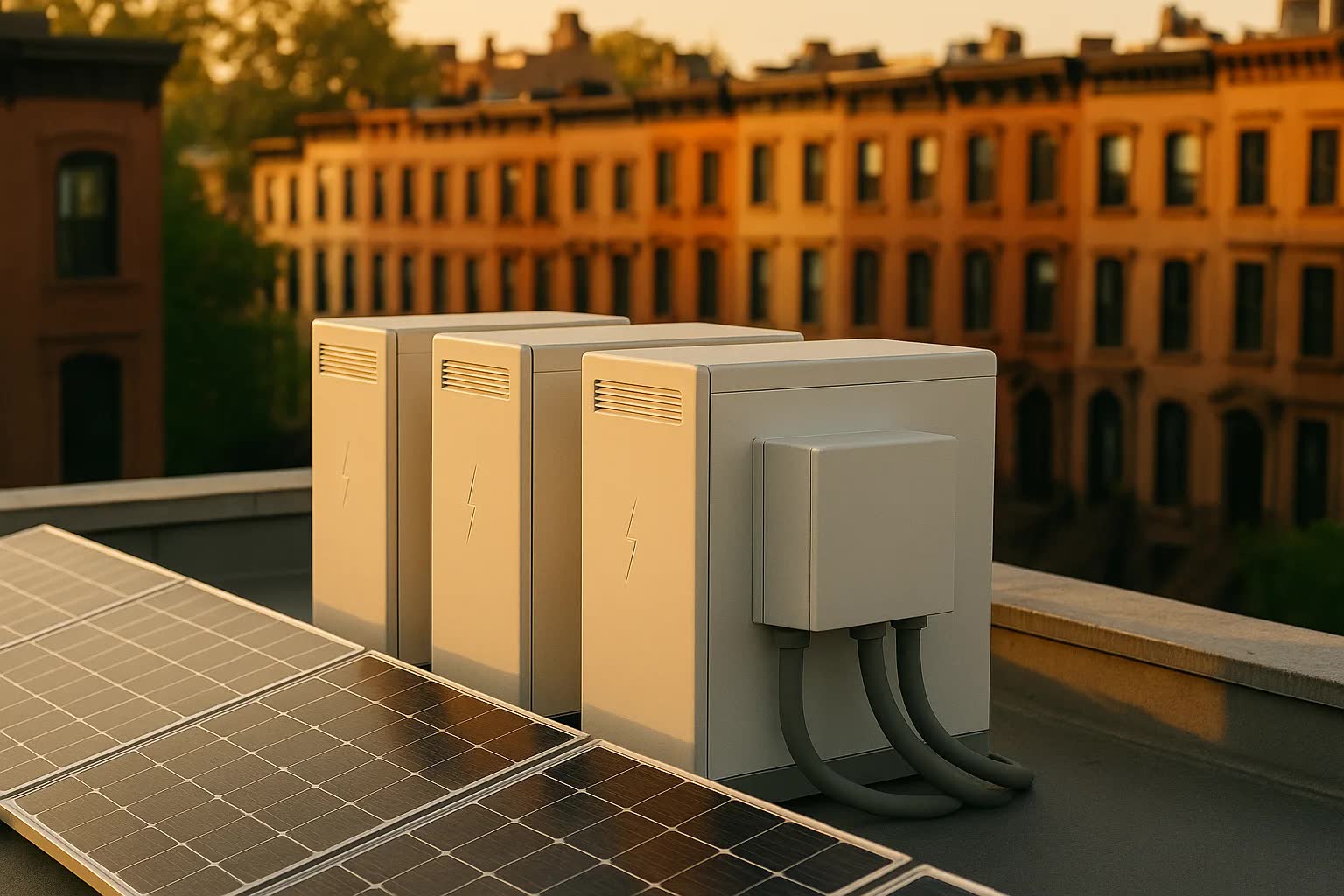
NEW YORK — As summer temperatures climb and air-conditioner demand strains aging substations from Red Hook to Williamsburg, a wave of rooftop battery pilots is quietly reshaping Brooklyn's skyline and its electricity use, city and industry officials say. Utility crews and private operators have installed banks of lithium-ion batteries on multifamily roofs, small manufacturers and community centers to shave late-afternoon demand peaks, test whether clustered rooftop systems can act as virtual power plants and help avoid costly infrastructure work around chokepoints such as Atlantic Avenue and the Brooklyn Navy Yard.
The pilots are a joint effort between MetroGrid Utilities, Rooftop Renew LLC, and the Brooklyn Office of Energy Resilience, with funding from a mix of utility rates and private investment. Installations have been sited on a mix of building types — a six-story co-op near Barclays Center, a converted warehouse off Third Avenue in Gowanus, the parish hall of a church on Columbia Street in Red Hook, and a handful of small industrial rooftops in Sunset Park — to test performance across different load profiles and physical constraints.
Technically, the systems operate both behind the meter and as aggregated, grid-facing resources through an advanced management platform that dispatches stored energy during demand spikes or when wholesale prices spike. "This is about resilience as much as it is about economics," said Lena Park, deputy director of the Brooklyn Office of Energy Resilience. "If a heat wave knocks out a transformer on another part of the network, parked stored energy on our rooftops can buy us time until crews can make repairs."
Neighbors have begun to notice the equipment: metal-clad enclosures and inverter cabinets beside HVAC units, wireless telemetry boxes at penthouse levels and small cooling systems on parapet walls. Pilot managers say the footprints are intentionally small to minimize structural upgrades; one system near the Gowanus Canal occupies a 12-by-20-foot section of a former red-brick factory roof, while another sits behind the billboard on Flatbush Avenue across from the Hoyt–Schermerhorn subway entrance.
The pilots are modest in scale but concrete in ambition: 52 rooftop systems across seven Brooklyn neighborhoods totaling roughly 13 megawatt-hours of storage and able to deliver about 4.5 megawatts of power for three hours, project leads said. The package carries an approximate $9 million price tag including hardware, controls and installation, with average installed cost of about $175,000 per rooftop; MetroGrid contributed $6 million while private partners supplied the rest. Modeling suggests an aggregate demand shave of 8 to 12 percent on targeted feeders during summer peak hours and potential deferment of two local substation upgrades for at least five years.
Community groups have welcomed the resilience benefits but pushed for more transparency on who benefits financially. "We welcome investments in heat resilience, but rooftop batteries can’t be another hidden subsidy for landlords," said Isaiah Moreno, director of the Red Hook Resilience Project. "We want binding agreements that protect tenants from rent hikes and require surplus value to be reinvested into the neighborhood." The pilots include a landlord incentive program, but several tenant advocates say they want clearer commitments on revenue sharing and affordability protections.
MetroGrid says the pilots are also a test of market rules and interconnection processes that traditionally favored large central power plants. Project engineers spent months negotiating interconnection agreements and testing software that aggregates dozens of small batteries into a virtual power plant able to bid into capacity markets and respond to distribution-level signals. Utility engineers say successful aggregation would reduce reliance on fast-start fossil peaker plants during hot afternoons and could cut transmission congestion charges for constrained corridors serving Brooklyn.
Beyond the installations themselves, the pilots have sparked a small manufacturing and training push in Brooklyn. SunStep Batteries, a firm based in the Brooklyn Navy Yard, has produced dozens of metal enclosures and is hiring locally; company spokeswoman Tara Liu said the yard plant expects to expand assembly to 100 units a year. Meanwhile a partnership between Rooftop Renew and Kingsborough Technical Institute has enrolled 60 trainees in a six-week course on battery operations, safety and inverter programming, with a pledge to prioritize graduates for installation and maintenance roles.
Local business owners in Park Slope and Williamsburg who volunteered for early tests report modest economic benefits. "During a two-day heat event last July our tenant laundromat avoided a service interruption and we saw a 14 percent reduction in peak demand charges," said Nora Malik, owner of a mixed-use building on Seventh Avenue. Rooftop Renew’s chief operating officer, Jonah Reed, offered a broader assessment: "The pilots are showing that a portfolio of rooftop assets can behave predictably under stress and bring real, measurable reductions in peak load and bills," he said.
City planners and pilot backers say the real question now is scale. Organizers hope to refine permitting processes and tariffs through the coming year and propose a larger roll-out for summer 2026 that would expand into Queens and parts of the Bronx if regulators approve new aggregation rules. For Brooklyn residents watching transformers and rooftops alike, the pilots are a small but visible glimpse of a distributed energy future that could keep lights on, lower bills and reduce emissions — provided the next phase matches technical promise with tangible community benefit.