Bronx Environmental Tech Incubator Turns Low-Cost Sensors Into Local Policy Wins
Community-driven startups are co-designing air-monitor networks with residents to create data that city agencies can act on.
By Malik Johnson · March 19, 2026 · 4 min read
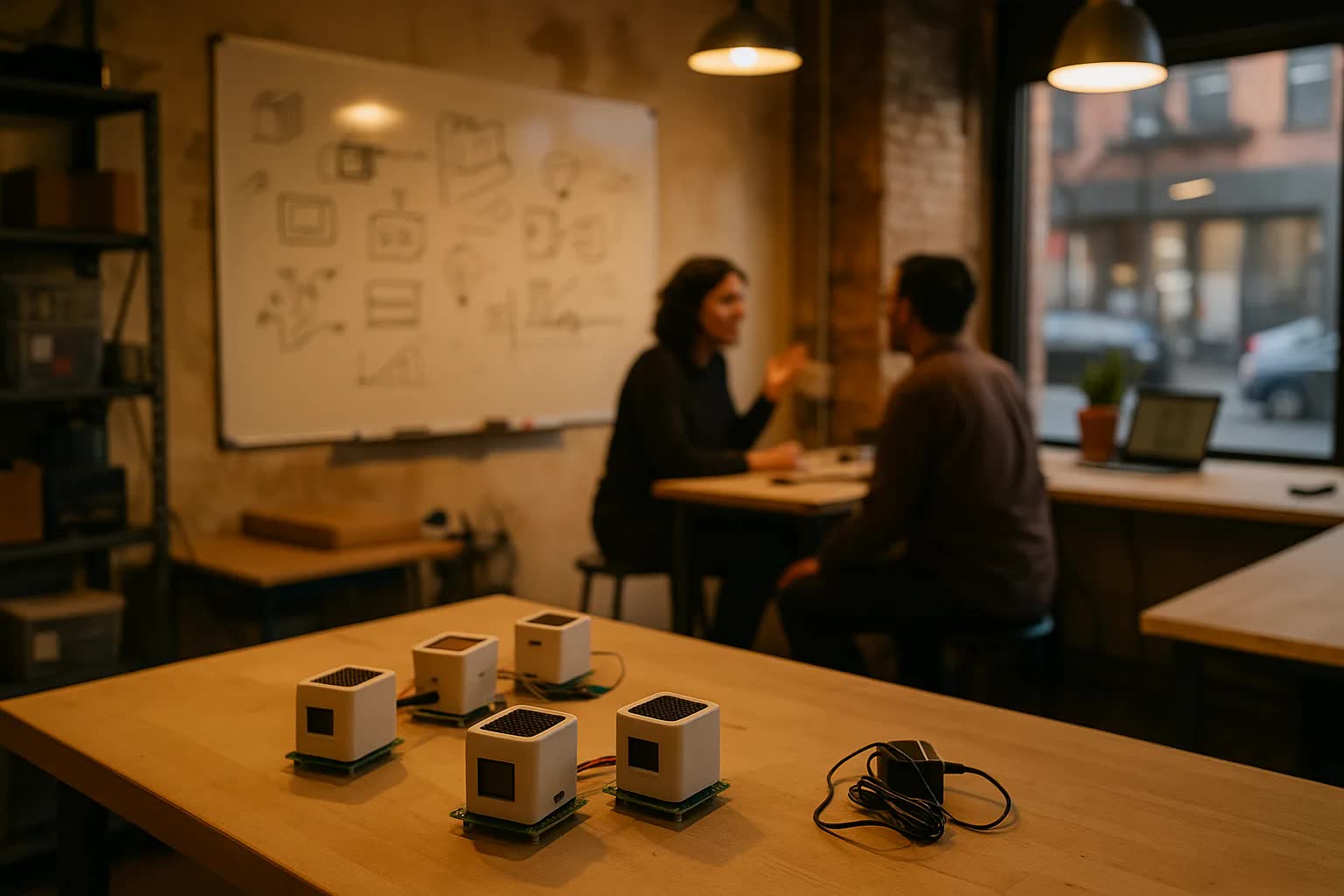
On a blustery March morning under the elevated tracks of the Bruckner Expressway, a row of weathered lampposts in Hunts Point now hosts small blue boxes that have already reshaped neighborhood complaints into city policy changes, validating a new model of environmental technology rooted in community co-design. What began as a pilot project in a converted warehouse near the Hunts Point Produce Market has become the Bronx Environmental Tech Incubator’s signature approach: low-cost air sensors developed by local startups, installed with residents’ input and packaged as evidence that city agencies can act on at block-by-block scale.
The incubator, now three years old, sits on a narrow industrial block off Bruckner Boulevard and pairs hardware teams with organizers from Mott Haven, Fordham and East Tremont to build networks of monitors that reflect lived experience rather than abstract grids. "We insist that sensors listen to people first — not the other way around," said Aisha Delgado, director of Bronx Green Labs, a nonprofit partner that runs a community training program from the incubator’s lab. "When a parent says the air is worse at school pickup, we build to capture that moment."
Startups in the program design devices meant to track PM2.5, nitrogen dioxide and temperature-humidity profiles while running on solar-assisted battery packs and transmitting data over low-power wide-area networks. The boxes are sized to hang on storefront awnings, schoolyard fences and traffic sign poles; residents helped select mounting heights and nozzle placements to avoid vandalism and collect breath-level readings close to sidewalks. Data streams are cleaned on a local gateway before being pushed to an open dashboard the incubator maintains for neighborhoods and to a secured API shared with city agencies.
The scale and cost figures are concrete. The incubator has deployed 482 sensors across 27 Bronx census tracts and two adjacent Queens blocks, each unit built for roughly $70 in parts versus the $8,000 to $12,000 price of federal reference monitors. Twelve startups have graduated from the program; three rounds of foundation and city seed funding totaled $3.2 million. Network latency averages 14 to 18 minutes from sensor read to dashboard, and the incubator reports an 82 percent uptime across devices during the winter months, when battery performance typically drops.
Residents say that numerical readings translated into action faster than previous complaint-driven channels. Sensors installed along Westchester Avenue near the Bruckner exposed persistent spikes in NO2 during afternoon school dismissals, coinciding with long idling queues for delivery trucks. "We used to shout into the void; now we bring printouts, maps, and a timeline," said Carlos Mendez, community organizer at the Hunts Point Coalition for Health. "That made the city send inspectors and led to a truck staging rule that reduced idling by measured amounts on weekday afternoons."
City agencies acknowledge the value of localized data while seeking safeguards. The Department of Transportation confirmed it used the incubator’s maps to adjust curbside loading zones in two pilot corridors; the Department of Health and Mental Hygiene is evaluating whether hyperlocal PM2.5 trends can augment its asthma prevention programs in the South Bronx. Agency officials say the data has to meet quality-control thresholds before it can be used for regulatory compliance, a process the incubator is addressing through third-party validation.
To that end, the incubator contracted the Bronx Institute for Urban Health to run collocation studies, placing 96 low-cost units beside municipal reference monitors for three months. The independent lab reported correlations of 0.88 for PM2.5 and 0.82 for NO2 after algorithmic calibration, with seasonal bias adjustments applied. Those results have helped persuade neighborhood school principals and local clinics to accept the sensors’ findings as a basis for operational changes such as modified outdoor recess schedules and improved HVAC use in rental buildings along Tremont Avenue.
A growing number of enterprise offshoots have spun out of the incubator’s cohort, offering subscription services to small schools and bodegas. AirTrace, a startup that installs classroom sensors and provides daily digest emails to parents, now serves 18 charter and district schools in the borough; StreetSense sells analytics packages to community health centers to map asthma hotspots. "The incubator gave us the nuts and bolts, and the neighborhood partners gave us the stories; the combination turned data into revenue that pays for maintenance," said Leila Park, AirTrace’s founder and a graduate of the incubator program.
Challenges remain: sensors drift over time, panels get dirty, and long-term funding for replacements is uncertain, prompting incubator staff to focus on repair training and local procurement. Data governance is another battleground; the incubator established a community board to set rules about who can access raw readings and how long personally identifiable deployment records are retained. Advocates warn that without formal procurement pathways at city agencies, these hyperlocal networks could be sidelined even after they prove their worth.
Looking ahead, the Bronx Environmental Tech Incubator is preparing a borough-wide expansion plan and a pilot to federate its API with municipal systems so that validated alerts can trigger neighborhood-level responses automatically — from additional street sweeping to targeted traffic enforcement — while keeping residents in control of their data. Organizers say the model could be replicated in other boroughs where freight corridors and dense housing produce similar exposures, but they emphasize that the real test will be scaling maintenance and ensuring the sensors continue to translate lived complaints into measurable policy wins.