Bronx Vocational Programs Partner With Manufacturers to Fill Skilled Trades Gap
Community colleges and local factories have launched targeted training pipelines to supply technicians and welders for a resurging industrial sector.
By Noah Fitzgerald · March 21, 2026 · 4 min read
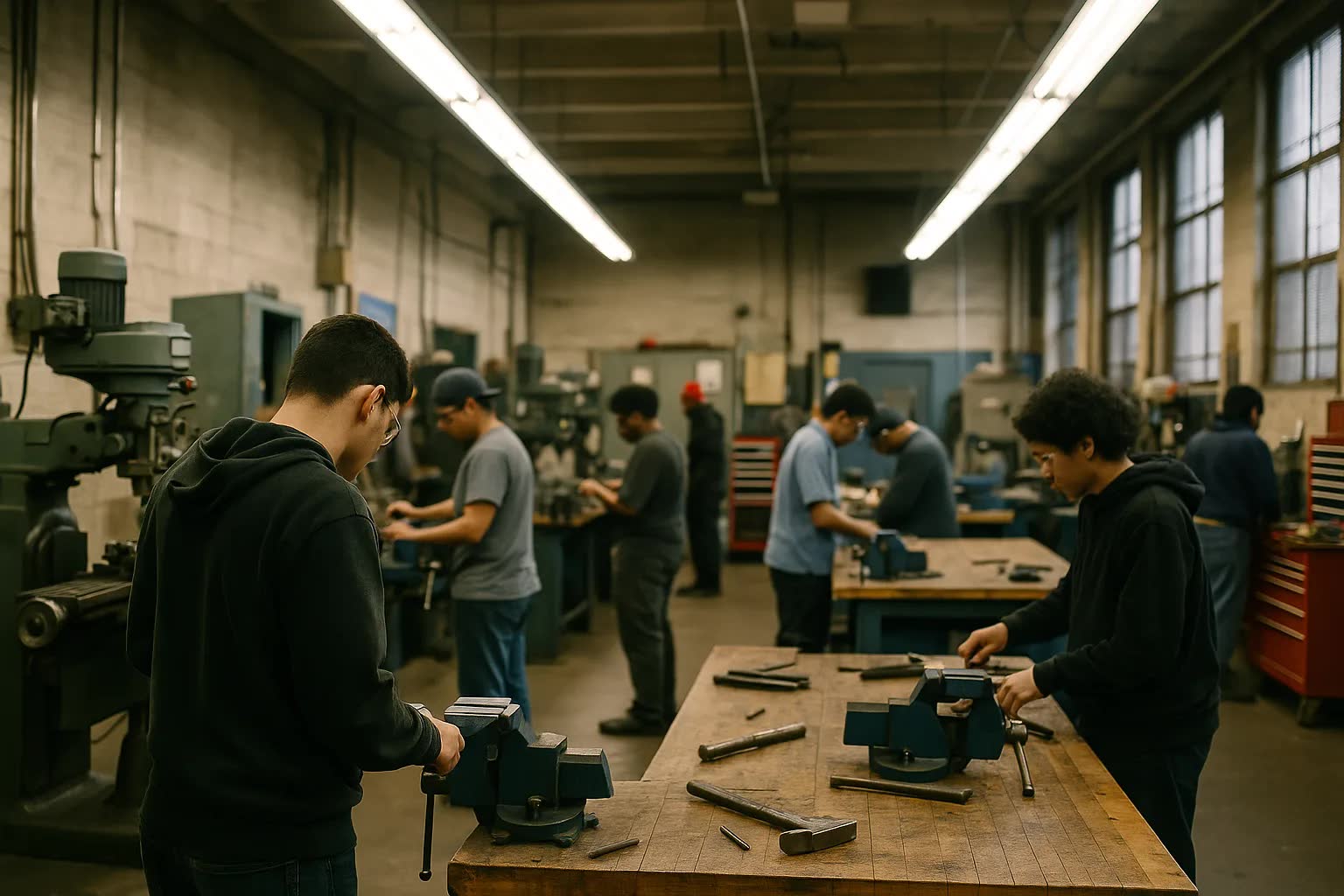
NEW YORK — March 21, 2026 — A cluster of Bronx community colleges and manufacturers has built a fast-growing pipeline to supply technicians, welders and industrial maintenance workers to meet a resurging local factory economy, targeting neighborhoods from Hunts Point to Mott Haven and Port Morris where new and rehabbing plants have multiplied along the Harlem and East Rivers.
For decades the South Bronx’s waterfront factories were an afterthought in a city that shifted toward services. Now, a combination of reshoring trends, demand for cold-storage capacity near the Hunts Point Produce Market and small-batch metal fabrication for transit and building systems has prompted manufacturers to invest in workforce training next door to community college shop classrooms and vacant warehouse lofts.
The effort has taken several forms: short, skills-focused certificates; paid apprenticeships tied to specific employers; and ‘stackable’ credential pathways that move trainees from basic safety and blueprint reading to CNC operation and robotic welding. Programs are run by a loose coalition of Bronx VocTech Institute, the Bronx Manufacturing Alliance, and neighborhood partners such as the Port Morris Innovation Lab, which share equipment, curriculum and employer commitments.
“We built our classes with employers sitting at the table,” said Maria Alvarez, director of workforce development at Bronx VocTech Institute. “That means students are not taking abstract shop classes — they are earning credentials that Riverdale Steelworks or a food-logistics plant in Hunts Point will accept as direct proof of readiness. It shortens the hiring cycle and reduces first-year turnover.”
The numbers behind the push are concrete. From January through December 2025, coalition partners reported opening 1,200 employer commitments across Bronx zip codes for entry- to mid-level technicians and welders; 620 people enrolled in training cohorts last year, with a 68 percent job-placement rate within 90 days of completion. Starting wages for placed graduates ranged from $25 to $36 per hour depending on shift and certification, and employers pledged more than 3,400 hours of on-the-job mentoring across 18 host sites.
Manufacturers say the training reduces costly on-site retraining and safety incidents. “We had skilled-union shortages in 2023 and 2024, and we kept losing candidates for lack of specific machine training,” said James Conway, plant manager at Riverdale Steelworks in Port Morris. “What we’re seeing now is candidates who can read a blueprint, run a press brake and pass a weld test after a six-week cohort. That’s a game changer for our shop floor productivity.”
Trainees point to convenience and real-world exposure. Malik Johnson, 28, lives near Fordham Road and completed a 14-week welding certificate in Mott Haven before landing a journeyman-track role at a light-manufacturing plant on Bruckner Boulevard. “I could afford the class because it paid a stipend and the employer kept me on for a paid internship,” Johnson said. “I learned on the actual machines I would use at the job, and now I’m on nights with a crew that used to bring in temp welders from out of state.”
Funding to create seats and buy equipment has come from a patchwork of sources. The city workforce fund awarded $3.8 million spread over three years to community consortia in 2024, local philanthropic foundations matched capital purchases for welding booths and CNC lathes, and a small-business tax incentive program in Albany reserved forgivable loans for manufacturers that hire and train within 12 months. Local unions have also agreed to recognize some noncredit certificates as equivalent to initial shop experience, smoothing placement into apprenticeship ladders.
Despite early gains, challenges remain. Space for classrooms and labs is scarce in dense blocks near the waterfront, wraparound services such as childcare and transportation subsidies lag students’ needs, and credential portability between boroughs is still uneven. “Students often juggle multiple jobs and family care,” said Eileen Park, associate dean for workforce programs at the Bronx Manufacturing Alliance. “We’re seeing success when programs pair training with day-care vouchers, transit subsidies and flexible schedules that mirror manufacturers’ shift patterns.”
Looking ahead, partners say they intend to scale and diversify the model, adding green-manufacturing modules for electric-vehicle component assembly and commissioning a pilot that embeds robotics technicians into three Bronx plants by 2027. If the current placement rates hold and funding streams stabilize, the coalition hopes to place 1,500 graduates over the next three years and expand a manufacturing corridor along Bruckner Boulevard that could anchor further private investment and long-term career ladders for Bronx residents.