Brooklyn High School’s Robotics Team Wins Regional Grant to Build Community Sensors
Students will deploy air-quality and noise-monitoring sensors across their neighborhood as part of a civic-tech curriculum.
By Evelyn Torres · April 23, 2026 · 4 min read
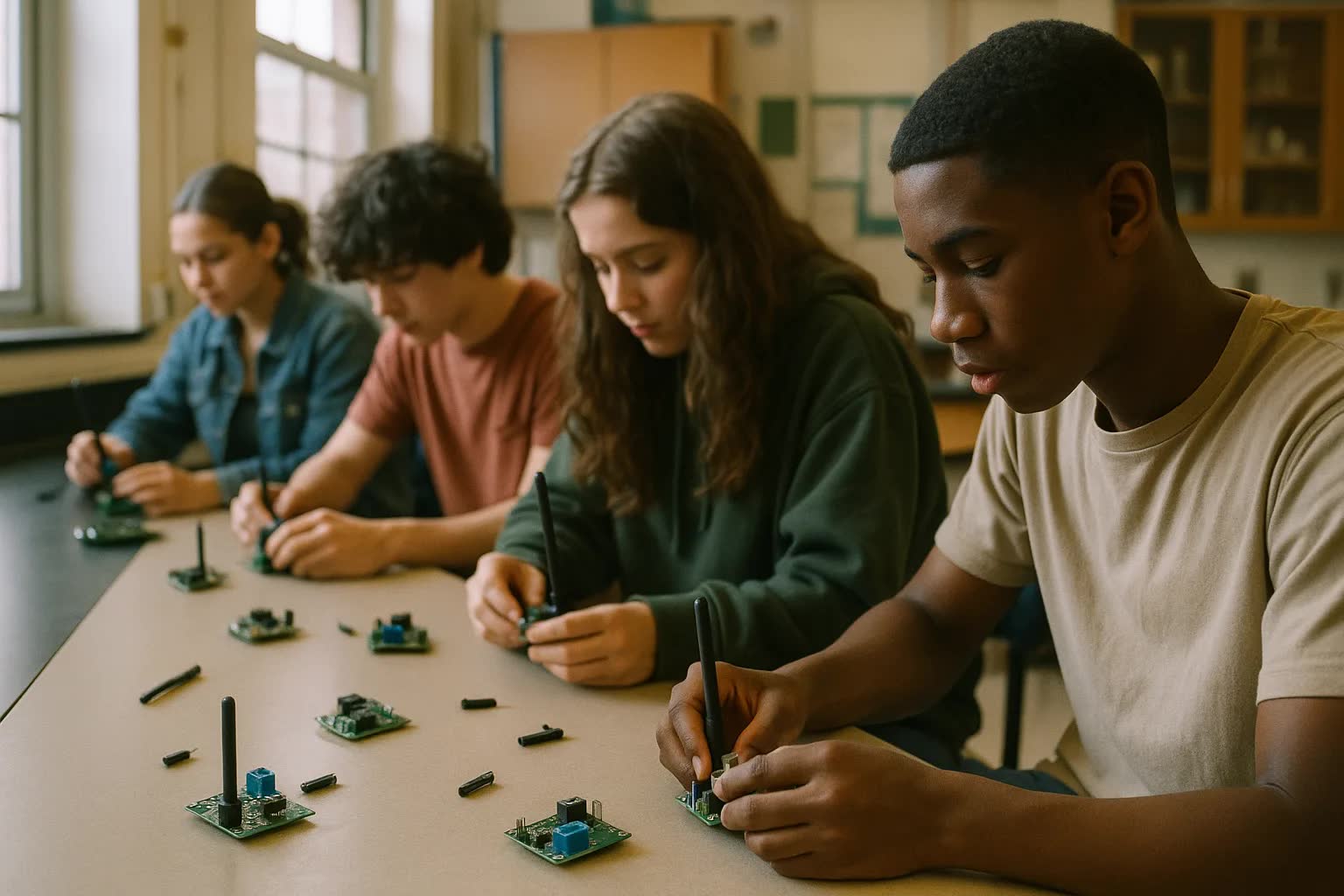
Students at Marcy Avenue High School in Bedford-Stuyvesant won a competitive regional grant this week to build and deploy a network of air-quality and noise sensors across northern Brooklyn, a project that school leaders say will bring civic technology—and hard data—directly into neighborhoods that have long complained of pollution and chronic noise. The award marks one of the first times a high school robotics team in the city has been granted funds to run a sustained, community-facing environmental monitoring program, turning a robotics curriculum into a tool for neighborhood advocacy from Fulton Street to Myrtle Avenue and down toward Gowanus.
The grant, a $150,000 award from the Northeast CivicTech Fund, will finance 40 sensor nodes that the Marcy Robotics Team will assemble, calibrate and install over the next 12 months, officials said. Each node will measure PM2.5, PM10, nitrogen dioxide and decibel levels, and will relay data through low-power wide-area networks to a public dashboard the students will maintain. About $95,000 of the grant covers hardware and cloud services, $30,000 is earmarked for stipends and training for student technicians, and the remainder will pay for community outreach and repair kits.
The idea grew out of a pilot last fall when the team, composed of 32 students from grades 9 through 12, placed three prototype sensors along Marcy Avenue, outside Marcy Avenue High and near Maria Hernandez Park in Bushwick, where diesel truck traffic and weekend events produced wildly variable readings. "We saw spikes at 2 a.m. on weekends that no city sensor captured, and the lack of street-level data kept neighbors from doing anything about it," said Rosa Delgado, robotics coach and computer science teacher at Marcy Avenue High School, who helped write the grant proposal. "This gives residents and students the same kind of evidence city agencies use to make decisions."
Students will also learn to manage data privacy and community consent, a component school administrators emphasized in meetings with local leaders. "We have to balance transparency with people's right to live without being surveilled," said Asha Patel, executive director of the Bedford-Stuy Environmental Alliance, which partnered on the grant to provide community liaisons and host deployment clinics. "These readings are about air and sound, not about tracking individuals, and the students are learning how to make that distinction in practice."
The program includes classroom modules in data science, sensor engineering and civic law taught during a new elective called Civic Tech Lab, plus weekend workshops for residents at the nearby Marcy Community Center on Myrtle Avenue. Professors from a consortium of local colleges will guest-lecture, and an unpaid externship with the community board's environmental committee will be offered to seniors. "We're trying to create a pipeline from curiosity to community impact," Delgado said. "Kids who solder a circuit may also learn to testify at a board meeting or write a FOIL request. That civic muscle matters."
City officials said they would watch the project as a potential model but stopped short of promising formal adoption of the student data. "We welcome community-sourced data and encourage collaboration, but municipal decisions depend on a range of validated inputs," said Daniel Mercer, chief of environmental analytics at the fictional New York Office of Urban Science, who has advised the team on calibrating sensors. "What the students are doing could supplement fixed monitors and help pinpoint local micro-environments for further study."
Not everyone in the neighborhood greeted the plan with immediate enthusiasm. At a town-hall meeting on Wednesday at the Stuyvesant Heights Library, some residents raised concerns about sensor placement, data ownership and how results might affect property values along Lewis Avenue and the blocks bordering the Brooklyn-Queens Expressway. Marcy Avenue High officials said the deployment schedule was adjusted after those meetings to prioritize placements on public lampposts, school buildings and community centers, rather than private homes, and to require written consent for any sensor within 25 feet of a residential entrance.
The grant's numbers give a sense of scale: 40 sensors, 32 students on the team, 12 months from assembly to full deployment, and an anticipated 1.2 million data points collected in the first year if sensors report every five minutes. Initial coverage will focus on a roughly 2.5-square-mile area stretching from Fulton Ferry to Broadway Junction, including parts of Bedford-Stuyvesant, Bushwick and the northern edge of Gowanus, with plans to expand into Red Hook and Sunset Park if the pilot demonstrates reliability. The team estimates maintenance costs at about $8,000 annually after the first year.
For the students, the grant offers practical stakes. Marcus Lin, the team's captain and a senior who plans to study electrical engineering, said the project sharpened his sense of purpose. "We've built robots for competitions, but this is different because our work stays in the neighborhood and people actually use it," Lin said. "I ran a model that showed how a sensor on Atlantic Avenue could catch a recurring spike from a delivery route; now we can bring that to the community board with proof."
Organizers say the project could become a template for other schools in the city, enabling students to become civic partners rather than merely observers. Over the coming months, Marcy Avenue High will host public calibration sessions, data-literacy workshops and a showcase at Brooklyn Borough Hall. If the pilot achieves its goals, Delgado said the team hopes to expand the curriculum and the sensor grid to neighboring schools and to seek additional funding for long-term staffing. "We want to graduate students who leave with not just a trophy, but a toolkit for change," she said, looking toward a fall rollout that would put the first 10 sensors online and make neighborhood-level environmental data part of everyday civic conversation.