Brooklyn Jewish Music Festivals Mix Klezmer With Hip Hop
Producers in Williamsburg and Crown Heights are curating cross‑genre lineups that blend traditional klezmer with contemporary rap to draw diverse crowds.
By Diego Alvarez · March 13, 2026 · 5 min read
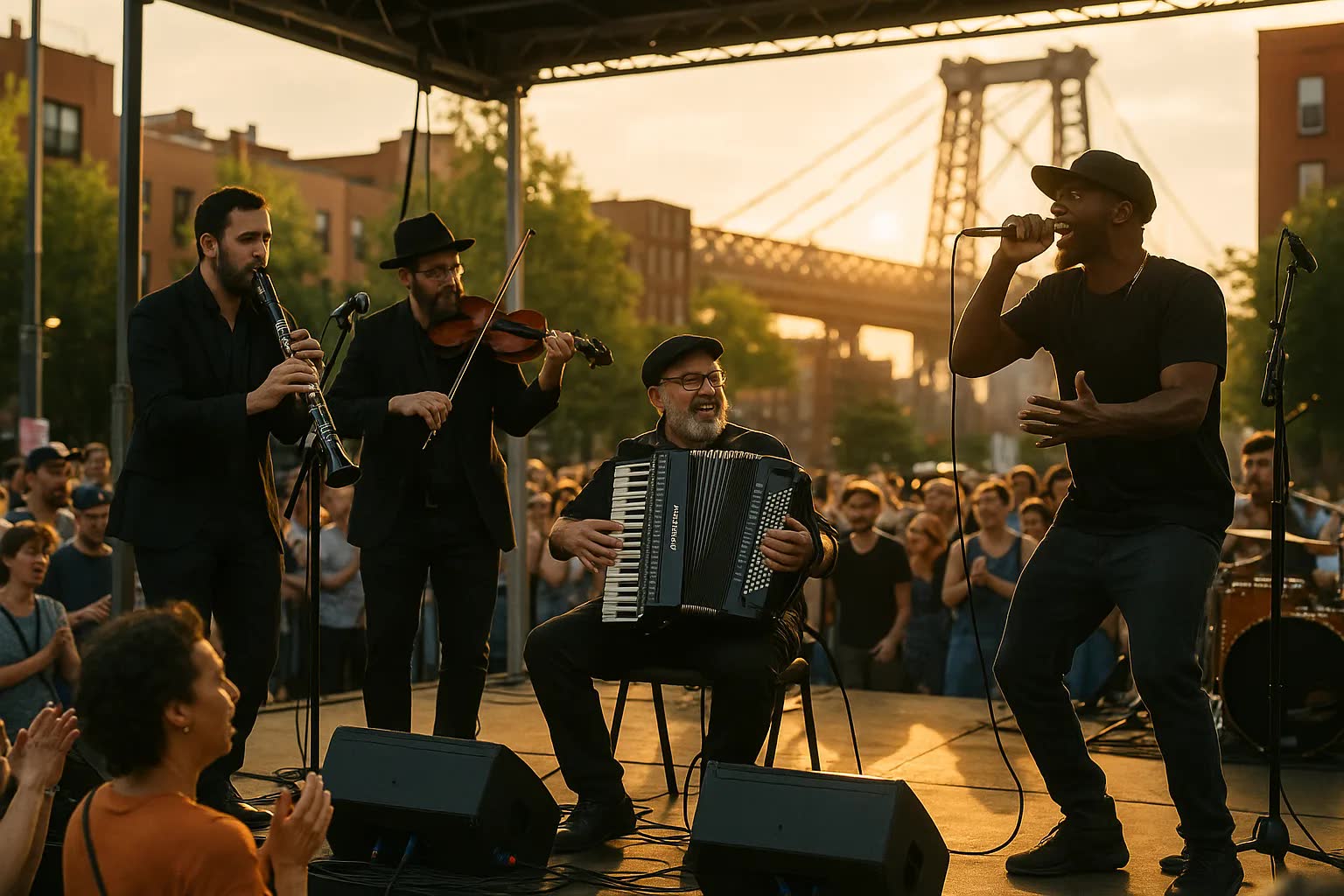
NEW YORK — On a blustery Friday evening in Williamsburg, a clarinet wailed a mournful Yiddish phrase and a Bronx-born MC answered with a rapid-fire verse about loyalty and rent, the two sounds colliding on Bedford Avenue outside a converted factory that has been reborn as a music space for the Shtetl Sessions festival. Across town in Crown Heights, a block party under the el on Eastern Parkway saw elderly congregants and college students trading dance moves as a brass section punctuated the beat from a drum machine; producers here say the deliberate mixing of klezmer and hip hop is drawing crowds that look less like the stereotypical audiences at either genre’s purist gatherings and more like the city itself.
The movement has roots in a handful of small producers who started experimenting with cross-genre lineups two summers ago, including Miriam Katz, artistic director of the Shtetl Sessions and a longtime promoter who lives on Lorimer Street. "We’re not trying to nationalize tradition; we’re trying to let it breathe," Katz said as she watched sound checks on a rig outside the Loom Collective on South 4th Street. "Klezmer is a language of memory and celebration; hip hop is a language of story and survival. When you put them together, you hear new sentences."
Klezmer — the folk music of Ashkenazi Jews that flourished in Eastern Europe and migrated with communities to New York in the early 20th century — has always been adaptable, absorbing elements from Romani, Balkan and American genres over generations. Hip hop, born in the Bronx, has been similarly porous. What feels new in Williamsburg and Crown Heights is not just musical sampling but formal programming: workshops in klezmer modes for beatmakers, rap cyphers accompanied by accordion, and shared sets where a violinist and a DJ trade solos.
DJ Avi Rosen, co-founder of the Kosher Beats Collective and a producer who moved to Williamsburg from Flatbush five years ago, said the creative impulse is also civic. "When I grew up," Rosen said, "music in my house was klezmer at weddings and hip hop on the radio. It’s not an aesthetic experiment so much as honoring the soundtrack of my body. We program shows so a ninety-year-old who heard the clarinet at a wedding can find common ground with a nineteen-year-old who only knows beat drops."
The numbers suggest the idea has legs. Festivals and events that billed themselves as cross-genre in 2025 drew a combined estimated attendance of 18,700 people across 34 events citywide, according to compiled ticketing and box office figures released by three of the producers; Shtetl Sessions reported 4,200 attendees in 2025, Crown Beat Block Party in Crown Heights drew roughly 3,500, and smaller neighborhood nights averaged 150 to 600 patrons. Organizers said about 62 percent of attendees were between 18 and 35, ticket prices ranged from free neighborhood block parties to $28 for headlined club nights, and combined production budgets for the largest festivals approached $215,000 before sponsorships or in-kind donations.
Not everyone has embraced the mash-up without reservation. At Congregation Beit Shalom on President Street, Rabbi Lev Goldman, who oversees cultural programming for the mid-sized Orthodox synagogue, praised the outreach potential but cautioned about surface-level appropriation. "We welcome curiosity," Goldman said, "but we also want depth. Klezmer carries liturgical and communal weight — if it’s reduced to a catchy sample we risk erasing context." The organizers counter that many sets include mini-lectures or translated lyric sheets and that they consult elder musicians and community leaders during planning.
The practical work of blending the styles has led to unexpected collaborations. Esther Bloom, a 68-year-old klezmer fiddler who grew up playing at weddings in Borough Park and now teaches at a community center on Sterling Place, has recorded with two rappers from Crown Heights and led a master class at the Crown Heights Arts Center on Eastern Parkway. "At first I thought the beat would drown the violin," Bloom said. "But when I heard a rapper ride the klezmer mode, I realized the rhythm gave the melody new shape. It’s a conversation, not a takeover."
Local businesses have felt the economic ripple. Blue-Sky Records, a vinyl shop on Wythe Avenue that began stocking Yiddish 78s alongside hip hop pressings, reported weekend sales up 18 percent during festival weekends last season, and nearby cafes and bodegas say foot traffic spikes by 30 to 45 percent on concert days. Promoters note an ancillary benefit: emerging artists of all backgrounds report that shows programmed with diversity in mind create better merchandise and post-gig networking opportunities, which in turn support the music scenes they inhabit rather than extract from them.
Curators also face logistical challenges: finding rehearsal space, negotiating union rates for horn sections, and ensuring sound systems can handle the dynamic range of acoustic instruments against reinforced bass. "We’ve learned to calibrate the room differently," said Tamir Gold, a producer and musicologist at the Brooklyn Institute for Sound Studies, which runs an artist residency that pairs traditional musicians with beatmakers. "Mic placement, stage layout, even load-in times change when you have a cantorial singer and a crew of MCs. But those constraints also spur creativity — someone figures out how to make a trumpet snap against a 808 and that becomes a new trick in the city’s toolkit."
Organizers are already planning expansions for 2026, from a mini-tour that will bring headline pairings to Prospect Park’s bandshell to outreach residencies in Queens neighborhoods that have their own Jewish and hip hop histories. Katz says a recorded anthology is in the works and that she hopes the model will travel beyond Brooklyn: "We want this to be a template for neighborhoods that are negotiating change and inheritance. Music is the easiest kind of diplomacy." Producers, musicians and venue owners say they’ll keep tweaking the formula to preserve the delicate balance between reverence and reinvention, and to see whether Brooklyn’s experiment can become a sustained cultural exchange rather than a seasonal novelty.