Brooklyn Rooftop Solar Push Targets Low-Income Rowhouses
Nonprofits and contractors are brokering group-installation deals to bring solar arrays to small multifamily buildings and cut energy bills.
By Noah Fitzgerald · April 26, 2026 · 4 min read
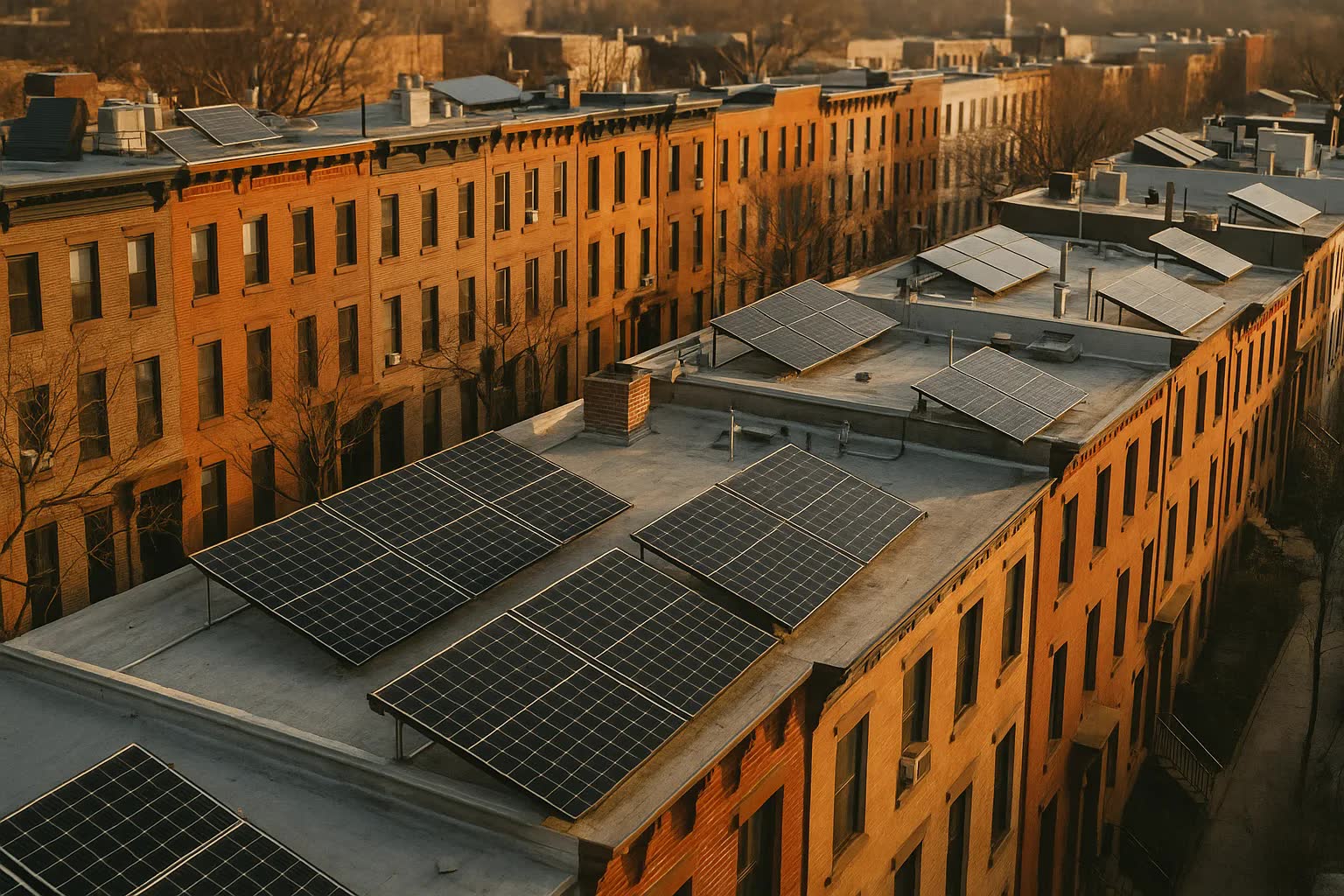
NEW YORK — A quiet solar push is climbing the low-slung rowhouse roofs of Bedford-Stuyvesant, Crown Heights and Sunset Park as nonprofits and contractors assemble group-installation deals aimed at slashing energy costs for low- and moderate-income families across Brooklyn, starting with concentric blocks around Fulton Street and the Navy Yard.
For decades, Brooklyn’s small multifamily rowhouses — three- and four-story buildings with narrow footprints and aging electrical panels — have been overlooked by rooftop solar campaigns that favored big-box warehouses and single-family suburbs. Now community groups are brokering collections of buildings into one procurement process, arguing that scale and standardization can overcome the higher per-building paperwork and labor costs that have kept solar off so many staircases and shed roofs.
The model relies on neighborhood coordinators, prequalified contractors and a single permitting package filed with the city’s Department of Buildings. "By bundling 30 or 40 rowhouses we get down to a realistic per-household price and a single timeline for construction," said Marina Alvarez, executive director of SolarRoots NY, a Brooklyn nonprofit leading pilot projects in Bed-Stuy and Crown Heights. "We treat blocks like a single campus, and that changes the math for owners and renters alike."
Program numbers in early pilot runs are concrete enough to persuade reluctant landlords. SolarRoots NY and partners are targeting 1,200 rowhouses across North and Central Brooklyn over five years, with average systems of roughly 6 kilowatts per building and an installed cost before incentives of about $18,000. Through bulk procurement, state and city grants and a neighborhood GreenRow Fund, the average net cost per building in the pilot drops to $11,000, with family-level annual electricity savings of about $1,400 and payback windows of five to eight years. The initial pool includes 15 prequalified contractors, and organizers say combined permitting and interconnection times have fallen from averages near 90 days to closer to 30 in the bundled approach.
The work is already visible on Tompkins Avenue in Bed-Stuy, where three-unit owner Darnell Price watched crews mount racking on his flat roof last month. "I was paying almost $500 a month per unit before we did this," Price said. "Now my tenants get lower bills and I can keep rents stable without eating the entire energy cost. That’s what made me sign on — it’s practical, not flashy." Price’s brownstone sits two blocks from the Marcy Avenue subway line, and his installers coordinated access with neighboring buildings and a local community board to avoid late-night work.
Contractors say the clustered model simplifies technical hurdles as well. "We design one standard roof layout, one wiring plan and one utility application for a ten-block cohort," said Ivy Chen, founder of RooftopWorks LLC, a Ridgewood-based installer on the prequalified list. "That reduces change orders, saves on scaffolding time and lets crews work block by block. The hard parts are structural reinforcement in older rowhouse attics and meter upgrades for buildings with grandfathered wiring, but bundling means we can amortize those fixes."
Financing arrangements vary: some owners take advantage of direct-install grants that cover up to 60 percent of the system, others sign power purchase agreements where the nonprofit owns panels and sells the power at reduced rates; a third option stitches in a community-solar credit from a nearby rooftop farm. Organizers estimate the GreenRow Fund — a mix of philanthropic capital and municipal grants assembled for the pilot — will provide roughly $4.2 million in direct subsidies and loan guarantees over the first two years, with an additional $3 million in workforce development credits meant to train local installers and hire from neighborhood hiring lists.
Neighborhood rollout plans hinge on elective buy-in from block associations and landlord groups and on negotiating historic-district rules in places such as Park Slope and parts of Fort Greene. The program already coordinates with the Department of Buildings and the local utility to standardize interconnection; labor partnerships aim to hire apprentices from a Sunset Park job-training program and place trainees at a satellite shop near the Brooklyn Navy Yard. "This is about jobs and resilience," said Anjali Mehta, policy director at Brooklyn Energy Cooperative. "If we build local capacity to install and maintain systems, the economic benefits stay here in the borough."
Still, critics caution that complexity could slow expansion. Historic-preservation boards can require panels be hidden from street view, adding costs. Some small landlords worry about upfront obligations and long-term maintenance; tenant advocates press for clear lease language so savings flow to renters. Organizers acknowledge those challenges and say the bundled approach makes legal templates and warranties easier to deliver, but that scaling beyond clusters requires clearer city incentives and faster administrative sign-offs.
Advocates say the pilot’s next step is testing battery storage integration and a tenant-billing protocol across entire blocks, aiming to expand to 5,000 buildings boroughwide by 2030 if the early savings hold. For now, crews will keep climbing stairwells, filing one permit packet for a row of three- and four-unit homes and measuring actual utility savings block by block — a microgrid of modest brownstones that supporters hope will become an engine for lower bills and cleaner air across Brooklyn.