Brooklyn's Rooftop Farms Multiply Thanks to New City Grants
From Gowanus to Bay Ridge, grant-funded soil remediation and irrigation projects are turning unused roofs into produce hubs for neighborhood markets.
By Sofia Martell · April 6, 2026 · 4 min read
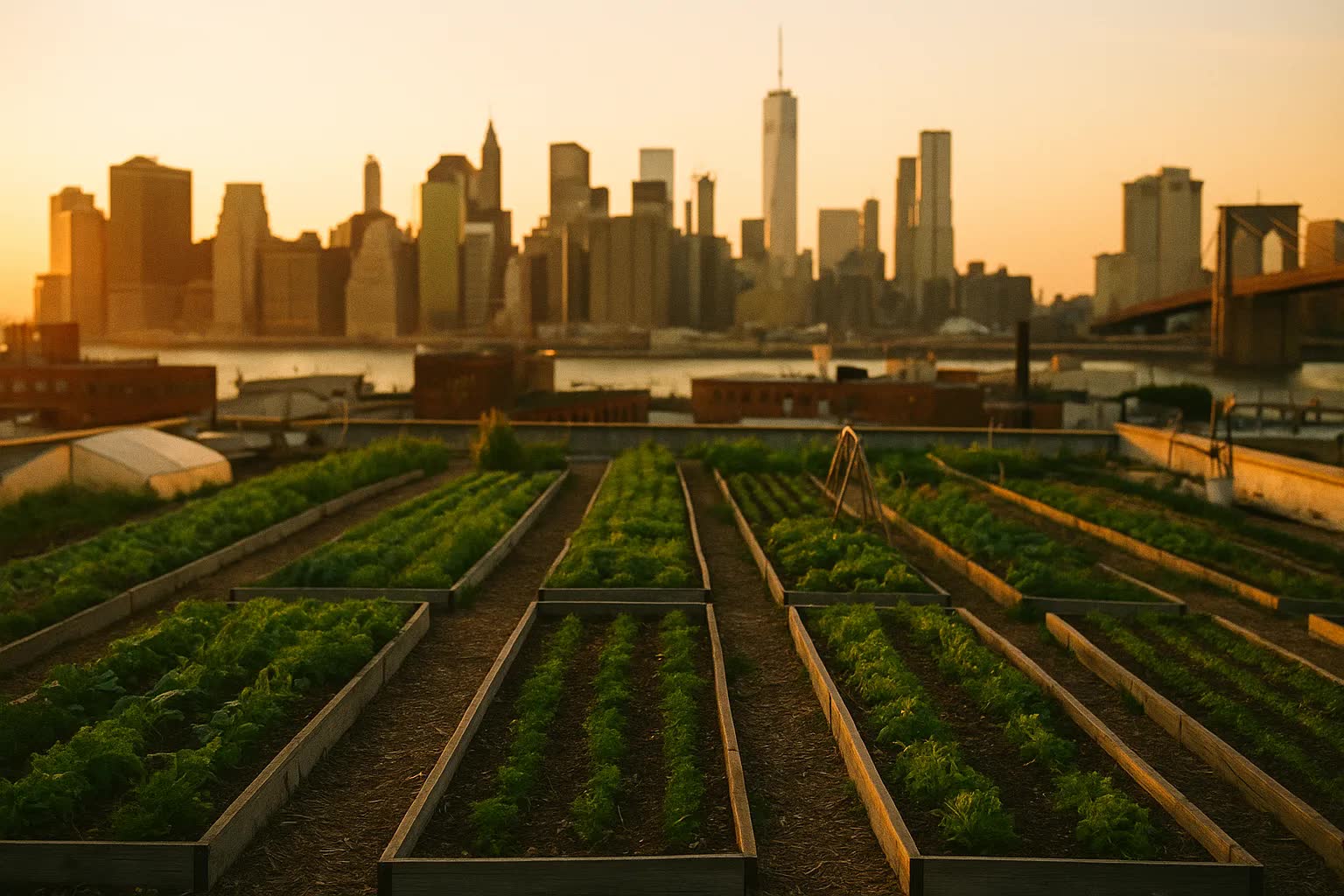
On a blustery morning above Third Avenue in Gowanus, a once-neglected warehouse roof now hums with drip irrigation, cloches and rows of lettuces that sway under the sightline of the Manhattan skyline; it is one of a swelling number of rooftop farms that have sprung up across Brooklyn this spring after the city funneled new grants into soil remediation and irrigation infrastructure. The grants, directed especially to neighborhoods that have struggled with food access and industrial contamination, are turning unused and often structurally marginal roofs into productive plots for neighborhood markets, school programs and small-business supply chains.
The push is part of the municipal Green Roofs Initiative, a five-year program administered by the City Urban Agriculture Fund that began disbursing its second round of grants in January. The money covers the expensive early work—soil testing, removal of contaminated fill, structural reinforcement and the installation of automated irrigation and rainwater-harvesting systems—that has long kept commercial and community groups from converting rooftops into farms. City officials say the goal is both to increase local fresh produce and to add stormwater mitigation and urban heat-island relief in dense boroughs like Brooklyn and the North Shore of Staten Island.
At 481 Carroll Street, behind a red-brick building that fronts the Gowanus Canal, a 10,000-square-foot rooftop plot operated by the nonprofit Canal Cultivators feeds a weekly stand at Fourth Avenue and Union Street and supplies salad greens to two neighborhood cafés. Volunteer coordinator Jemma O’Neill points to raised beds where crews replaced a layer of historic fill contaminated by heavy metals with a certified growing medium paid for by the grant. "We could never have taken on the soil remediation without that support," O’Neill said. "This roof was a question mark in 2024; now it’s a year-round source of food and training for local residents."
Leila Santos, director of the Green Roofs Initiative, said the program deliberately prioritized sites near transit corridors and food deserts. "We looked at subway access, proximity to public housing and existing community organizations," she said. "The intent was to seed a network of rooftops that can move produce into farmers markets, corner stores and school cafeterias without long truck trips." Santos said the initiative also requires grantees to include job-training commitments, particularly for young adults from neighborhoods with high unemployment.
Concrete numbers illustrate the program’s early reach: in the first three months of 2026 the city awarded $6.3 million in grants to 72 rooftop projects across Brooklyn, Queens and the Bronx, adding roughly 230,000 square feet of productive green roof space. The funds paid for remediation on 58 roofs, installed irrigation systems on 64, and underwrote cold-frame structures on 21 sites for winter growing; program partners estimate the new capacity can produce an additional 45 tons of vegetables annually and create 128 part- and full-time jobs over the next two years, a projected 31 percent increase in city-supported urban agriculture employment.
Bay Ridge’s newest rooftop operation sits above a former textile warehouse on Third Avenue, where Ridge Harvest CSA has converted 7,200 square feet into a mix of herbs, tomatoes and winter squash. "We had the vision but not the capital to make the old roofing safe for beds and containers," said Marcus Bianchi, owner of Ridge Harvest and a former restaurateur. "The grant covered compaction tests, a reinforced membrane and a gravity-fed irrigation system that slashes our water bills. We’re selling to the Sunset Park greenmarket and two Bay Ridge bodegas already." The farm also runs weekend planting workshops for neighborhood families and a weekday garden internship for high-school students.
Technically, rooftop farming on older buildings presents multiple challenges: loading limits, wind exposure, drainage, and legacy contaminants from past industrial uses. Soil remediation often requires removal of 'urban fill'—layers of imported soil used in 20th-century construction that can contain lead, mercury or other heavy metals—replaced with a lightweight engineered growing medium, a geotextile liner and a ballast layer to protect roof membranes. Several contractors contracted through the grant program, including Brooklyn Soilworks and Harbor Roof Systems, specialize in modular planters that meet building-code limits and can be installed with minimal disturbance to tenants.
Ana Ruiz, lead agronomist at Brooklyn Soilworks, said the grant-funded projects are changing how developers and co-ops view their roofs. "We’re seeing a shift from thinking about roofs as liabilities to thinking about them as community assets and infrastructure," Ruiz said. "When we install automated irrigation tied to weather sensors and a built-in rainwater capture system, rooftops become reliable suppliers rather than seasonal experiments." She added that the program’s emphasis on monitoring soil and water quality has helped mitigate liability concerns for building owners.
Community advocates and market operators say the new rooftop farms have immediate local benefits beyond produce. Several projects in Bushwick, Red Hook and Sunset Park partner with after-school programs, nurse practitioners and food-pantries to direct harvests to seniors and families on public assistance. Market manager Tori Singh of the South Brooklyn Commons market on 1st Street estimates that rooftop-sourced produce accounts for roughly 22 percent of the week’s fresh offerings on market days at nearby Brooklyn Bridge Park and that smaller corner-store deliveries have reduced grocery gaps along certain stretches of Fourth Avenue where larger stores are sparse.
City officials and project leaders say this is only a beginning. The Green Roofs Initiative is preparing a third funding round focused on winterizing roofs with passive solar cold frames and shared root-warming infrastructure that could extend the growing season by months. "We want to knit these rooftop farms into a resilient local food network," Santos said. "The next phase is distribution hubs and a training pipeline so the jobs they create are durable." As contractors finish spring installations and rooftop plots move into production, neighborhood markets from Gowanus to Bay Ridge will offer an early test of whether lifted soil and a few well-placed grant dollars can change how the city feeds itself while cooling its streets.