Can Public Land Help Build a More Affordable New York?
Hunter’s Point South is set to gain nearly 1,000 homes, a child-care center, and a public pool on city-owned land — an experiment in whether government property can anchor mixed-income communities without displacing the people who already live there.
By Iris Ye · July 29, 2026 · 5 min read
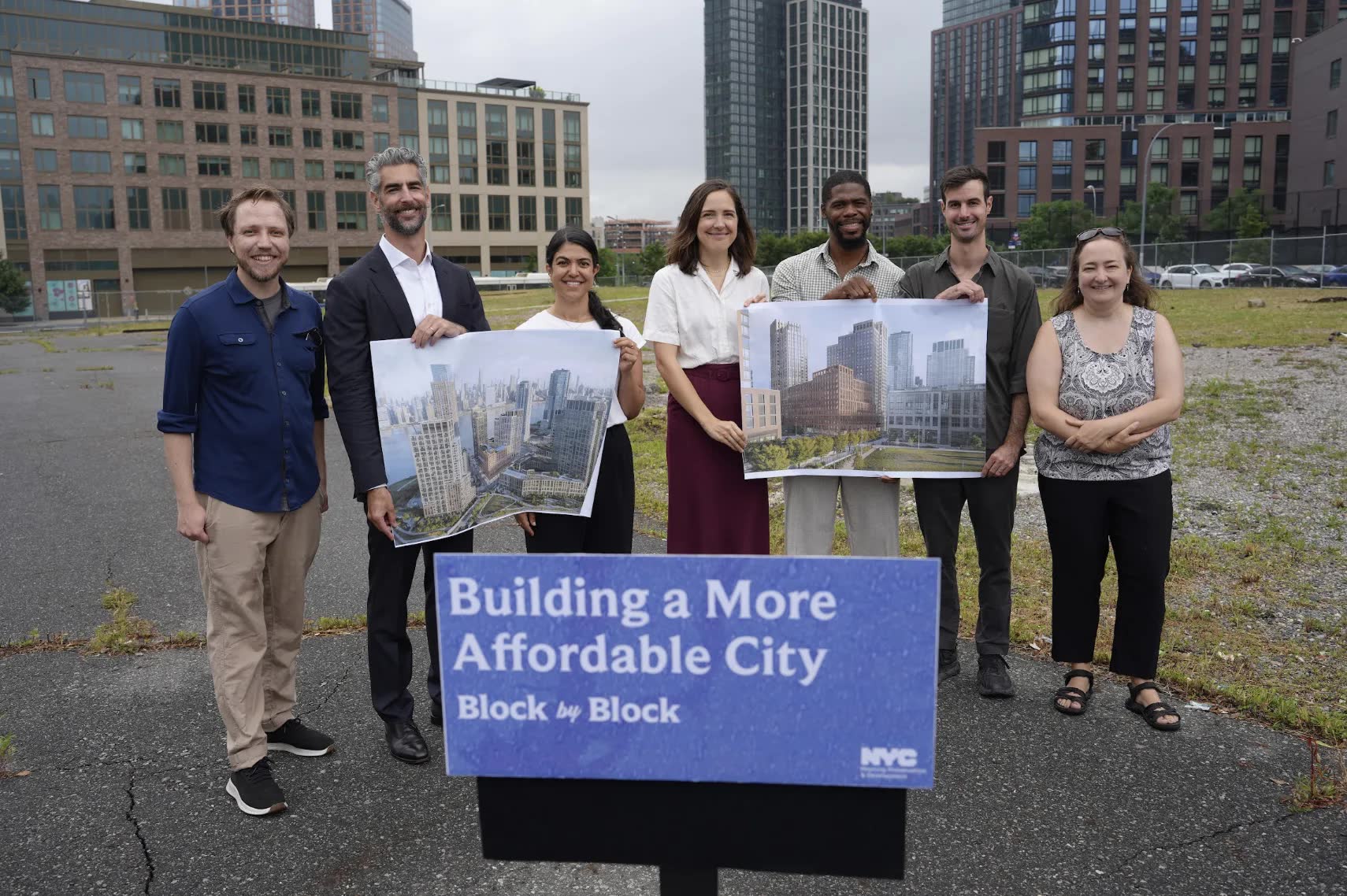
A long-vacant piece of public land along the Queens waterfront is set to become nearly 1,000 homes, offering New York City a new test of how public property can support housing, services and community life in a rapidly changing neighborhood.
The New York City Department of Housing Preservation and Development announced Wednesday that the city has selected a development team for The Orion, a three-building, mixed-use project at Hunter’s Point South in Long Island City.
The project is expected to include about 980 apartments, with approximately 658 designated as income-restricted housing for households ranging from extremely low to moderate incomes. Nearly 150 apartments will provide supportive housing, including 149 units for people who have experienced homelessness.
About one-third of the apartments will have two or more bedrooms, responding to a need for housing designed for families rather than only individuals and smaller households.
The Orion will also include an affordable child care center with an outdoor play area, a workforce development center, flexible community space and a ground-floor indoor swimming pool. The pool will primarily serve residents, while programs operated by Commonpoint Queens are expected to make it accessible to the broader community. About 6,000 square feet of retail space is also planned along Second Street and Center Boulevard.
The combination reflects a broader understanding of affordability. For young workers, immigrant families and households with children, the cost of living in New York is shaped by more than monthly rent. Access to child care, employment, transportation and public space can determine whether residents are able to remain in a neighborhood over time.
The project will rise on Parcel E, a roughly 70,000-square-foot city-owned site at 54-42 Second Street. The broader Hunter’s Point South area was once an industrial waterfront and was later included in New York’s unsuccessful bid to host the 2012 Olympic Games.
The city subsequently transformed the area into a mixed-income residential district. More than 3,000 homes, three schools, commercial and community facilities, new infrastructure and a waterfront park have already been built there.
That history reflects a shift in urban ambition: from preparing a site for a global spectacle to building the everyday infrastructure of city life.
The Orion will be developed by Slate Property Group, The Hudson Companies and Volunteers of America–Greater New York, with Marvel serving as the architect. The project will use the city’s Mixed Income Market Initiative, which combines market-rate and income-restricted apartments within the same development.
The model is designed to use revenue from market-rate housing to help support apartments for lower-income and formerly homeless residents. Its effectiveness, however, will depend on details that have not yet been released, including rent levels, income requirements and the distribution of apartments across different income bands.
The city has also not announced a construction or completion date. The development team must continue working with HPD, secure financing and update the community before construction begins.
Those unanswered questions matter. A project can add housing to an expensive neighborhood without necessarily making the surrounding area broadly affordable. The Orion’s impact will ultimately depend on which households qualify, how accessible its services become and whether the plan moves from architectural rendering to completed homes.
Cities from New York to rapidly growing urban centers across Asia face a similar challenge: how to add density and investment without separating ordinary residents from jobs, schools and opportunity.
The Orion offers one possible approach by treating housing as part of a larger social infrastructure. Whether it becomes a model for a more inclusive New York will depend on who is able to live there and whether the public benefits promised alongside the apartments become part of everyday community life.