Carved in Chongqing, Reimagined in New York
A Manhattan exhibition brings the Dazu Rock Carvings — ancient Buddhist, Taoist, and Confucian reliefs embedded in Chongqing’s hillsides — to New York through interpretation rather than relocation, exploring how an immovable UNESCO World Heritage site can still travel.
By Iris Ye · August 4, 2026 · 5 min read
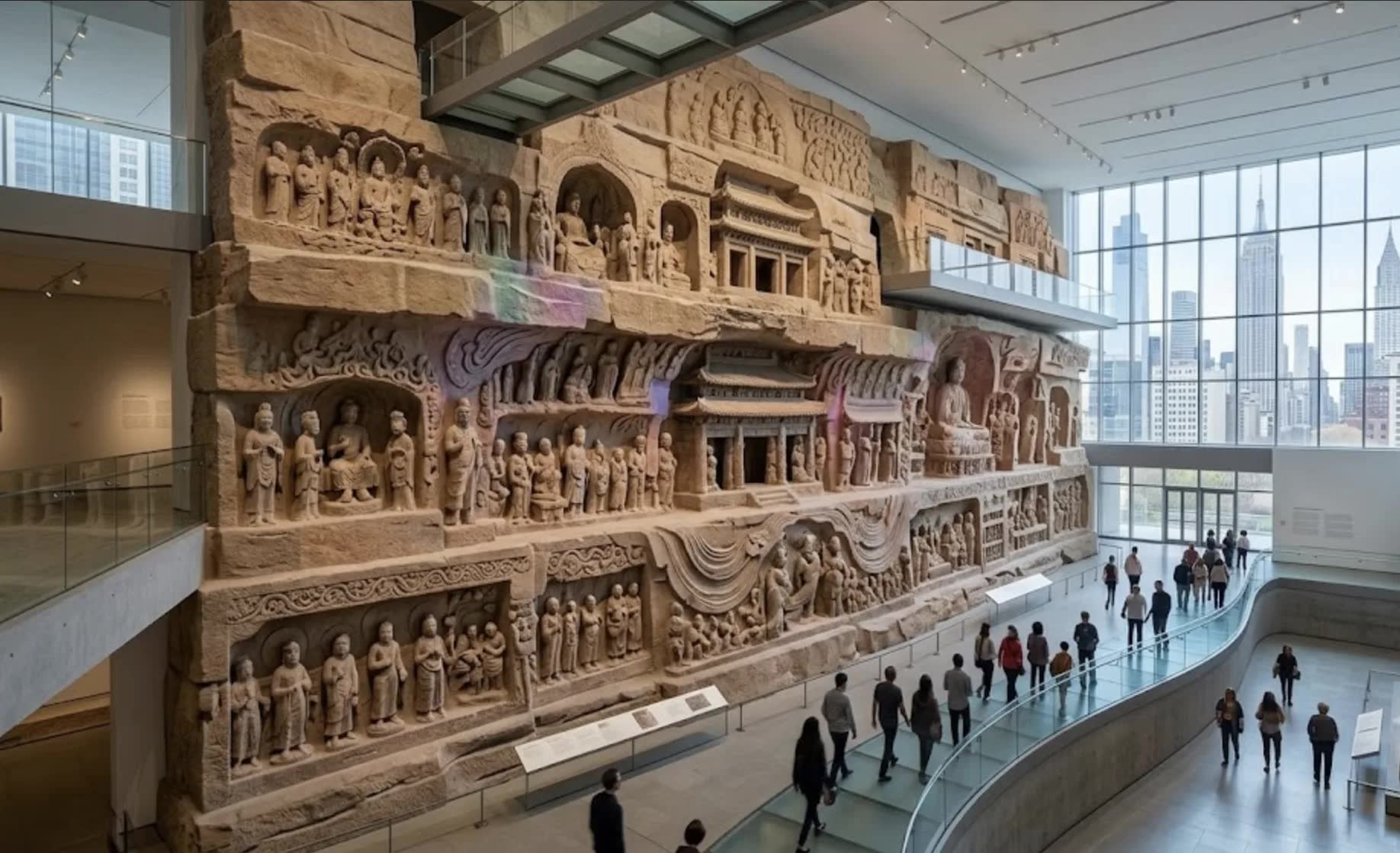
A new exhibition in New York is bringing the history and artistic legacy of the Dazu Rock Carvings, one of China’s UNESCO World Heritage sites, to audiences far from the cliffs where the works were created centuries ago.
“Harmony of the East: World Heritage Dazu Rock Carvings — An Exhibition of Art and Life Narratives” opened at the Memor Museum in Manhattan on July 31. Presented in collaboration with the Dazu Rock Carvings Research Academy, the exhibition introduces the carvings through a museum setting while placing them within their historical and philosophical context.
Unlike paintings, ceramics or other objects commonly exchanged between museums, the Dazu Rock Carvings cannot simply be removed and transported. They are embedded in the hillsides near Chongqing in southwest China, making the New York exhibition not a relocation of the heritage site, but an interpretation of it.
The Dazu Rock Carvings consist of five major groups created primarily between the ninth and 13th centuries. Their thousands of figures and inscriptions encompass Buddhist, Taoist and Confucian themes, as well as scenes of family life, labor and ordinary social experience.
UNESCO inscribed the carvings on its World Heritage List in 1999, recognizing their artistic quality, diversity of subject matter and distinctive synthesis of several philosophical and religious traditions. The carvings are significant not only as religious art, but also as records of the communities that created them.
That connection between spiritual belief and daily life gives the works particular relevance in a contemporary museum. Visitors are not encountering an isolated collection of sacred figures. They are being introduced to a historical society in which religion, ethics, family relationships and everyday experience were deeply interwoven.
The exhibition also highlights a challenge facing institutions that present cultural heritage internationally: how to make a site understandable without separating it from the environment and history that give it meaning.
For an audience unfamiliar with Chinese rock art, visual beauty may provide the first point of entry. Yet the deeper value of the carvings lies in the ideas and social experiences represented within them. Providing that context is essential if an international exhibition is to move beyond spectacle toward genuine understanding.
New York offers a fitting setting for that effort. The city’s museums and cultural institutions regularly introduce audiences to histories originating far beyond the United States. In these spaces, heritage is viewed not only by specialists or members of a single cultural community, but by visitors who bring different backgrounds, references and questions.
The Dazu exhibition therefore represents more than the overseas presentation of an ancient Chinese art form. It shows how an immovable heritage site can enter a new cultural conversation without physically leaving its original landscape.
The carvings remain in Chongqing, but the histories they preserve can still reach new audiences — provided that they travel with the context needed to understand them.