Ceramicists of the Hudson Valley Forge Sustainable Glazes from Local Clay
Studio potters are experimenting with regional minerals and kiln technologies to create work rooted in local geology and climate concerns.
By Priyanka Rao · January 20, 2026 · 4 min read
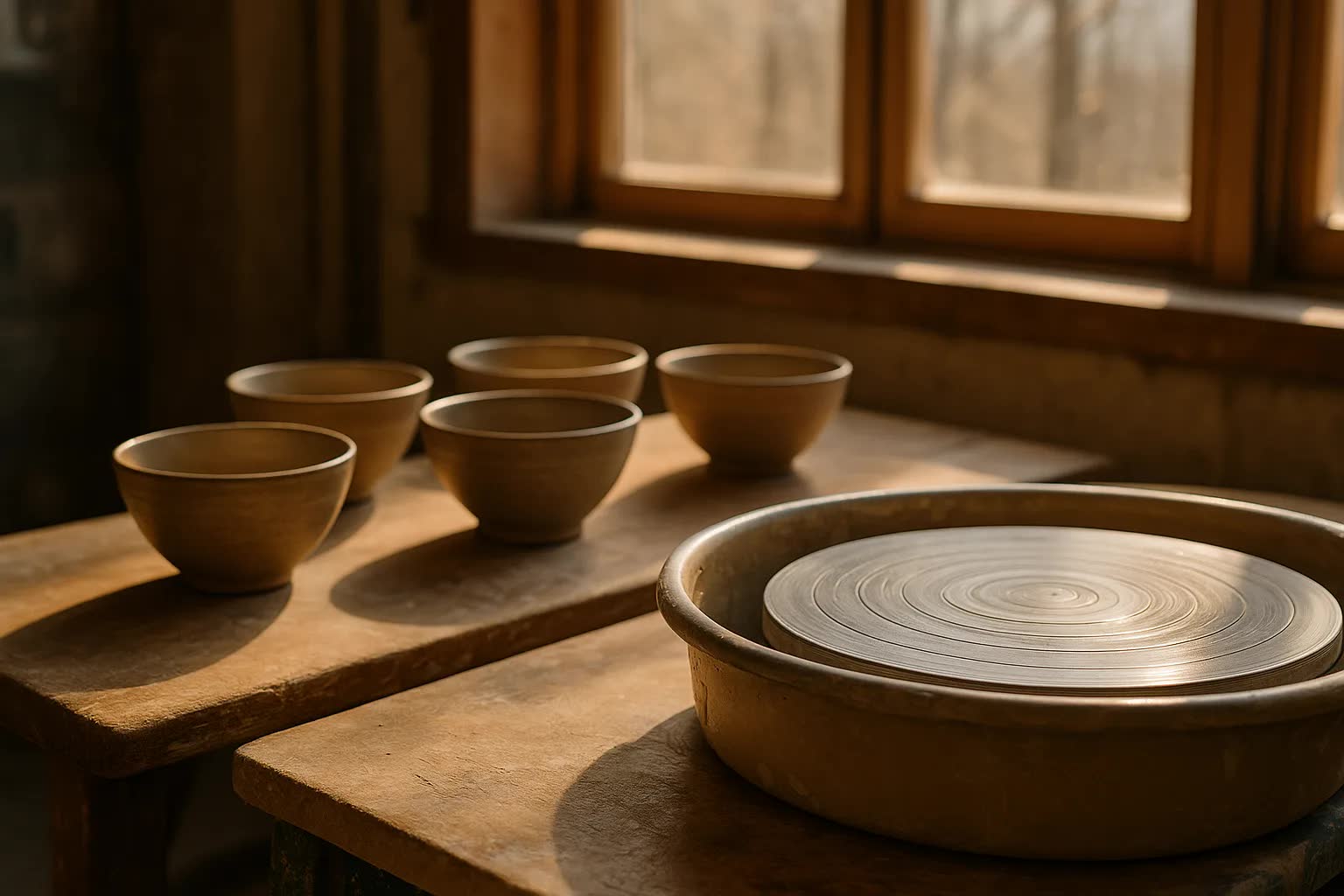
NEW YORK — In galleries on West 24th Street and a pop-up window in DUMBO last spring, small clay vessels and ash-glazed platters drew crowds not for celebrity provenance but for a provenance grounded in bedrock: potters from the Hudson Valley are making glazes from locally dug minerals and the work is finding an audience in Manhattan neighborhoods that prize craft rooted in place as much as design.
The movement, which has spread from studio towns like Beacon and New Paltz up to Cold Spring and Kingston, responds to two impulses: a desire among makers to connect their wares to the valley’s distinctive geology and a practical push to reduce the carbon footprint of ceramic production by cutting transport and relying on lower-firing, chemically simpler glazes.
At Beacon Clayworks, a converted warehouse a three-minute walk from the Metro-North station, co-director Maya Sato demonstrated a glaze she calls 'Beacon Silt' that starts with iron-rich clay her apprentices pull from a riverbank two miles north of town. "You can see the valley in the color," Sato said. "It’s not just romantic. When we use the materials that are already here, we control variability and we cut down on freight and foreign chemical mixes."
The recipes are as much experiments in kiln chemistry as in fieldwork. Luis Marquez, head kiln technician at a cooperative in New Paltz, described swapping out commercial manganese and chrome compounds for locally sourced glauconite and manganese nodules he salvaged from a quarry on Route 299. "We had to rethink firing cycles and atmosphere,” Marquez said. “A lot of what we are doing is making the kiln act differently so the local stuff behaves predictably."
The practical stakes are measurable. A survey organized by the Hudson Valley Clay Consortium this year of 87 working studios found that 34 studios — or 39 percent — now incorporate at least one locally sourced mineral into their glazes. Participating studios reported cutting inbound material shipments by an average of 52 percent, reducing yearly freight-related costs by a median of $2,400 and claiming an average reduction in estimated kiln-related CO2 emissions of 18 percent after adopting hybrid gas-electric kilns or lower-temperature firings.
Those numbers have drawn attention from curators and collectors in Manhattan neighborhoods historically important to craft sales. Galleries in Chelsea and the Lower East Side have begun to ask for origin statements with pieces, and designer shops in the West Village and the Upper East Side have placed small orders. "Clients in Chelsea ask more pointed questions now — they want to know if the color is minerally specific or chemically lacquered," said Rowan Chen, owner of a gallery on West 20th Street that mounted a Hudson Valley ceramics show last fall.
The work is also a response to local environmental concerns. Potters recount flood events and erratic winters that have altered river paths and exposed new deposits of clay and iron. At the same time, municipal planners in towns like Beacon and Kingston have been negotiating access to old quarry sites and riverbanks with property owners and conservation groups, setting limits on how much material can be removed and requiring erosion controls. "We’re trying to strike a balance between a living craft and river health," said Claire Thomason, director of the Hudson River Heritage Trust, who has advised several studios on best practices.
Collaboration has been essential. Artists are partnering with geology departments at regional colleges and with ceramic engineers to map the valley's mineralogy and to test toxicity and glaze stability. A shared lab in Kingston, funded by a foundation grant and a crowd-sourced pool from local potteries, runs routine x-ray fluorescence tests and toxicity screens, documenting which local materials make safe, durable surfaces and which require stabilization or very specific firing atmospheres.
There are commercial challenges. Local materials are inherently variable, which makes batch-to-batch consistency difficult; some retailers are reluctant to take on wares that differ measurably from piece to piece. There are also regulatory hurdles—permits for extraction, air-quality rules for kilns and insurance questions for pop-up sales—that each studio must navigate, often with limited legal help. Still, the economic picture is encouraging: several small studios report that their locally sourced lines command a 15 to 25 percent premium and that wholesale orders from New York City boutiques have increased year over year.
Looking ahead, the Hudson Valley ceramics movement appears poised to deepen ties with the city it supplies. Potters plan a series of winter workshops in Chelsea and the East Village this season, and a consortium-wide exhibition is slated for next spring that will include process documentation, soil maps and kiln logs alongside finished work. For makers who see clay as an archive of place, the next step is not just to sell vessels but to translate the valley’s geology and climate story into objects with lasting aesthetic and environmental value.