Chelsea Data Center Reuses Waste Heat to Warm Nearby Office Towers in Pilot
A new piping scheme diverts excess server heat to adjacent buildings, testing whether commercial recycling can cut energy bills and emissions downtown.
By Dominic Russo · January 8, 2026 · 4 min read
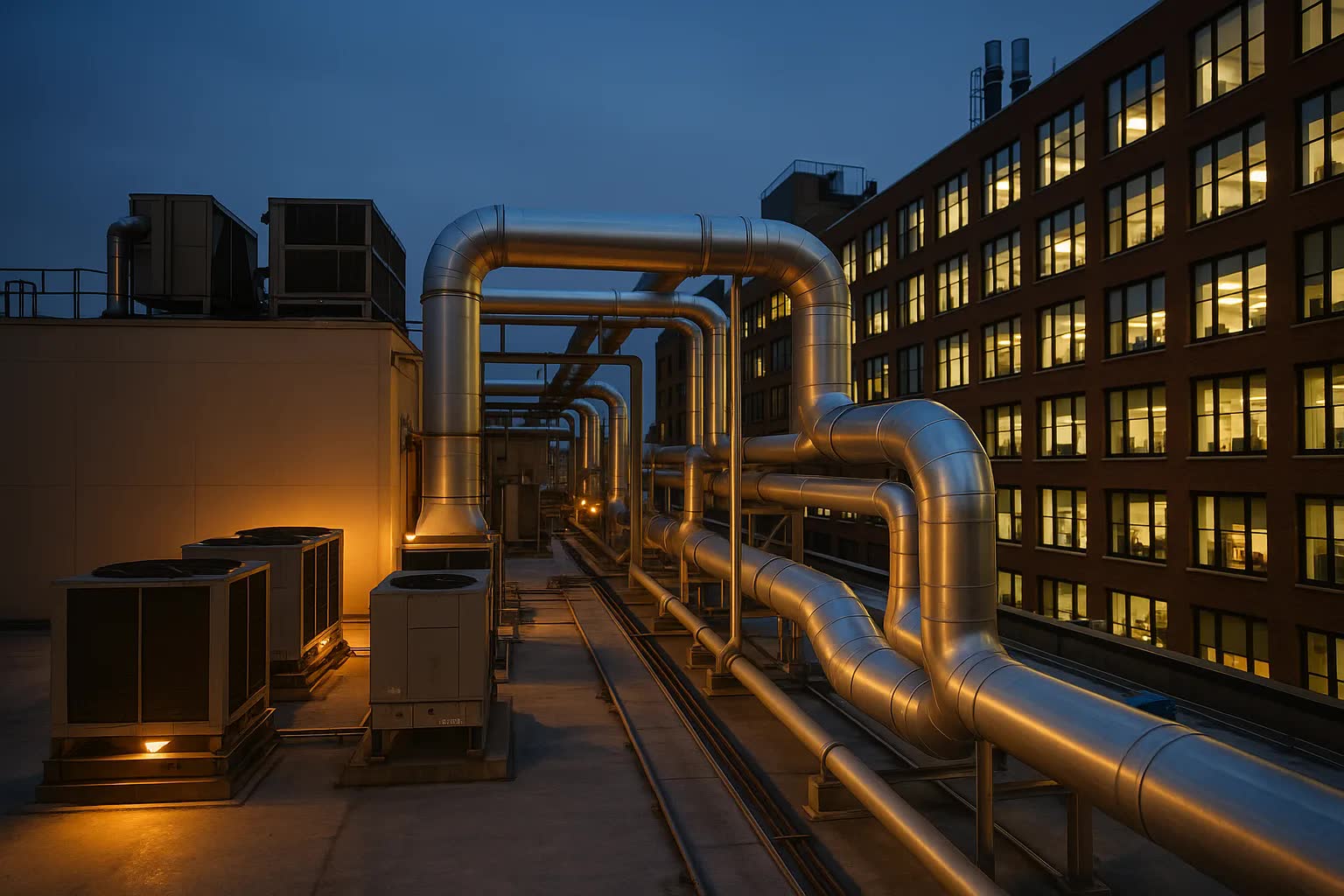
NEW YORK — In a pilot that city officials and building managers say could reshape how Manhattan keeps warm, a Chelsea data center has begun piping server waste heat into a cluster of nearby office towers, recycling excess energy that would otherwise be vented to the street and the High Line breeze, and testing whether downtown commercial buildings can cut energy bills and carbon emissions by sharing resources.
The project centers on Hudson Rack Data Center, a whiteshade-block facility on West 18th Street that serves financial and media clients across the borough, and a newly installed 600-foot network of insulated pipes that carries hot glycol from server-room heat exchangers into a subterranean exchange room beneath the block between Ninth and Tenth avenues, where it feeds into the heating plants of three adjacent towers owned by Parkline Properties.
"We used to pay to throw that heat away," said Marisol Vega, chief sustainability officer at Hudson Rack Data Center, standing near the data hall where humming racks gave off a steady orange glow. "Now we're turning what used to be a liability into an asset that benefits our neighbors and lowers the entire campus's carbon footprint."
Parkline Properties said the retrofits were made with equipment from ConserveTech Solutions and agreements that allow the data center to charge for delivered thermal energy by the megawatt-hour. "Our tenants are seeing a material change in monthly costs," said Ethan Park, facilities manager at 320 West 18th Street, a 240,000-square-foot office building that is part of the pilot cohort. "It's not a free lunch, but it's a fair trade of heat for lower gas use and a more resilient plant."
The pilot has specific, measurable targets: the system can deliver up to 2.4 megawatts of thermal power at peak, enough to heat roughly 200,000 square feet of office space; it recovers about 65 percent of the heat produced by the servers; the initial capital cost of piping, heat exchangers and controls was $3.2 million; Parkline estimates a combined fuel savings of about $420,000 in the first winter season and a payback window of roughly 4.5 years, with an annual avoidance of approximately 1,200 metric tons of CO2 compared with conventional boilers.
City regulators and clean-energy programs played a role in speeding permitting and providing modest grants. The pilot cleared expedited review from the New York City Department of Buildings and qualified for a $350,000 incentive from the Office of Energy Efficiency and Sustainability for infrastructure that reduces reliance on fossil fuels in large commercial buildings, officials said, part of a larger push to meet the city’s greenhouse gas reduction targets.
Advocates for citywide district heating have pointed to the Chelsea trial as a model that could be replicated along other technology corridors, such as Flatiron and Hudson Yards, where data centers and office towers sit in close proximity. Similar schemes have long existed in Northern Europe and some Canadian cities, but the urban fabric and muni-code patchwork in Manhattan has made replicability a subject of debate among engineers and architects.
"The physics are simple, but the implementation is complex," said Dr. Peter Lin, senior mechanical engineer at ConserveTech, who oversaw the thermal modeling for the project. "You have to match temperature quality, provide controls for variable server loads, and build in redundancy so that tenants are never reliant on one heat source. We also integrated thermal storage tanks so we can smooth supply during server load swings."
Local reactions have been mixed. Some firms in the Meatpacking and Chelsea corridors welcomed the prospect of lower heating bills and fewer emissions; neighborhood groups voiced enthusiasm about innovative reuse of urban resources ahead of upcoming zoning reviews. A nearby café owner on Ninth Avenue, whose rent increased last year, said he hoped savings would eventually translate into cheaper commercial leases, while a resident group sought assurances about noise and truck traffic during initial construction.
Project managers say the pilot will be monitored through the next two winters with third-party verification of energy and emissions data, and that lessons learned will inform a planned expansion study to connect other commercial nodes in Midtown and the Far West Side. If results hold, the model could encourage policymakers to adopt streamlined permitting and financial incentives that make waste-heat recycling a routine part of downtown development and retrofit strategies.