City Installs Air-Quality Sensors in Public Schools Following Widespread Smoke Episodes
The initial rollout prioritizes schools near highways and the waterfront, with officials planning public dashboards for parents.
By Keisha Brown · March 15, 2026 · 4 min read
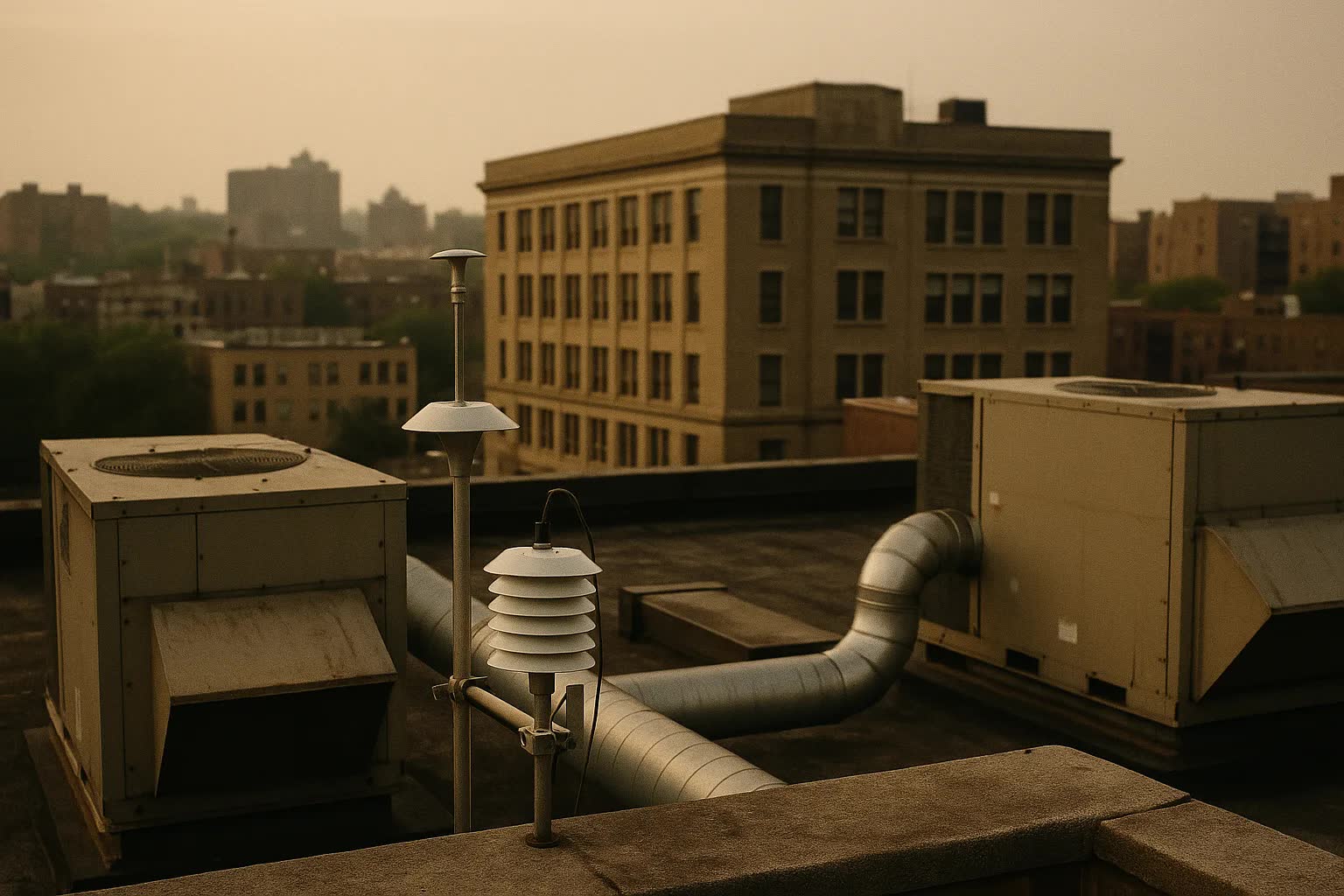
City education and health officials began installing air-quality sensors in public school classrooms and common areas across New York this week, a move officials say is aimed at preventing future disruptions after a series of widespread smoke episodes that last year clouded the East River waterfront, choked neighborhoods along the Bruckner Expressway and forced outdoor recess to be canceled from Sunset Park to Co-op City.
The initial rollout prioritizes schools that sit adjacent to major traffic corridors and the waterfront — clusters along the FDR Drive and West Side Highway, schools under the shadow of the Bruckner and the Cross Bronx, and district buildings in Red Hook, Battery Park City, Astoria and parts of southeast Queens — city officials said, with the stated goal of making real-time air data visible to parents through public dashboards later this spring.
“We owe it to students and staff to have accurate, timely information about what they are breathing,” said Dr. Maya Chen, the city’s chief environmental health officer, who oversees the sensor program for the Department of Health and Mental Hygiene. “These sensors are not a standalone fix, but they are a critical piece of a larger strategy to reduce exposures and make building systems work better when pollution spikes.”
The first phase will place roughly 1,200 sensors in about 400 schools, covering an estimated 225,000 students and staff, officials said; the city has budgeted $14.8 million for equipment, installation and the first two years of maintenance, with an additional $3 million pledged by a local foundation to expand monitoring in underserved neighborhoods. The devices will measure fine particulate matter (PM2.5), ozone and nitrogen dioxide and will be set to push alerts when readings exceed 35 micrograms per cubic meter for PM2.5 over a one-hour average, a threshold that triggers indoor air quality responses for building operators and school nurses.
The equipment, sourced through a city procurement with a vendor called AeroSense Solutions, will be mounted in cafeterias, gymnasiums and classrooms and linked to the school building management systems where feasible so that ventilation can be adjusted automatically when pollution levels rise, officials said. School construction crews will also install Wi-Fi extenders in older buildings with poor connectivity — a common problem in schools built in the 1950s and 1960s in parts of the Bronx and Queens — so data can flow to a central platform maintained by the Department of Environmental Protection.
“At P.S. 160 in Sunset Park we had three days last year when teachers kept kids indoors because the air outside smelled of smoke and parents were calling in alarmed,” said Luis Alvarez, principal of P.S. 160, which sits a block from Third Avenue and the Gowanus Canal. “Having a sensor that tells us whether the air around and inside our building is safe will change how we respond, and it will help reassure families that we’re making decisions based on hard data.”
Advocates for environmental justice welcomed the plan but urged the city to move quickly to ensure sensors are maintained and the data are used to protect students in historically overburdened neighborhoods. “The Bronx and sections of north-central Queens already face higher asthma rates and traffic pollution; delayed monitoring just prolongs inequity,” said Asha Banerjee, a PTA president in Astoria whose children attend a middle school near the Whitestone Expressway. “We need public dashboards and clear, multilingual guidance tied to every alert.”
Citywide air-quality records used to design the rollout showed stark neighborhood differences: in a yearlong analysis compiled by the health department, coastal and highway-adjacent districts recorded PM2.5 hourly exceedances roughly twice as often as inland neighborhoods, and schools within a half-mile of major arterials had average indoor spikes 30 percent higher than counterparts in lower-traffic areas. That data, officials said, drove the decision to place more sensors in waterfront and corridor schools in the initial tranche and to phase deployment across all five boroughs by the start of the next school year.
Officials stressed that privacy safeguards are being built into the public dashboard, which will publish aggregated, building-level air-quality readings and historical trends but not live footage or location-tracking information for individual students. “We are presenting neighborhood and school-level air scores that parents can trust without exposing personal data,” said Dr. Marcus Lee, a pediatrician who consulted on the project for the Department of Education’s health unit. The city also plans training sessions for principals and school nurses on interpreting sensor alerts and coordinating with custodial staff to adjust ventilation, seal drafty windows and, where appropriate, move sensitive activities indoors or reschedule outdoor programs.
If the trial meets technical and operational benchmarks, the city intends to expand monitoring to all 1,800 district schools by fall 2026 and to install complementary sensors at playgrounds and after-school sites in high-risk neighborhoods, officials said — and the promised public dashboards are expected to go live in June, ahead of a summer season when wildfire smoke and construction-related pollution typically rise. The program’s success, advocates said, will be judged not just by the devices on walls but by whether the data leads to faster protective actions and long-term investments in cleaner school buildings.