Community Groups Challenge Expanded Surveillance Camera Network in the Bronx
A city proposal to add CCTV and facial analysis tech sparks privacy battles with neighborhood organizers.
By Rachel Cohen · January 5, 2026 · 5 min read
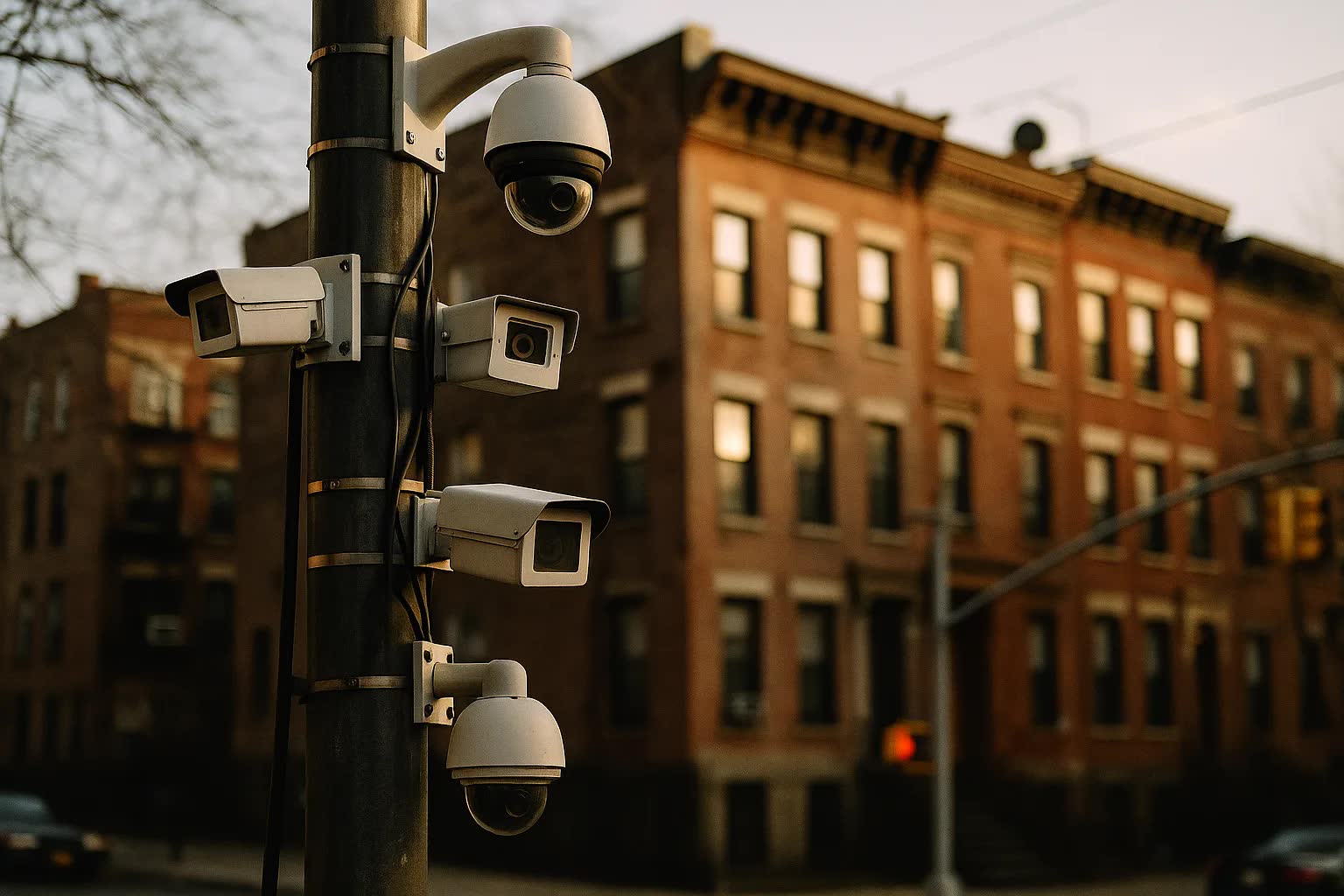
NEW YORK — The city’s plan to expand a network of closed-circuit cameras and deploy facial analysis software across large swaths of the Bronx has sharpened a dispute over public safety, privacy and equity that is playing out block by block from Fordham Road to the South Bronx waterfront. City officials say the move will help police and transit agencies reduce crime and improve response times, while neighborhood groups and civil liberties advocates argue the proposal would entrench invasive surveillance in areas already overpoliced and disproportionately affect Black and Latino residents near Yankee Stadium, Bruckner Boulevard and the Mott Haven waterfront.
Under the proposal, the City Surveillance Coordination Unit would add roughly 1,200 fixed CCTV cameras on lamp posts, transit plazas and public-housing exteriors and integrate feeds with an analytics platform that includes facial analysis and automated license-plate readers. Officials told community boards the system would also include 250 mobile cameras for special events and emergency deployments, striking a particular focus on congested corridors like Fordham Road, Third Avenue in Tremont and the pedestrian crossings at East 161st Street by Yankee Stadium. The plan envisions joint access for municipal agencies including the transit authority and the police department, with a dashboard intended for realtime monitoring and historical queries.
“We’re not against tools that make our neighborhoods safer, but this proposal is a blank check for continuous, automated scrutiny of Bronx residents,” said Marisol Alvarez, director of the Bronx Coalition for Privacy, citing fears of persistent tracking and data misuse. “Our communities have lived experience with overpolicing; adding facial analysis to street cameras risks turning every commute to work or walk to school into a record that can be searched and misapplied.” Alvarez said her group would press for camera-free buffers around schools and shelters and for a binding prohibition on facial recognition.
City officials defended the project as narrowly tailored and accountable. “These cameras are a force multiplier for public safety, enabling quicker deployment of officers to violent crime hot spots and improving traffic enforcement at dangerous intersections,” said Aisha Bello, deputy commissioner for the City’s Urban Surveillance Unit. Bello said the facial analysis function would be used only in limited circumstances and only after administrative approvals tied to criminal investigations. “We are building audit trails, role-based access and a strict data-retention schedule,” she said.
A senior NYPD surveillance planner who requested anonymity told NYDailyWatch that the department expects the integrated system to shave response times by minutes in critical incidents and to help identify stolen-car rings that utilize Bronx street grids to move vehicles across borough lines. The planner added, however, that operational details — including exactly how and when facial analysis would be triggered — remain under negotiation with city lawyers and the surveillance unit, and could change if the community oversight panel appointed by the mayor imposes additional conditions.
The proposal’s fiscal and technical underpinnings include a projected cost of $48 million up front and roughly $6.5 million a year for operations and maintenance, according to presentation materials circulated at neighborhood meetings and reviewed by NYDailyWatch. The rollout would be phased: 400 cameras in phase one covering parts of Mott Haven, Hunts Point and Tremont; 500 in phase two reaching Fordham, Kingsbridge and portions of Riverdale; and the remainder in a third phase focused on transit hubs and the Bruckner and Southern Boulevard corridors. Vendors the city has identified claim face-analysis systems with claimed identification rates above 90 percent under ideal conditions, and the plan calls for image retention periods ranging from 30 days for general camera footage to 180 days for clips associated with investigations.
Neighborhood meetings staged in community boards across the borough have grown tense. At a packed Fordham Plaza hearing, residents pressed officials on whether cameras could be mounted on private buildings and whether footage might be shared with federal agencies. “You don’t get to say our neighborhoods are a test lab,” said Darnell Ruiz, owner of Bronx Brew on Bruckner Boulevard, whose storefront has been the site of several free-speech rallies. “My customers, many of them elderly or undocumented, already avoid the subway at certain hours — this will push them further from public life.” Tenant leaders from Mott Haven and Longwood urged binding community benefits, including job training for young people to work in the new tech-driven monitoring center.
Academic and legal experts lined up to assess technical risk, focusing on documented disparities in facial analysis systems. “These algorithms were trained on datasets that underrepresent darker skin tones, which can translate into higher false positive rates for Black and Brown faces,” said Dr. Henry Kwame, director of the Urban Data Ethics Lab at Riverfront University. “Absent rigorous, publicly overseen testing and a statutory ban on certain uses, the technology can reproduce and amplify discriminatory policing patterns.” Civil rights attorneys point to lawsuits elsewhere that forced municipalities to abandon or curb similar programs after community pushback and legal challenges.
Real estate and development stakeholders are watching the debate for its potential economic impact. Jessica Park, vice president for policy at the Metro Property Council, said businesses want safer streets but not at the cost of alienating customers. “There’s a balance,” Park said. “Investors and retailers are concerned about the optics of ubiquitous surveillance; some landlords fear liability if they allow camera mounts on private facades without clear rules. At the same time, insurers and some tenants have asked for better lighting and monitoring at key commuter nodes.” Local realtors in Kingsbridge and Spuyten Duyvil told NYDailyWatch that listing language may shift if neighborhoods are perceived as more heavily surveilled.
The next steps in the process are scheduled to play out in the first quarter. The City Surveillance Coordination Unit plans a formal public hearing Jan. 20 at Lehman College, followed by a 45-day comment period and an independent privacy impact assessment to be commissioned by the mayor’s office. Community groups have already signaled they will seek injunctive relief if the city moves forward without binding constraints and an enforceable audit mechanism. Advocates also want a citywide policy that bans real-time facial recognition for routine policing and requires judicial oversight for any use tied to investigations. For now, the proposal has put the Bronx at the center of a broader citywide conversation about technology, safety and civil liberties that is likely to shape municipal surveillance policy for years to come.