Cornell Tech's New Quantum Computing Lab on Roosevelt Island Sets Sights on Drug Discovery
The $340 million facility, opening this fall, aims to solve molecular simulation problems in minutes that would take classical supercomputers thousands of years — with pharmaceutical breakthroughs as the primary early target.
By Sherry Fan · August 6, 2026 · 4 min read
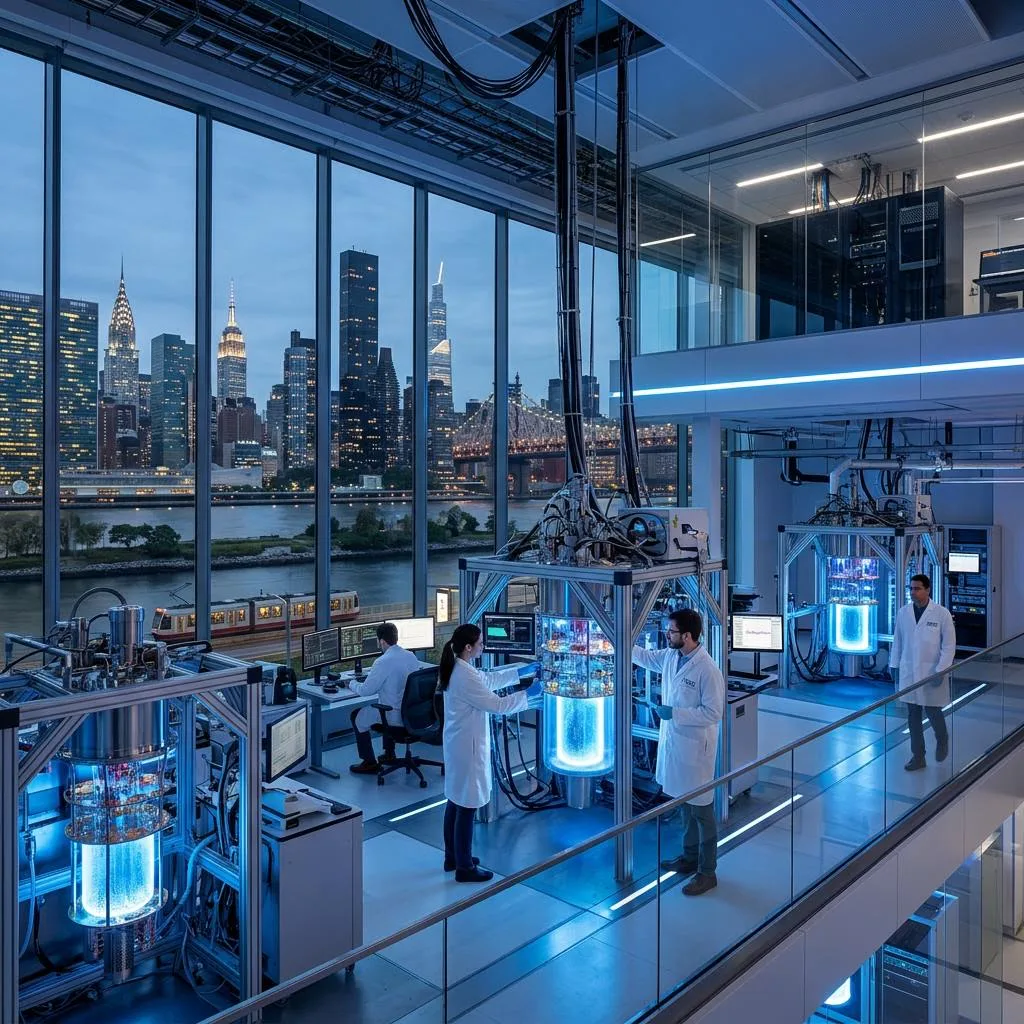
ROOSEVELT ISLAND, N.Y. — Cornell Tech unveiled the steel-and-glass structure that will house its new Center for Quantum Computing and Molecular Simulation on Wednesday, a $340 million facility the university says will rank among the three most advanced quantum research installations in the world when it opens to researchers this October. Designed by Bjarke Ingels Group, the building's photovoltaic glass exterior generates 30 percent of the lab's power needs while offering sweeping views of both the Manhattan and Queens shorelines.
The center's flagship instrument is a 1,024-qubit quantum processor developed jointly with IBM, housed in a sub-basement chamber cooled to 15 millikelvin — colder than interstellar space — to preserve the fragile quantum states on which its calculations depend. At that scale, the processor can simulate the behavior of complex molecules with a fidelity that classical supercomputers cannot approach, opening the door to drug discovery workflows that currently take years to compress into weeks.
Cornell Tech's inaugural research agenda centers on three disease areas where the precise molecular mechanisms are poorly understood: antibiotic-resistant bacterial infections, Alzheimer's disease, and pancreatic cancer. Twelve pharmaceutical companies — including Pfizer, Bristol-Myers Squibb, and Roche — have signed research agreements giving their scientists access to the facility in exchange for co-funding and data-sharing commitments.
New York City officials have championed the lab as a centerpiece of the city's ambition to become the nation's leading hub for quantum technology. City planners are reviewing applications for three additional life-sciences buildings that would cluster around the quantum facility to form what one Economic Development Corporation official described as 'a quantum valley with subway access.'
Not all observers are convinced the timeline will hold. Quantum computing has a long history of ambitious promises and delayed deliveries. Cornell Tech's dean of computing, Dr. Kavita Bala, acknowledged the challenge while insisting the facility's hybrid classical-quantum architecture hedges against it. 'We are not betting everything on one vision of the future,' she said. 'We are building infrastructure that is useful today and transformative when the hardware catches up.'