The Met Opens 'Harlem Rising': Its Most Ambitious Survey of Black American Art in Decades
Spanning four floors and more than 300 works — from Aaron Douglas murals to Kehinde Wiley canvases — the exhibition rewrites the museum's own history of omission.
By Priya Nair · August 16, 2026 · 5 min read
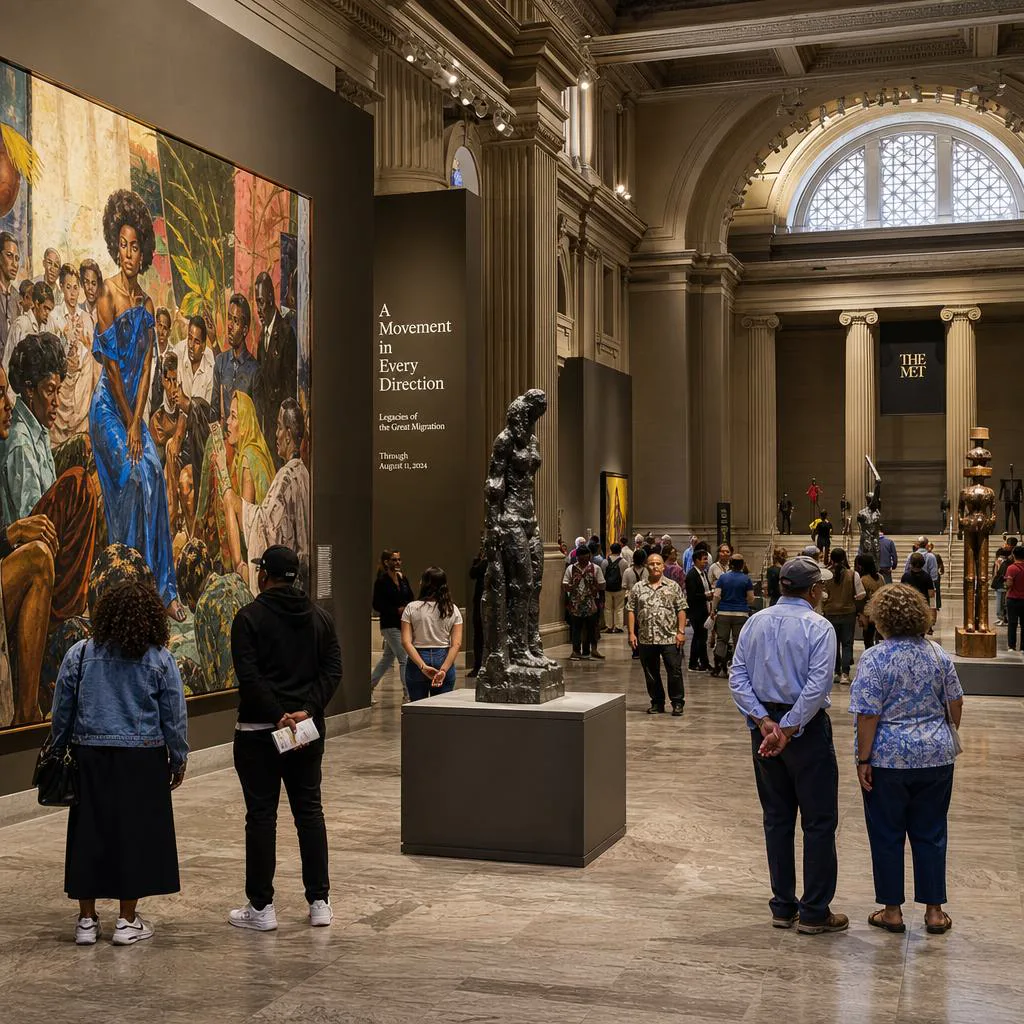
The Metropolitan Museum of Art opened "Harlem Rising: A Century of Black American Art," its most comprehensive survey of African American visual culture, to the public on Friday — an exhibition five years in the making that spans more than 300 works across four floors of the museum's main building and confronts, head-on, the institution's own history of exclusion and neglect.
The show begins in 1905 and ends in the present day, moving through the Harlem Renaissance of the 1920s and '30s, the civil rights era, the Black Arts Movement, and the contemporary moment with a density and seriousness that sets it apart from previous surveys. Visitors enter through a reconstructed Negro Ensemble Company playbill archive before stepping into a grand gallery anchored by a rarely exhibited Aaron Douglas mural loaned from Fisk University — the first time it has left Nashville in 40 years.
"This exhibition is not a celebration," said Dr. Amara Osei-Mensah, the Met's newly appointed curator of African American Art, who spent three years negotiating loans from private collectors, historically Black colleges, and community organizations whose holdings have rarely been seen inside a major encyclopedic museum. "It is a reckoning and a revelation. These artists were making some of the most innovative work in the world at a time when this institution was closing its doors to them."
The exhibition's most talked-about room is a vast circular gallery on the second floor devoted to the 1960s and '70s, where paintings by Faith Ringgold, Norman Lewis, and Barkley L. Hendricks hang alongside protest photographs by Roy DeCarava and Kwame Brathwaite. At the center of the room, suspended from the ceiling, is a monumental new commission: a textile installation by Theaster Gates that incorporates archival fabric from demolished South Side Chicago church pews and, woven through it, fragments of sheet music from Black Baptist hymnals.
Contemporary artists are given the entire fourth-floor wing normally reserved for European decorative arts — itself a pointed curatorial statement. Works by Kehinde Wiley, Amy Sherald, Titus Kaphar, and Jordan Casteel hang in rooms the museum has historically reserved for Old Masters. Wiley's enormous "Femme piquée par un serpent" variant, depicting a young Black man from Harlem in the posture of a classical reclining nude, dominates the first room and stops visitors cold.
The Met has not been without controversy on the subject of Black American art. In 2019, a widely circulated analysis found that fewer than three percent of works in its American Wing were by Black artists, despite the wing purporting to represent the breadth of the nation's visual history. Director Max Hollein acknowledged that history directly at the opening preview Thursday evening. "We have not always lived up to what we say we are," he told an audience that included many of the artists represented in the show. "This exhibition is not an apology. It is a beginning."
"Harlem Rising" runs through February 22, 2027. The accompanying catalog, published by Yale University Press, is nearly 700 pages and includes essays by scholars including Henry Louis Gates Jr., Saidiya Hartman, and art historian Darby English. Timed tickets are required and available through the Met's website; lines at the Fifth Avenue entrance stretched around the block on opening morning.