Cycling Advocates Demand Protected Lanes on Cross-Bronx Corridors
A new traffic safety report links the lack of protected infrastructure to a spike in bicycle injuries in the borough.
By Caroline O'Neill · January 21, 2026 · 4 min read
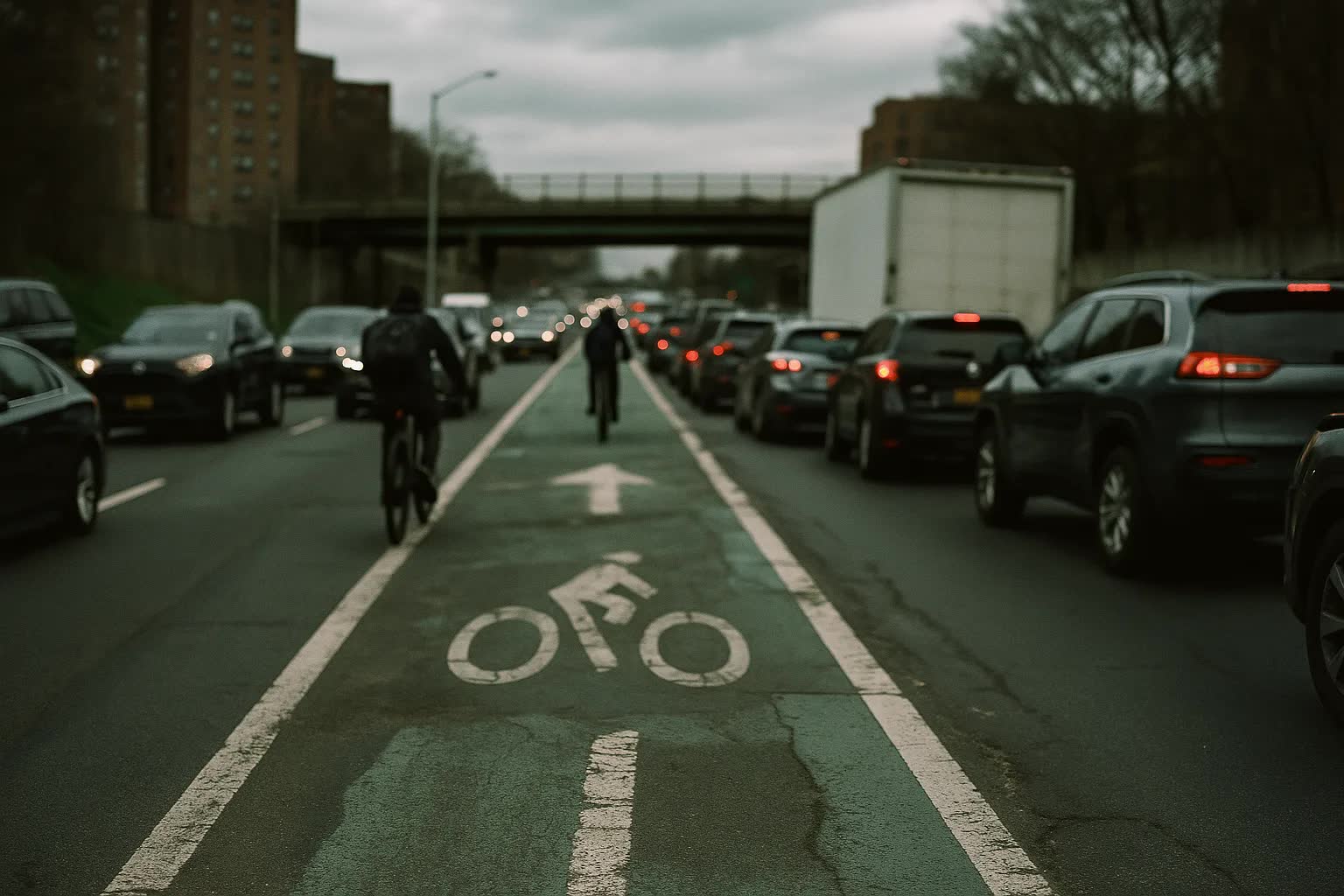
A new traffic safety report released this month has galvanized cycling advocates across the Bronx, who say the borough’s busiest east‑west and north‑south corridors remain perilously ill‑equipped for two‑wheel travel, contributing to a surge in crashes and injuries on streets from Mott Haven to Pelham Parkway and along the Grand Concourse near Yankee Stadium.
The study, produced by the Bronx Safe Streets Coalition, examined collisions involving bicycles on 14 primary corridors and argues that the absence of continuous, protected bike lanes is a major factor behind a year‑over‑year rise in serious injuries. "Riders are being squeezed between buses and trucks on streets that were designed for cars, not people," said Ana Ruiz, director of the Bronx Bicycle Coalition, who helped brief community boards in Fordham and East Tremont this week. "Protected lanes aren’t a luxury — they’re a public‑safety necessity if we want to stop more people from getting hurt or worse."
Advocates focused in particular on Grand Concourse, Webster Avenue, Fordham Road and Bruckner Boulevard, corridors that carry a mix of subway lines overhead, high‑capacity bus service and freight traffic serving Hunts Point and the South Bronx. Residents in Mott Haven and Belmont told reporters that deliveries and transit buses create constant conflicts; cyclists also complained about uneven pavement and narrow curbside lanes that shift from painted buffer to nothing across a single block near 149th Street.
The report’s data is stark. An analysis of city crash reports from 2019 through 2024 found 1,240 reported bicycle injuries boroughwide in 2024, a 32 percent increase from 2019; 610 of those injuries occurred on the 14 corridors studied. Hospitalization rates for cyclists rose from 9 percent of reported injuries in 2019 to 14 percent in 2024, and intersections accounted for 58 percent of crashes. The Bronx currently has roughly 8 miles of physically protected bike lanes, compared with about 60 miles in Manhattan and 42 in Brooklyn, according to the coalition’s tally of city DOT maps.
City Department of Transportation officials acknowledged the report at a public meeting but said planning and capital timelines, not a lack of will, have constrained rapid change. "We’re prioritizing projects based on crash history and available funding, and we have active plans to study protected corridors in the Bronx," said Marcus Li, senior planner for the DOT Bronx office, who presented preliminary concept designs for Webster Avenue and Pelham Parkway. "But physical protection requires curb work, drainage adjustments and coordination with utilities — it’s not something we can stripe overnight without creating new hazards."
Local riders say the delay has immediate consequences. "Last month a garbage truck passed me with inches to spare on the Concourse and there was nowhere to go," said Luis Morales, a food delivery courier who lives in Tremont. Morales, 28, described a near‑miss at 167th Street where a left‑turning cab clipped his handlebar; he suffered a broken wrist and says he still avoids parts of Fordham Road at rush hour. Community groups say such stories are common enough to move beyond anecdote, citing near‑daily reports to neighborhood clinics and churches in Kingsbridge and East Tremont.
The push for protected lanes has revealed tensions between road safety goals and business interests along some commercial strips. Shop owners on Fordham Road have expressed concern that removing curbside parking for a protected lane might reduce customer access at a time when small businesses are still recovering from pandemic losses. "We want safety for our people, but we also need customers to keep the lights on," said Tamara Singh, president of the Fordham Road Merchants Association. The coalition says design approaches such as raised plantable buffers and short loading zones can balance deliveries with rider safety.
The Bronx Safe Streets report recommends a prioritized list of interventions: install physically protected lanes on Grand Concourse from 138th Street to Mosholu Parkway and on Webster Avenue from 149th Street to Fordham Road; convert curbside lanes to protected lanes with concrete or flexible posts; rebuild intersections with protected corner refuges and leading pedestrian intervals; and deploy a borough‑wide bicycle detection and counting network to guide future investments. The group also called for a pilot project on Bruckner Boulevard to test protected lanes adjacent to freight routes serving Hunts Point.
Advocates say models in other boroughs offer blueprints for change. Community board members in Sunset Park and Prospect Heights have pointed to recent DOT pilots that added concrete medians and protected bike lanes on busy corridors, resulting in lower speeds and fewer serious injuries within a year. But Bronx leaders stress that scale and equity matter: "Too often the Bronx gets piecemeal fixes while other neighborhoods get full corridors," said Ruiz. "We need a coordinated plan with measurable timelines and ring‑fenced funding so these streets stop being danger zones."
The coalition plans to present its findings to the city budget office and the DOT next month and has scheduled a neighborhood hearing at the Bronx Library Center for March. DOT officials said they will issue a response within 60 days and that any protected‑lane proposals would be subject to community engagement, engineering studies and capital funding cycles. Advocates said they will push for an initial set of pilot installations by summer 2026, arguing that visible, physical protection can reduce injuries quickly while longer term street redesigns proceed.