A New Glass Tower Near the Flatiron Reignites the Fight Over How the City Should Look
A gleaming residential tower rising near the Flatiron District has become a lightning rod in a long-running argument about glass, context, and the soul of the streetscape.
By Priya Nair · July 22, 2026 · 5 min read
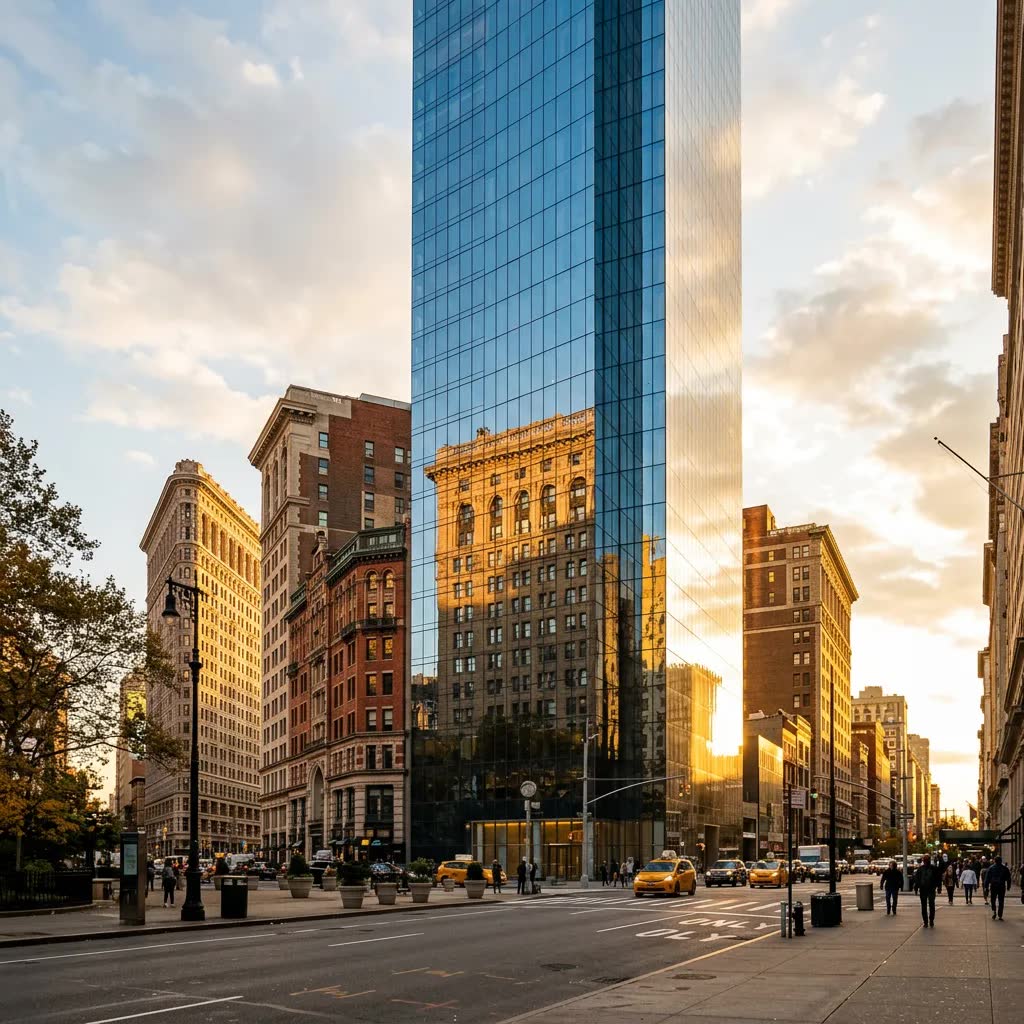
NEW YORK — A slender residential tower nearing completion a few blocks from the Flatiron District has done what few new buildings manage: it has made people stop on the sidewalk and argue. Its facade — a taut, mirrored skin of blue-tinted glass — reflects the ornate masonry of its older neighbors, and depending on whom you ask, that reflection is either an elegant tribute or an act of quiet vandalism. The debate has spilled from architecture blogs onto community-board agendas and back again.
Defenders of the tower, including its design firm, argue that its reflective surface is a deliberate gesture of deference, mirroring the district's beloved terra-cotta and limestone rather than competing with it. "The building disappears into its context by reflecting it," a spokesperson for the developer said. "On a clear afternoon, what you see in that glass is the neighborhood, not the tower." Supporters add that the surrounding blocks have always absorbed new styles, and that today's controversial addition often becomes tomorrow's cherished landmark.
Critics are unpersuaded. Several architectural historians and neighborhood preservationists contend that a mirror is not the same as a contribution, and that the tower's height and sheen overwhelm the intimate, human-scaled streetscape that gives the district its character. "Reflecting a beautiful building is not the same as being a beautiful building," one critic wrote in a widely shared essay. "It's a way of taking credit for someone else's work while adding nothing of your own."
The dispute has revived a broader civic conversation about the wave of glass towers that has reshaped Manhattan's skyline over the past two decades, and whether the city's review processes adequately weigh how new construction meets the ground and relates to what surrounds it. At a recent community-board session, residents lined up on both sides, some praising the tower's craftsmanship and others warning that a district known for its distinctive silhouette risked being flattened into anonymity, one reflective slab at a time.
City planning officials, for their part, have largely stayed out of the aesthetic fray, noting that the project cleared its required reviews and complies with zoning. But the intensity of the reaction has not gone unnoticed. Several planning advocates argue that the episode illustrates the limits of a regulatory framework that scrutinizes bulk and shadows but leaves questions of beauty and context almost entirely to the market and the eye of the beholder.
For now, the tower continues to rise, its upper floors catching the late-day sun and throwing it back across the district in sheets of blue light. On a recent evening a small knot of pedestrians paused at the corner to watch the sunset ricochet off the glass. "I hate it," one said cheerfully to a companion, without taking her eyes off it. "But I keep looking at it." Her companion nodded. "That," he said, "is the whole problem."