Fulton Fish Market’s Cold Chain Goes Digital to Cut Waste and Boost Profits
A new IoT tracking system monitors temperature and location across shipments serving the NYC metro area.
By Noah Fitzgerald · March 17, 2026 · 4 min read
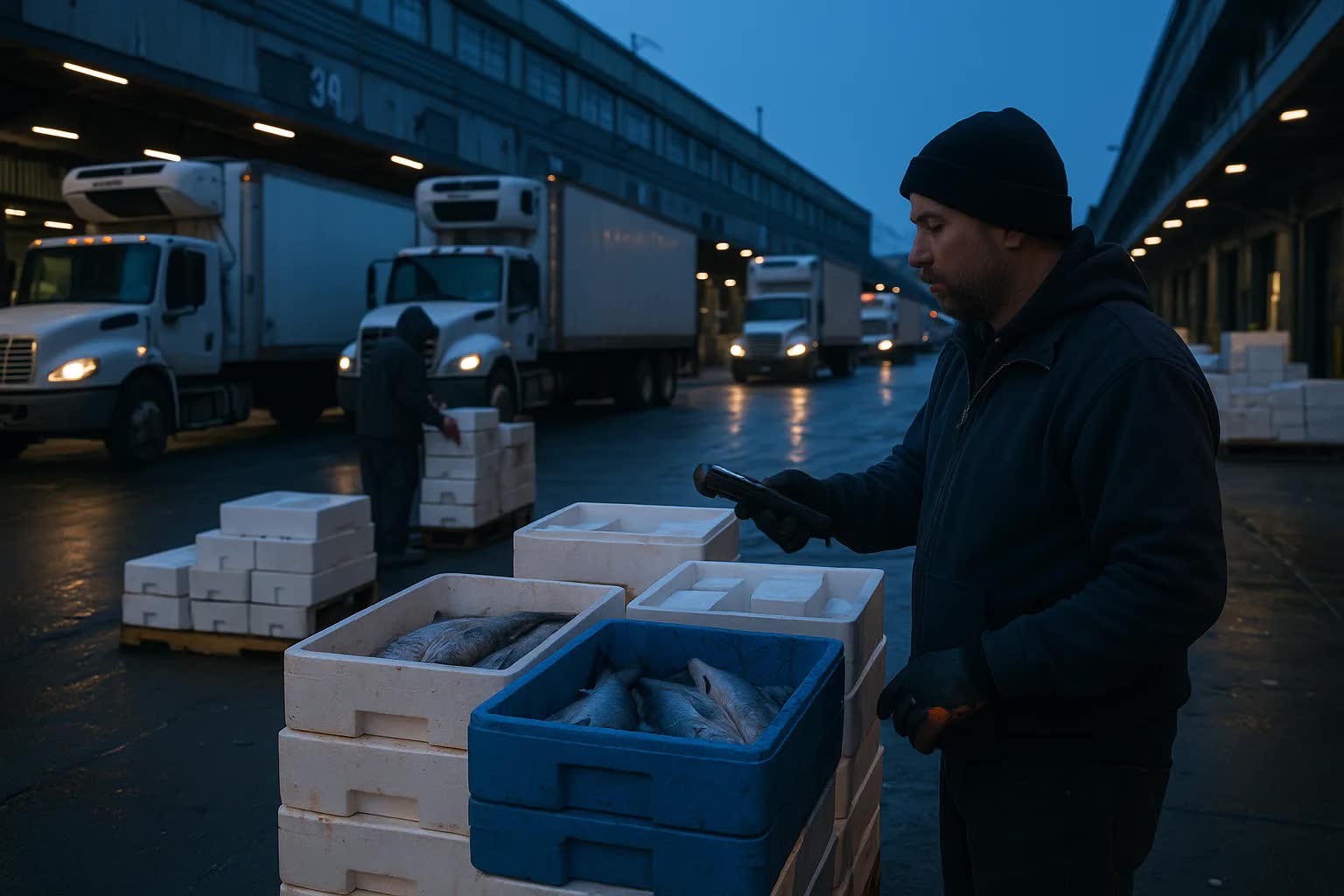
NEW YORK — Trucks from the old Fulton Fish Market cut through the Bronx morning fog near the Bruckner Expressway before dawn on a recent Tuesday, but the boxes inside are no longer anonymous. A new internet-of-things tracking system installed across the market’s cold chain now monitors temperature, humidity, door openings and GPS location in real time as shipments fan out from Hunts Point to Chelsea Market, Red Hook and dozens of restaurants across Manhattan, Brooklyn and Queens, officials say — a digital retrofit intended to curb spoilage, speed deliveries and fatten thin margins for fishmongers who long operated on gut instinct and hand-scribbled manifests.
For more than a century the Fulton Fish Market was synonymous with Fulton Street and the clamorous auctions of lower Manhattan; today the marketplace’s wholesale sheds are anchored in Hunts Point, where a tangle of wholesalers, refrigerated trucks and local docks manage millions of pounds of seafood each year. That density is both an asset and a liability: short shelf lives and frequent transit delays have historically cost sellers in the market time and product, while razor-thin wholesale prices mean even small losses reverberate across kitchens from the East Village to Astoria.
The system, developed by a New Jersey startup called ColdChain Labs in partnership with Fulton Fish Market Logistics, bolts low-energy sensors to pallets and retrofits refrigerated trailers with cellular and LoRaWAN gateways, feeding a cloud dashboard accessible by brokers, stores and customers. “We used to chase returns and guess what happened,” said María Castillo, chief operating officer at Fulton Fish Market Logistics. “Now we can pinpoint the two-minute window when a trailer door was ajar outside a restaurant on Seventh Avenue, and we can decide in real time whether that box goes to sale or back to processing.”
The technology stack combines temperature probes rated to ±0.5 degrees Celsius, geofencing rules that flag unscheduled stops and a blockchained provenance ledger that timestamps custody transfers from boat to dock to truck to buyer. Restaurants can opt into push notifications; fish retailers receive tamper-evident reports before signing receipts. Delivery drivers use a lightweight app on factory-fit tablets that pairs with each trailer’s gateway, so a driver pulling into Red Hook’s Atlantic Basin or the Chelsea Produce Terminal can verify product history before unlocking a trailer.
The program’s early metrics suggest measurable gains. Since the full rollout in January the network has deployed 3,200 pallet sensors and retrofitted 420 refrigerated trucks serving 68 wholesale stalls and 275 downstream accounts; average in-transit temperature excursions have fallen by 38 percent, spoilage events reported to logistics managers have dropped from roughly 1.8 percent of shipments to 0.9 percent, and Fulton Fish Market Logistics projects first-year savings of $4.2 million from reduced waste and fewer customer refunds. The pilot also cut CO2 emissions per delivered pound by an estimated 7 percent by enabling tighter route consolidation.
Drivers and dock workers report immediate, practical changes. “When you get an alert that a pallet sat over 12 minutes on a rickety dock in Gowanus because the elevator was stuck, you can react,” said Eddie Ramos, operations supervisor for a fleet of refrigerated trucks based on Bruckner Boulevard. “It’s not about Big Brother; it’s about not losing a whole day’s worth of product because of one bad hand-off.” Those on the docks say the digital receipts have reduced arguments over timing and condition during off-hours drops in neighborhoods such as Sunset Park and the Lower East Side.
Still, the rollout has encountered friction. Urban cellular dead spots, heavy congestion on the West Side highway and the patchwork of small vendors at seasonal markets complicate consistent telemetry. Small stallholders in the market who buy in single pallets have balked at per-sensor fees, and some restaurateurs in older brownstones near Washington Square have reported occasional false positives from door-sensor triggers when uninsulated alleyways produce rapid temperature swings. ColdChain Labs says firmware updates and a tiered pricing model for small buyers should ease those pains by summer.
The initiative is also reshaping relationships among city agencies and private market operators. Fulton Fish Market Logistics worked with the Hunts Point Cooperative Market and a pilot group of 14 restaurateurs in Greenwich Village and the East Village to calibrate alert thresholds and delivery windows; one chef, Asha Patel of Sea & Salt on Bleecker Street, said the system eliminated a consistent late-morning return of oysters that used to force menu changes. “We used to lose the best hours of service to missing product,” Patel said. “Having that certainty has saved our kitchen time and our bottom line.”
Privacy and regulatory questions remain on the table. Health inspectors and the city’s Department of Food Safety have begun reviewing access protocols for the provenance ledger, and some vendors worry that granular route data could be used to undercut prices or expose small businesses’ customers. “We support transparency that prevents waste, but we also need guardrails so data isn’t weaponized against the little guys who make Hunts Point run,” said Leila Morgan, director of the Hunts Point Cooperative Market. Legal teams are drafting standardized data-sharing agreements that limit historical GPS access to verified compliance audits and explicitly prohibit resale of route data.
Looking ahead, market officials and providers say the next stage will unite predictive analytics with broader regional logistics: algorithms that predict product deterioration and automatically reroute trucks to the nearest refrigerated dock, contractual experiments tying sensor performance to insurance premiums, and pilots that integrate portside holds in New Jersey and Long Island City with Hunts Point’s network. “This is the beginning of moving an analog food system into a resilient digital era,” Castillo said. “If we can cut waste and lift margins here at Fulton, the model scales — to other perishable supply chains and to a city dependent on fresh food.”