Gowanus Greenway Inspires Site-Specific Performance Projects
Choreographers and theater makers are using the canal's fringe as both backdrop and participant in experimental outdoor shows.
By Tarek Mahmoud · December 20, 2025 · 5 min read
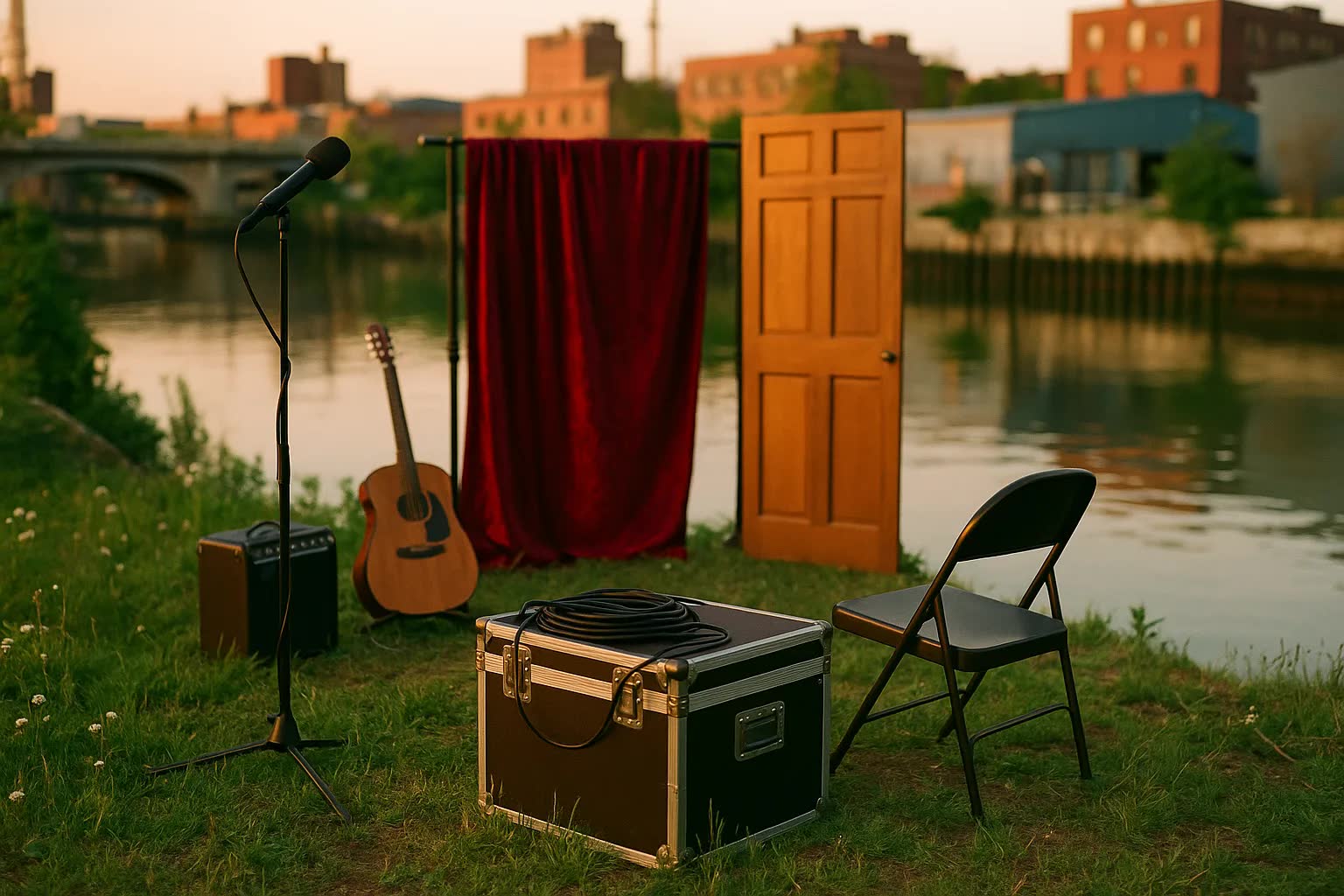
On a gray December evening the narrow strip of asphalt that runs along the Gowanus Canal, from the Carroll Street Bridge down past Hamilton Avenue toward Red Hook, became for an hour both stage and audience aisle as clusters of New Yorkers — residents, artists and curious passersby — followed dancers and actors who moved along the canal’s fringe, up stoops and across temporary platforms bolted to the bulkhead, transforming a part of Brooklyn long defined by industry and odor into a place of live, improvisational theater.
The recent wave of performances, collectively described by organizers as the Gowanus Greenway series, has pushed choreographers and theater makers to treat the canal not merely as a scenic backdrop but as an active element in their work: a resonant surface whose reflections, smells and periodic lapping determine sightlines, timing and movement. Smaller companies like CanalWorks Collective have staged site-specific dances that start on the steps of brownstones in Carroll Gardens and end on floating rafts tethered near the Third Street bridge, while the Smokestack Theater Company has transformed the cavernous ground floor of a converted dye factory on Smith Street into a scaffolded amphitheater whose metal beams are integral to the show’s aerial choreography.
“We build with the canal’s material conditions in mind — tides, smells, even the creak of the bridges,” said Marisol Reyes, artistic director of CanalWorks Collective, whose piece Tide/Turn ran for three nights in November. “The water answers back. You can’t pretend you’re in a proscenium house; you have to listen, and then choreograph with what listens to you.” Reyes said coordinating with multiple city agencies and neighborhood groups was essential, from securing permits to arranging portable lighting that would minimize glare into nearby brownstones.
Not everyone has greeted the pop-ups with unalloyed enthusiasm. Shopkeepers on Smith Street and residents of the over-120-year-old rowhouses in Carroll Gardens said the shows have at times complicated foot traffic and deliveries, while others praised the new attention on a stretch of Brooklyn that has been home to warehouses, auto shops and a long-running public conversation about environmental cleanup. “It’s a thrill to see artists reimagine where we live,” said Evan Cho, president of the Gowanus Block Association, who lives near Union Street. “At the same time, we want to make sure the work doesn’t crowd out regular life or ignore the canal’s ongoing remediation.”
Organizers say the numbers point to a modest but growing phenomenon: between April and November of 2025, 18 separate site-specific events took place along or immediately adjacent to the Gowanus Canal, attracting an estimated 12,600 attendees overall; average event budgets ran between $3,200 and $14,000, with one large-scale production accounting for a $58,000 line item for construction, safety marshals and barge rental. The Brooklyn Arts Fund and three neighborhood foundations distributed roughly $92,400 in combined microgrants to local projects this year, and city agencies issued 27 temporary use permits related to performance, lighting and waterfront access from May through October.
The practical realities of the canal have informed the aesthetics. Artists and crews contend with periodic flooding, pockets of methane discovered during staging, and a pungent odor that intensifies on still nights — conditions that can force last-minute reroutes and that require coordination with public safety officials. “We design contingencies into every cue,” said Anika Bose, a choreographer whose piece Bulkhead Ballet used life vests and rope work to incorporate the edge of the water. “If a tide comes up, the show adapts. That adaptability has made the choreography different, maybe braver.” The performances also worked with representatives from the local NYPD precinct and the borough’s ferry and maritime units to ensure safe passage for audiences that at times crossed floating walkways.
Artistically, the Gowanus ventures have produced a vocabulary of gestures, props and staging strategies unique to the canal. Rafael Mendes, whose bilingual song cycle Canal Cantos used rowers from a Red Hook crew as chorus, employed boathouse doors and steel pilings as percussion instruments. Pop-up installations took over storefront windows on Third Street and a former mechanic’s garage on Hamilton Avenue, with projection-mapped backdrops that played on the canal’s history of industry and immigrant labor. “There’s a danger of romanticizing a compromised landscape,” Mendes said. “But these are honest conversations with place; the show is better for the friction.”
Funding and institutional backing have been pragmatic rather than glorious: a handful of projects were underwritten by small grants from the Brooklyn Arts Fund and the newly established Canal Fringe Initiative, with box-office returns covering roughly 42 percent of production costs on average. Several collaborations involved local colleges and art schools providing technical crews and rehearsal space; one production was able to reduce costs by 18 percent through an in-kind partnership with a scaffolding company based in Gowanus. Organizers say continued fiscal support will be essential if the seasonal series is to scale without overburdening neighborhood infrastructure.
There are persistent tensions to manage: artists want access to the canal’s most evocative edges while residents and environmental advocates press for responsible interaction with a body of water still undergoing remediation and subject to storm surge risks. Neighborhood groups and arts producers have begun monthly steering meetings at a community center on Hoyt Street to draft guidelines on staging, rubbish removal and noise. “Our aim is to make these performances a fixture that respects the community’s needs,” said Tomas Linden, director of the Brooklyn Institute of Urban Culture, noting that theater has long been part of Brooklyn’s waterfront reinventions. “We’re figuring out how to be neighbors and collaborators at once.”
Organizers say the coming season will expand the experiment, with plans for a spring series that will include a daytime children’s procession along the Greenway, a winter-spring residency for a mid-size ensemble, and a pilot program to commission durable public art that can act as both safety infrastructure and permanent stage. If the rehearsals and negotiations of 2025 are any measure, the Gowanus Greenway will continue to be a laboratory where artists, residents and city agencies write the next chapters of Brooklyn’s waterfront together.