How an East New York Startup Is Teaching AI to Read Handwritten Court Records
A Brooklyn lab is building models to digitize decades of municipal case files and free up legal aid resources.
By Leo Wang · December 31, 2025 · 4 min read
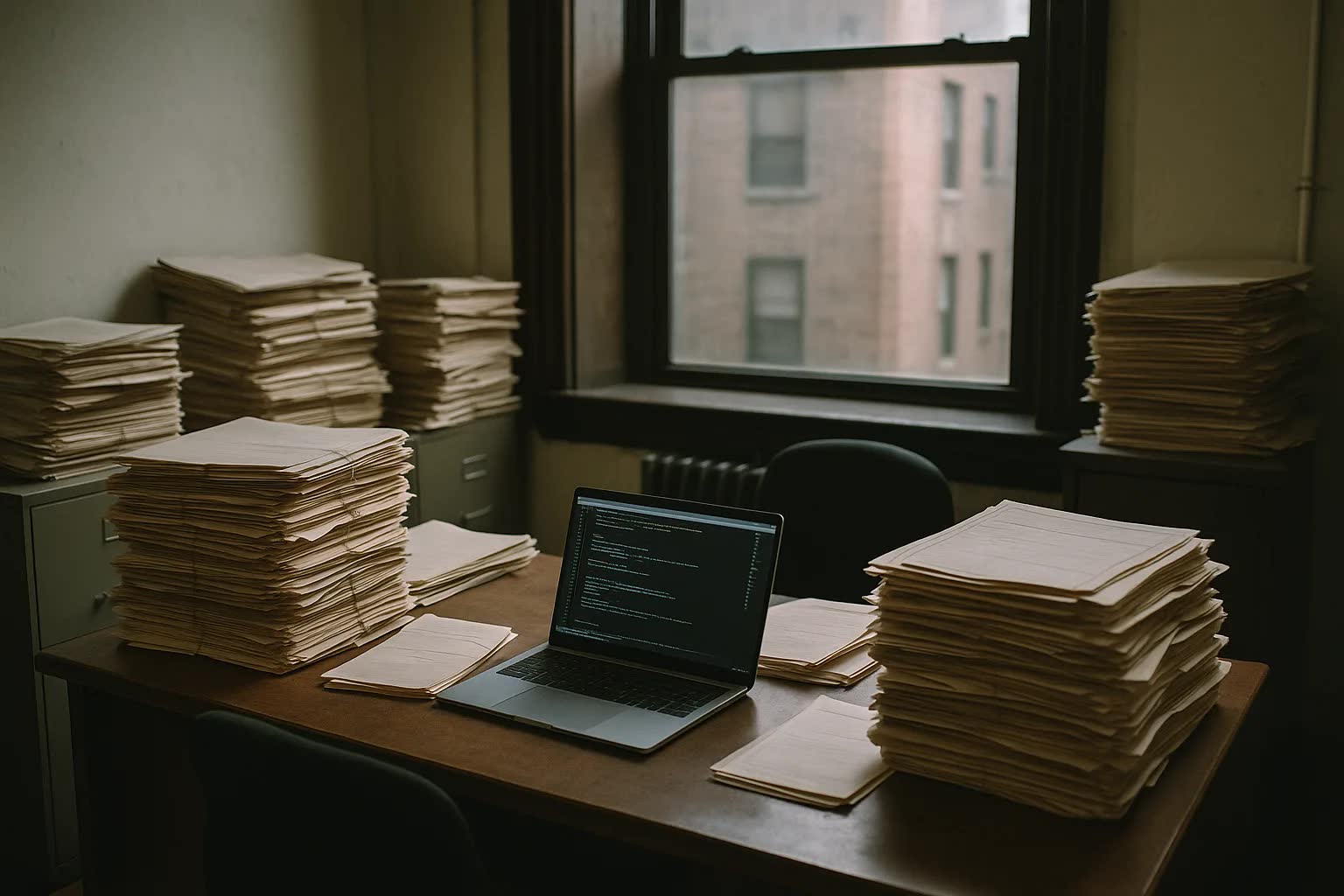
NEW YORK — In a converted textile loft three blocks from Broadway Junction in East New York, a scrappy team of engineers and paralegals is teaching artificial intelligence to read the messy handwriting in decades of municipal court records, with the aim of turning paper piles that have clogged Brooklyn’s courthouse clerks into searchable digital files and freeing legal aid attorneys to handle client work instead of chasing files down in basements and storage facilities.
The problem is both local and mundane: many of the city’s eviction, small-claims and misdemeanor case files were filled out by hand on standardized forms or scrawled on legal pads between the 1970s and the early 2000s, long before municipal systems were born digital. Those files, stored in warehouses near the Brooklyn Navy Yard and old records rooms by the Kings County courthouses, are often unreadable to off-the-shelf optical character recognition systems but critical for lawyers trying to build a defense or verify past proceedings.
The lab, doing business as EastLine Labs, was founded in 2023 by Maya Ortiz, a former civil-service data analyst who grew up in Cypress Hills. The company has stacked its open floor plan with scanners, worktables and monitors where local residents transcribe samples to train models. "We are not automating people out of jobs," Ortiz said. "We are automating the repetitive noise so trained attorneys and advocates can focus on the human work of representing clients." The tone in the lab blends do-good mission with a product focus: they want usable tools that meet the schedules of overburdened public defenders and legal aid offices.
Technically, EastLine Labs blends classic OCR with modern handwriting-recognition neural networks and a human-in-the-loop workflow that flags uncertain reads for review. The team has built layout-analysis modules to separate stamps and marginalia from the core text, named-entity extractors tuned to legal vocabulary, and Spanish-English models to reflect Brooklyn’s multilingual court population. Their pipeline creates both machine-readable metadata and image-backed transcripts to preserve chain-of-custody for evidentiary use.
So far the numbers suggest real progress: EastLine Labs says its pilot ingest has covered roughly 1.2 million pages across 42,000 case files from municipal dockets, and that its end-to-end system yields a 96% verified character-level accuracy after human review, up from a 78% baseline for raw OCR. The company reports an average search time reduction from an estimated 14 business days to under 8 hours for locating relevant documents in a case, and it lists a staff of 34 full-time annotators and 12 engineers supported by $6.3 million in seed funding and municipal grants.
Those pilots have already reshaped day-to-day practice for some neighborhood agencies. Harbor Bay Legal Aid, a nonprofit office headquartered on Atlantic Avenue in Crown Heights that handles eviction defenses for Brooklyn residents, participated in a three-month trial. "Before this, our attorneys spent days trying to verify court dates and prior judgments; now they pull a transcript in under an hour and get back to clients," said Evan Price, supervising attorney at Harbor Bay Legal Aid. He added that the faster access to records has already helped reopen several stalled housing cases.
Advocates and technologists say the equity implications are immediate. With searchable case histories, legal teams can more easily identify patterns of procedural error, duplicative filings and improper default judgments in neighborhoods such as Brownsville and East Flatbush, where landlording disputes and tenant displacement are common. EastLine Labs also runs weekend clinics at a community center on Pitkin Avenue where annotators get paid training and residents receive basic digital-privacy counseling, a program Ortiz describes as "workforce development tied to justice outcomes."
Still, the work raises thorny questions about privacy, bias and gatekeeping of public records. EastLine has constructed a two-layer security model in which sensitive fields are auto-redacted before analyst review and encrypted while in transit, and it requires data-use agreements with municipal partners that limit downstream commercial reuse. "We do not outsource judgment to a model," said Dr. Lena Cho, chief ethics officer at EastLine Labs. "Every high-impact extraction is routed for human review, and we maintain detailed audit trails so any correction is reversible and accountable."
EastLine Labs is also experimenting with a sustainable business model that blends municipal contracts, subscription services for larger legal clinics and grants from local foundations. The founders say their pricing is deliberately tiered so city agencies and nonprofits pay less, while private law firms and commercial clients pay market rates. Plans under discussion include a partnership with a nearby law school clinic for supervised student annotation work and a scaling roadmap to replicate the approach in Queens, where municipal record keeping presents similar backlogs.
If EastLine Labs’ pilots continue to meet their accuracy and adoption goals, the company plans a borough-wide rollout beginning in mid-2026 with aims to onboard additional clerks’ offices and expand its annotator workforce in East New York and neighboring Brownsville. For residents who have long found access to justice slowed by paper and bureaucracy, a small lab on a gritty block near Broadway Junction offers a telltale lesson of the digital age: better tools can mean faster relief, but only if technology is paired with local labor, legal expertise and explicit safeguards for privacy and fairness.