Hudson Valley Factory Uses Robots to Assemble Modular Housing for NYC Shelters
A pilot plant is marrying automation and prefab techniques to speed delivery of climate-resilient units to the city's toughest housing needs.
By Leo Wang · April 29, 2026 · 4 min read
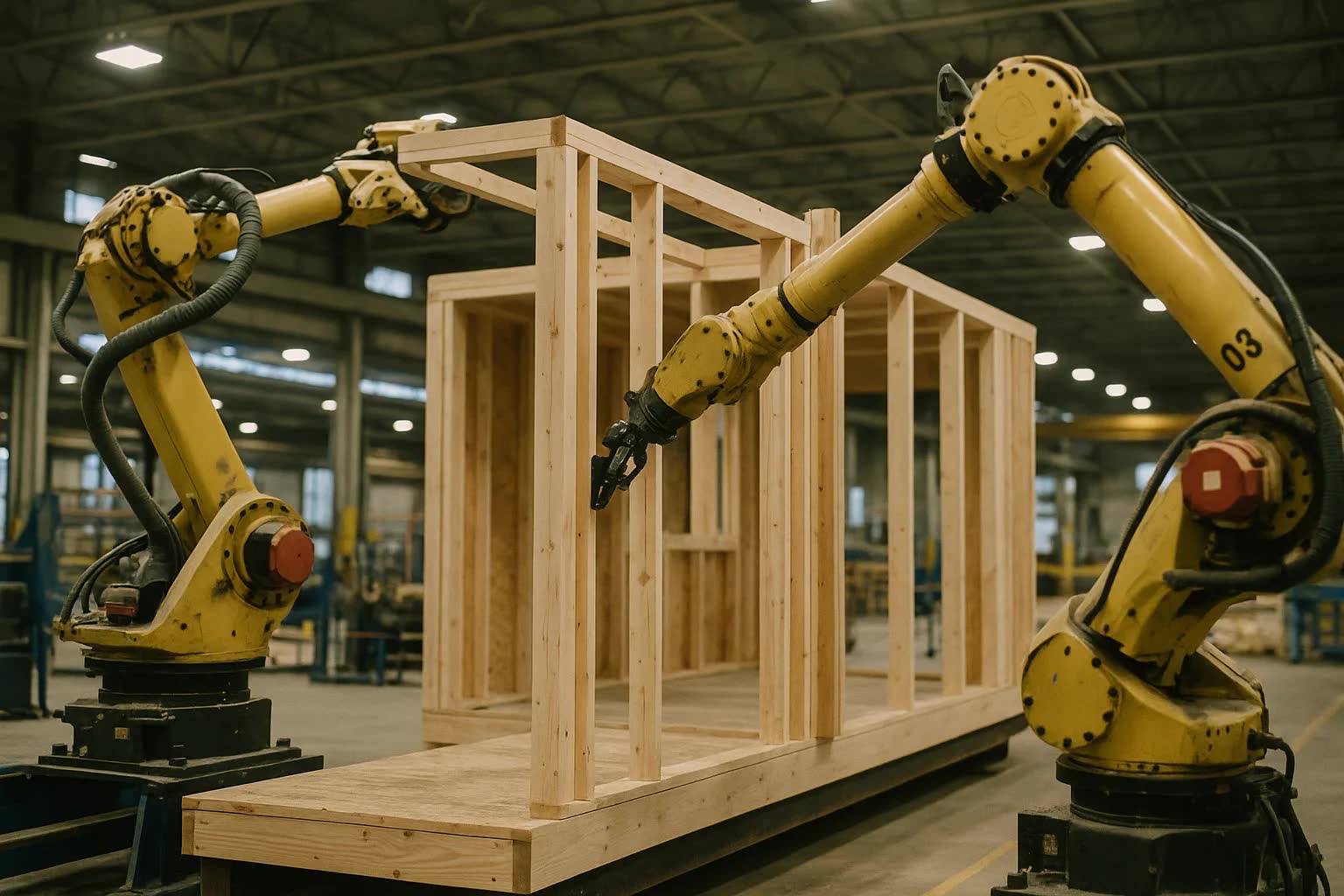
NEW YORK — A pilot plant in Beacon, in the lower Hudson Valley, is using industrial robots and prefab techniques to churn out climate-resilient modular units that city officials say could be delivered faster and more cheaply to New York City shelters than traditional construction, easing pressure on neighborhoods from East Harlem to Red Hook that are absorbing the city's toughest housing needs.
The facility, owned by ForgeMod Systems, sits on a former manufacturing corridor a few blocks from the Beacon Metro-North station and resembles an assembly line more commonly seen in automotive plants: articulated robotic arms bolted to the floor install structural frames, computer-controlled saws cut precision panels, and autonomous guided vehicles ferry completed pod interiors to loading docks bound for New York City.
“We designed this plant to be a bridge between engineering precision and social purpose,” said Elena Cortez, chief executive officer of ForgeMod Systems. “By using robots for repetitive framing and installation tasks, we can reduce waste and make each unit more consistent, which matters when you're building for vulnerable families who need safe, resilient housing quickly.”
ForgeMod's units are engineered to withstand coastal flooding and intense heat events, two climate risks that frequently test city shelters. Each volumetric module is mounted on a galvanized steel chassis, fitted with continuous insulation, upgraded HVAC with heat-recovery ventilators, rooftop photovoltaic arrays and rainwater diversion detailing to meet elevated flood-elevation standards. Interiors are pre-wired for security and medical monitoring systems so shelters in neighborhoods such as Chelsea, Hunts Point and Coney Island can accept move-in-ready units.
The pilot plant is producing measurable gains on speed and cost that the company and its city partners highlight. ForgeMod reports it can finish a 320-square-foot one-bedroom module in 10 workdays from the time raw panels enter the factory; the pilot output is currently 24 modules per month with a target of 150 per month after a planned equipment and workforce ramp-up later this year. The company says its modules reduce on-site construction time by roughly 35 percent and embodied carbon by about 30 percent compared with conventional site-built units. Initial contract work for the city is pegged at $10 million for the pilot phase; ForgeMod says the fully finished, turnkey shelter module averages $145,000 each.
“The robots don't replace people — they change the work,” said Thomas Alvarez, plant manager at the Beacon facility, who had previously supervised a carpentry shop in Poughkeepsie. “We still need skilled technicians to program, run and oversee the machines, and to do the finishing work that requires human judgment. But the repeatability of the automated systems cuts down rework and on-site surprises that delay shelter projects on narrow city sites.”
Logistics are a key part of the operation: completed units are loaded onto flatbeds and, for sites with waterfront access, dispatched by barge to minimize truck traffic on narrow Manhattan and Brooklyn streets. ForgeMod has coordinated deliveries to the 65th Street Marine Terminal and a temporary staging lot near the Brooklyn Navy Yard for assembly north of the city, and has reserved laydown lots in the South Bronx for rapid installation of family shelters in Hunts Point and nearby neighborhoods.
The pilot is financed through a blend of public and private money. ForgeMod closed a $8.5 million seed round from regional venture firms in late 2025 and secured a $10 million pilot contract with the city’s shelter innovation unit, according to company documents. The project also includes a $1.2 million grant from a local foundation supporting climate-resilient affordable housing, and ForgeMod estimates the factory created 120 direct jobs in Dutchess County during its first six months of operation.
Community reactions in New York have been mixed: some advocates praise the speed and quality control, while neighborhood groups raise questions about siting and long-term operations. “We need homes that last, not temporary fixes slapped together,” said Asha Patel, executive director of Shelter Watch Manhattan, a nonprofit that monitors shelter placements. “If these units can truly lower carbon footprints and be deployed quickly without displacing residents, that's a win — but the city must be transparent about where units will go and how they're maintained.”
ForgeMod executives and city officials say the Beacon pilot is a first step in what could become a broader, regional network of automated factories supplying the city and surrounding counties. The company plans to begin a phased scale-up in October with the aim of producing 1,800 modules a year by mid-2027, and it is in talks with community colleges and unions to develop retraining programs for the thousand-plus workers it expects to employ nationwide. If successful, the experiment could recalibrate how New York approaches emergency housing and climate resilience in the decade ahead.