Jackson Heights Festival Turns Family Stories Into Street Art
Residents are contributing recipes, memories and neighborhood sounds to a weekend arts program designed to preserve the many histories carried through a few Queens blocks.
By Sofia Alvarez · August 24, 2026 · 5 min read
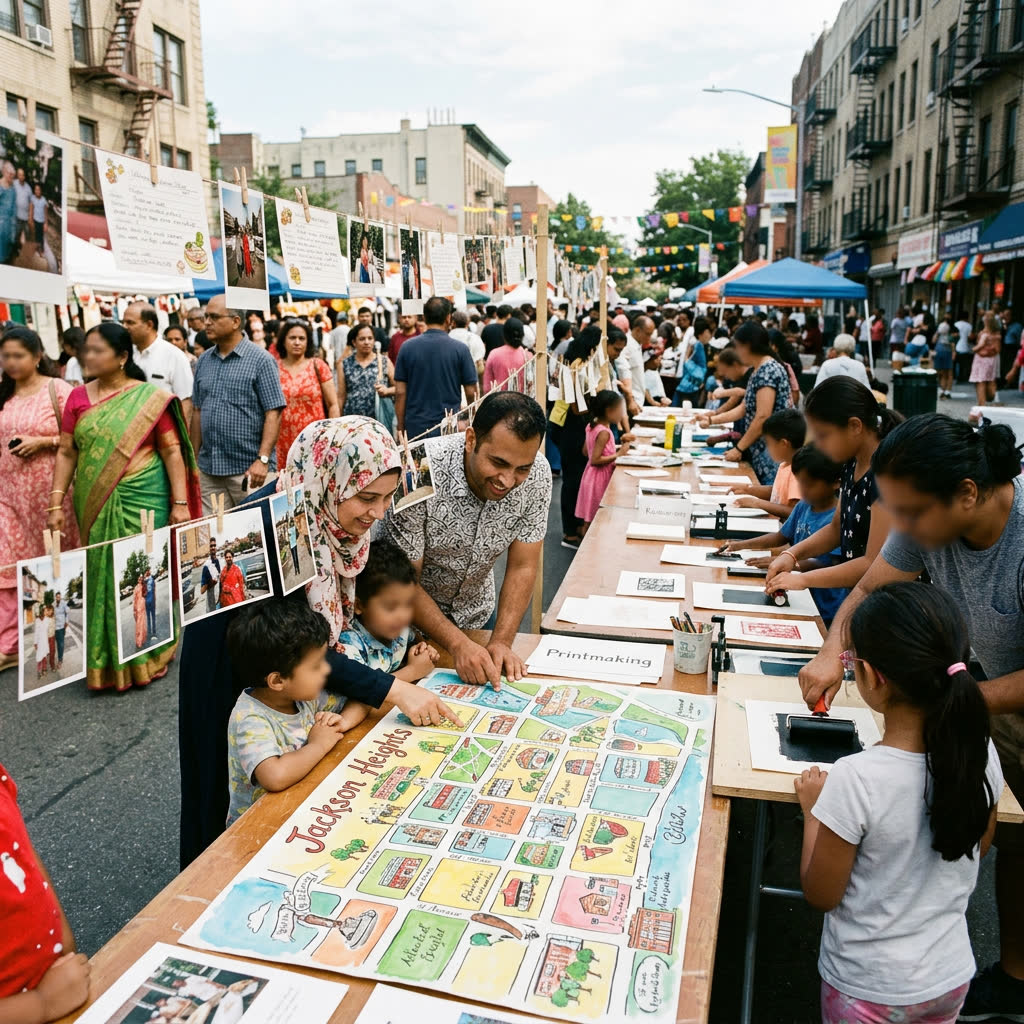
NEW YORK — On a folding table outside a community arts room in Jackson Heights, residents have been leaving copies of handwritten recipes, snapshots of first apartments and short accounts of journeys to Queens. This weekend, those contributions will become part of "Routes and Roots," a free neighborhood festival built around the idea that ordinary family records can form a public archive.
The two-day program will spread across a closed side street and three indoor spaces near 37th Avenue. Organizers from the Queens Mosaic Collective expect printmaking tables, small music ensembles, storytelling circles and a temporary outdoor gallery made from weatherproof reproductions of material gathered since May.
At the center of the project is a map stretching nearly 30 feet. Participants can connect the place where a family story began with a location in Jackson Heights, then add a note about a food, phrase, song or habit carried along the way. Project coordinator Reena Das said the lines overlap so densely around several blocks that the map has started to resemble woven fabric.
The festival's oral-history booth will offer interviews in multiple languages with help from trained neighborhood volunteers. Contributors can choose whether recordings remain private, enter a local research archive or appear in edited listening stations during future programs. Das said those options were important for residents who wanted to document a memory without placing it immediately before a public audience.
Children have shaped a separate section called "The Block We Notice." Over the summer, teaching artists asked young participants to draw details adults often pass by, including a particular fire escape, the pattern of sidewalk fruit crates and pigeons gathering above a bakery vent. The drawings will hang at child height along a temporary fence during the festival.
Local artists were paid to transform selected stories into original work rather than simply decorate the event, organizers said. Ceramicist Omar Vega made a series of small tiles based on kitchen-table patterns described by residents, while sound artist Celia Park assembled crosswalk signals, snippets of conversation and rolling cart wheels into a six-minute neighborhood composition.
Businesses along the route are taking part by displaying reproductions in their windows and hosting brief demonstrations. Organizers asked vendors not to use national flags as the sole marker of identity, encouraging them instead to highlight a personal object, craft or local memory. The approach is intended to show cultures as lived experiences that change over time, not fixed categories.
The collective plans to keep the project active after the street tents come down. A rotating version of the map and listening stations will visit neighborhood schools and senior centers this fall, and digital copies of approved contributions will be cataloged by theme. "A festival lasts a weekend, but a neighbor's story should not disappear on Monday," Das said.