Late-Night Subway DJs Turn Rides into Improvised Clubs
A network of musicians and sound engineers are staging pop-up sets on overnight MTA trains, sparking new debates over public-space performance and transit rules.
By Marcus Thompson · March 17, 2026 · 5 min read
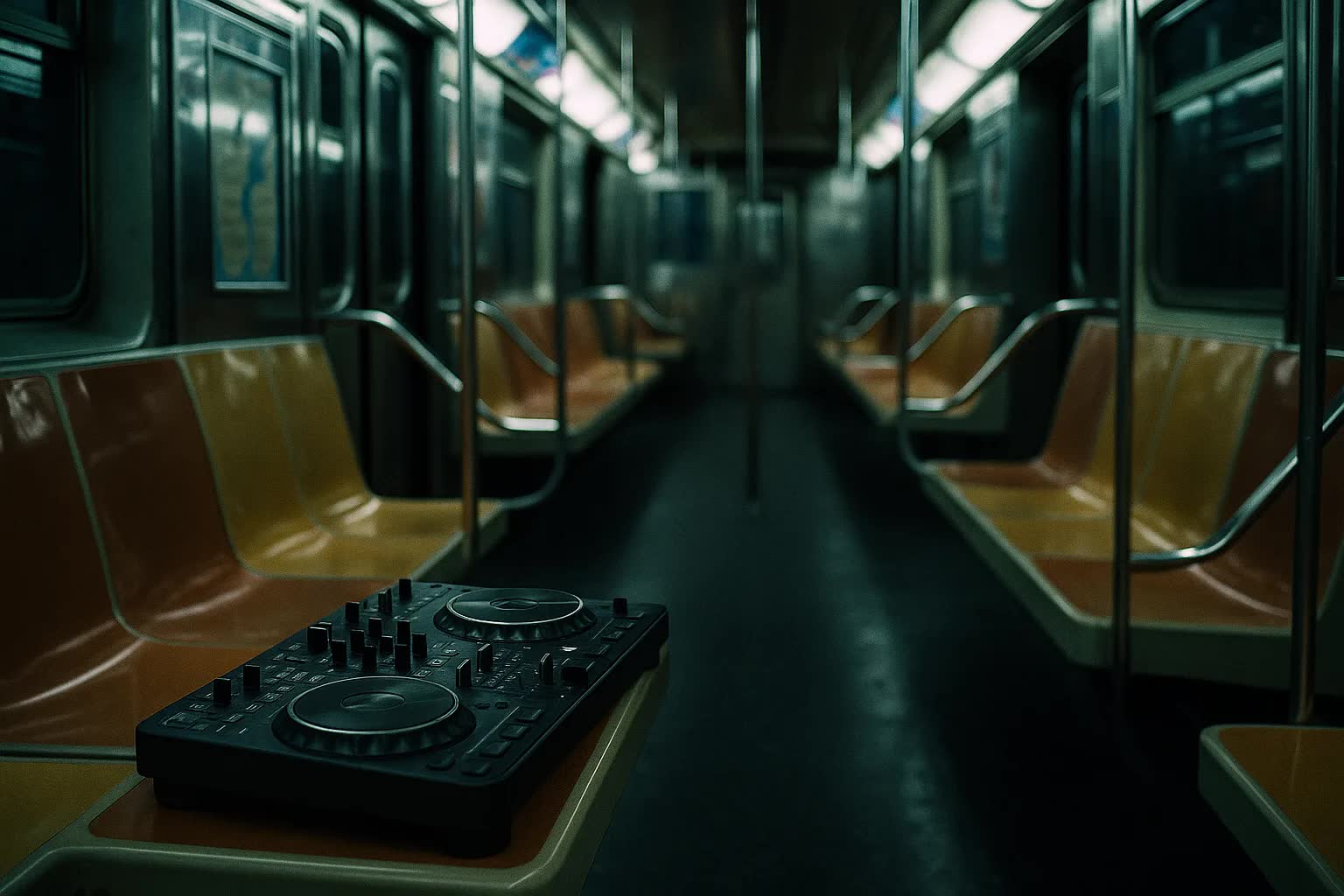
NEW YORK — On any given weeknight between midnight and 4 a.m., riders on parts of Manhattan's L, A and C lines are finding themselves inside makeshift nightclubs: a belt of speakers, a battery-powered mixer and a ring of shoulder-to-shoulder dancers materializing in a single subway car as the train slices past Union Square, Delancey Street and 14th Street-Union Square. The phenomenon has grown into a loosely organized network of DJs and sound engineers who stage pop-up performances on overnight MTA rides, turning commutes into improvised concerts and forcing new conversations about public space, transit safety and the role of art in the city that never sleeps.
The group at the center of the movement calls itself Midnight Rails Collective, a loosely affiliated mix of producers, audio technicians and former club promoters who use encrypted messaging apps to coordinate time slots and meeting points. They emphasize that the intention is not to disrupt, organizers say, but to create a transient, consensual performance that capitalizes on the peculiar intimacy of an otherwise empty late-night car. Their sets last roughly 15 to 30 minutes, conclude before camera-phone attention becomes unbearable, and migrate through neighborhoods from Williamsburg to the West Village to Sunset Park in Brooklyn.
"We think of it as a civic experiment more than guerrilla nightlife," said Luis Ortega, co-founder of Midnight Rails Collective and a former sound engineer at clubs in Bushwick. "Late-night trains are underused canvases. If you can make a 2 a.m. ride feel like a shared moment — with rules that respect other riders — that's valuable for a city that often privatizes its culture into expensive spaces." Ortega said the collective posts precise instructions only to confirmed members and trains its volunteers on de-escalation and clean-up so cars are left as they were found.
The setup is modest but deliberate: engineers bring compact subwoofers that fit under a seat, battery packs that comply with transit rules on portable chargers, and modular mixers small enough to be tucked away when the doors open. Performances often center on particular routes chosen for straight stretches and lower ridership — the A train’s run through Chelsea and the L line through Bedford Avenue and First Avenue are popular for the little hum of motion without frequent stops. Local club bookers from the Lower East Side and Greenpoint have begun scouting talent at these rides; one DJ who got a Saturday night residency at a Chelsea venue says the subway gigs functioned as a mobile audition.
An informal tally maintained by a transit-focused arts nonprofit shows 142 pop-up sets between Jan. 1 and March 1 across Manhattan and Brooklyn lines, with an estimated combined ridership of 9,372 people and an average audience of 66 per set; 64 percent of the performances took place on the L and A lines, while 12 percent occurred on late‑night shuttle runs into Queens. The tally also records 21 formal complaints lodged with the MTA during that period, three citations issued for amplified sound without permits and two incidents that required Transit Enforcement intervention; the collective says it has kept a parallel log and disputes the severity of those incidents.
City and transit officials say they are watching the trend with a mix of curiosity and caution. "We support public art, but we have to balance that with safety, accessibility and the rider experience," said Daphne Chen, an MTA liaison for public arts programs. Chen said the authority has been in contact with organizers and is exploring a pilot that would allow limited, permitted performances on designated late-night runs. "A formal framework could preserve the spontaneity artists value while ensuring trains remain safe and accessible for everyone," she said.
Not everyone riding the rails sees it that way. "I was heading home from my shift in Gowanus when a car turned into a full-on party at Canal Street," said Monique Harris, a 29-year-old barista. "At first it was fun — then a couple of older folks got up and moved because it felt exclusionary. I get the vibe, but there's a point where public transit isn't a nightclub." Nearby businesses in Chelsea and the East Village have reported mixed results; Marco Pellegrini, owner of a 24-hour diner near 14th Street, said some of his late patrons come in after a set, but others avoid the area on certain nights.
The legal landscape is murky. MTA rules prohibit unamplified and amplified performances without a permit in certain areas of the system, and police can issue summonses for nuisance or disorderly conduct, but enforcement resources are limited overnight and officers often prioritize crimes with higher immediate risk. A senior MTA planner who requested anonymity told NYDailyWatch that the agency lacks both a concise policy tailored for transient pop-ups and the staff to regulate them consistently without a new program or clearer written guidance.
Artists and advocates argue that the late-night sets fill a void in New York's nightlife ecosystem as clubs shrink and rents rise in neighborhoods like Williamsburg, the Lower East Side and Astoria. For some DJs, the subway offers a way to reach a cross-section of the city outside the selfie-flooded late-night bar scene: dancers in work boots from Sunset Park, music students from Manhattan, and nurses finishing shifts at NYU Langone. Video clips shared on social apps have amplified the phenomenon — one March clip of a set weaving through an L train car has amassed more than 240,000 views on a popular video-sharing site — prompting both invitations from small venues and renewed scrutiny from transit authorities.
The debate now hinges on whether the city will codify a middle path. The MTA has convened a working group that includes arts liaisons, transit police and rider representatives to draft a pilot permitting process that could run this fall on select overnight services. Midnight Rails Collective says it will submit a formal proposal and is open to training, permits and a schedule that limits disruptions. For organizers and riders who have discovered an unlikely stage in the belly of the transit system, the question is whether the rambunctious, ephemeral spirit that makes the sets compelling can survive being regulated — or if a regulated pilot might open the rails to a more sustainable late-night cultural life.