Long Island Towns Race to Bring Fiber to Suburban Streets
Municipal efforts and private providers are targeting underserved hamlets with gigabit networks ahead of a statewide funding deadline.
By Mateo Ruiz · February 22, 2026 · 4 min read
NEW YORK — As the Long Island Rail Road slides west toward Manhattan each morning, commuters from Huntington, Patchogue and Port Jefferson are carrying a new requirement into offices in Midtown and neighborhoods like DUMBO: reliable, gigabit-speed internet. That demand is reshaping a suburban landscape where decades-old copper and slow cable lines leave hamlets such as Bayport and East Farmingdale scrambling to catch up, and local governments say the clock is ticking as a statewide broadband funding deadline looms this summer.
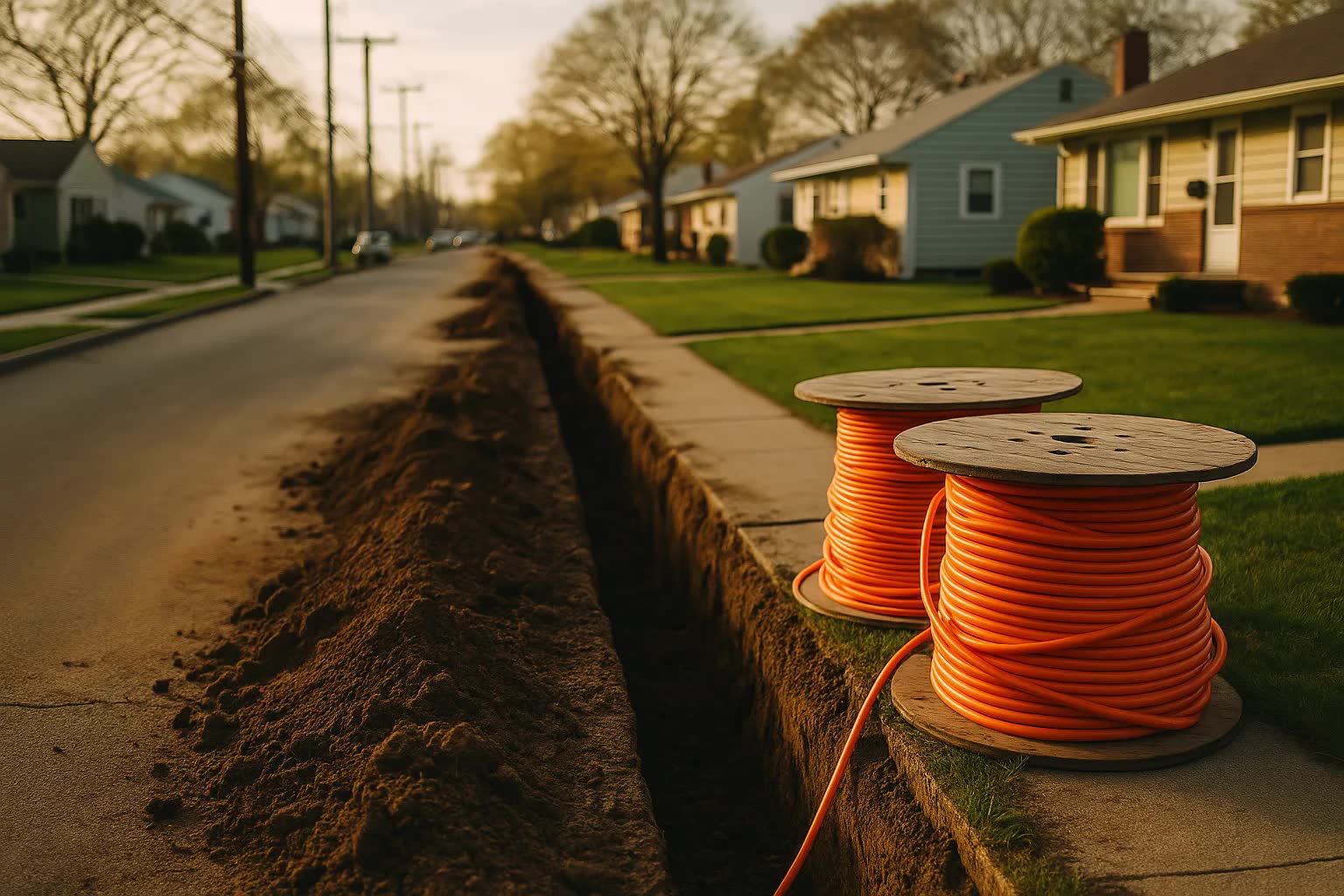
Across Nassau and Suffolk counties, town halls and private providers are racing to lay fiber optic cable along Main Streets and residential crescents that were bypassed during the broadband boom of the 2010s. Municipal initiatives are partnering with smaller regional providers, while national incumbents are focused on denser corridors. The result is a patchwork of projects — trenching on Montauk Highway, pole work along Merrick Road, and aerial drops in neighborhoods off Route 25A — all intended to bring symmetrical gigabit service to places that still list average download speeds well under 100 megabits per second.
Local officials describe the push as both economic development and emergency infrastructure. "We stopped pretending that fast internet is a luxury years ago — it's a public utility," said Eleanor Grant, director of broadband for the Town of Huntington, which has proposed a municipal fiber plan centered on Huntington Village and the surrounding hamlets. "If we want to keep professionals, teachers and small businesses in town, we need to build a network that supports remote work, telemedicine and the digital back offices of retail on Main Street."
Private companies are responding with their own plans. Marco Benedetti, CEO of HarborNet, a regional fiber operator based in Port Washington, said his firm has secured rights-of-way to string fiber across 120 miles of suburban streets and intends to connect several underserved neighborhoods this year. "We can deploy faster than most municipalities, but the permitting and pole make-ready work is still the bottleneck," Benedetti said. "We're prepared to invest alongside towns, but we need reasonable timelines from utilities and state regulators."
The scale of the effort is substantial: county broadband coordinators estimate roughly 85,000 residential and small-business premises across Nassau and Suffolk counties lack access to symmetrical gigabit service, and a combined total of 1,200 miles of last-mile fiber will be required to meet demand in targeted hamlets. State-administered grant programs earmarked roughly $350 million for municipal and public-private projects across Long Island this cycle, with local matches averaging 15 to 25 percent; project budgets in individual towns range from $1.2 million for a single hamlet rollout to $9 million for multi-village builds. The deadline to have grant applications approved and construction under contract has been publicly set for June 30, 2026.
On the ground, crews with spades, jackhammers and bucket trucks have become a regular sight. In Patchogue, where the downtown theater and waterfront restaurants attract weekend crowds from Brooklyn, contractors are installing conduit along West Main Street and coordinating with local historic preservation boards to minimize sidewalk disruption. In Massapequa, an apartment landlord on Hibiscus Lane said tenants complained about video calls dropping during important client meetings, which prompted the building to seek a bulk fiber connection to the street.
Property owners and small business operators are split between excitement and frustration over the pace of work. "Our bookstore in Port Jefferson runs author events and online sales; when the upload speed is slow, orders go backward," said Sofia Marin, owner of Harbor Books, who lives above the shop on East Main Street. "The crews have been polite and the town's been responsive, but we've had two rescheduled hookups. I get why it's complicated, but residents want timelines, not promises."
Technical hurdles and regulatory red tape complicate the builds. Pole attachment fees, make-ready upgrades to aging utility infrastructure, and right-of-way permits with villages and the state Department of Transportation add weeks or months to schedules, town planners say. Municipal broadband proposals must also weigh operating models — whether to operate a publicly owned open-access network or to seek a concession agreement with a private operator — and secure the municipal match to qualify for grants, often necessitating municipal bond votes or reallocation of capital funds.
Competition between municipal networks and private providers is heating up, with some towns pursuing hybrid solutions. The Village of Rockville Centre has solicited proposals for a public-private partnership that would use town-owned conduit to accelerate private deployments, while the Town of Islip is exploring a municipal authority to own fiber assets and lease capacity to multiple providers. Industry analysts watching Long Island say these arrangements could lower consumer prices and reduce service gaps if they materialize, but negotiating contracts can take longer than the engineering work itself.
Planners and providers say the next three months will be decisive: permits must be cleared, make-ready work scheduled and grant applications finalized if towns hope to secure state dollars and avoid a multi-year wait for other funding rounds. For residents who commute into Manhattan or work in creative studios in Red Hook and Williamsburg but call Long Island home, the payoff could be immediate: more reliable telemedicine visits, faster uploads for small businesses and better connectivity for students. "This isn't just wires in the ground," Grant said. "It's the infrastructure of daily life, and if we get it right this summer, the next decade of Long Island life will look very different."