The Lower East Side Builds a Microgrid to Outlast the Next Blackout
Scarred by past storm outages, a coalition of buildings is installing solar panels, batteries, and smart controls to keep the lights on when the grid fails.
By Aspen Young · August 4, 2026 · 5 min read
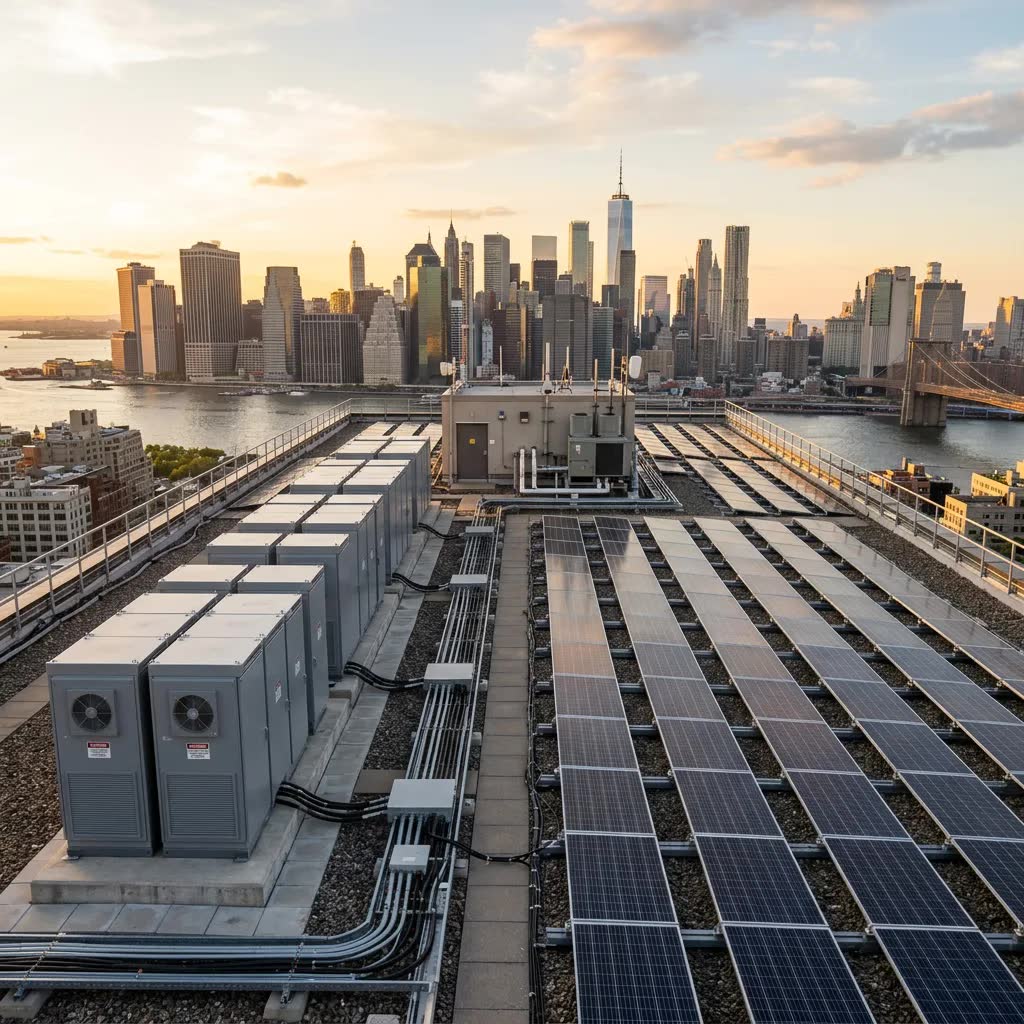
NEW YORK — On the Lower East Side, a coalition of residential buildings, a community center, and a small commercial strip is knitting itself into a microgrid — a self-contained network of solar panels, batteries, and computerized controls designed to keep critical power flowing even when the wider grid goes dark. The project, years in the planning, is a direct response to the memory of past storms that plunged the neighborhood into days-long blackouts.
A microgrid works by generating and storing its own electricity and, crucially, by being able to disconnect from the main grid and run on its own during an outage. Smart controllers constantly balance supply and demand across the connected buildings, drawing on rooftop solar during the day, storing surplus power in batteries, and prioritizing essential loads like elevators, medical equipment, and refrigeration when the grid fails. "The idea is that when the neighborhood around us goes dark, this block stays lit," one organizer said.
The effort grew out of hard experience. Residents recall the anxiety of high-rise apartments without working elevators or refrigeration during extended outages, a hardship that fell hardest on elderly and disabled neighbors. "People up on the fifteenth floor were trapped," one longtime resident recalled. "Insulin was going bad in the fridge. We swore we'd never be that helpless again." That resolve, organizers say, is what carried the project through years of technical and financial hurdles.
Financing and coordination proved as challenging as the engineering. Assembling a microgrid across separately owned buildings required navigating utility rules, securing grants and low-interest loans, and persuading skeptical owners to invest in equipment whose payoff is measured partly in avoided catastrophe. Energy consultants involved in the project said the regulatory framework for community microgrids remains a patchwork, complicating what is already an ambitious technical undertaking.
City and state energy officials have watched the project as a potential model for climate resilience, particularly in dense neighborhoods vulnerable to flooding and heat. As storms grow more intense, planners increasingly see distributed local power as a complement to the centralized grid rather than a novelty. "Resilience can't only be built at the level of the whole city," one official said. "It has to be built block by block, and this is what that looks like."
For the organizers, the microgrid is as much about community as kilowatts. Building it required neighbors to cooperate across the lines that usually divide a block, and the shared infrastructure has become a point of collective pride. "We built something together that no one of us could have built alone," one organizer said. "That's the part the engineers can't put in the spreadsheet." The system is expected to come fully online later this year.