Mamdani Unveils First City-Owned Grocery Store, Promising Prices 20% Below Market in the Bronx
The Mayor announced the debut location of his signature municipal grocery pilot in the South Bronx, pledging staple prices roughly a fifth cheaper than nearby retailers when it opens this fall.
By Marcus Bell · July 6, 2026 · 6 min read
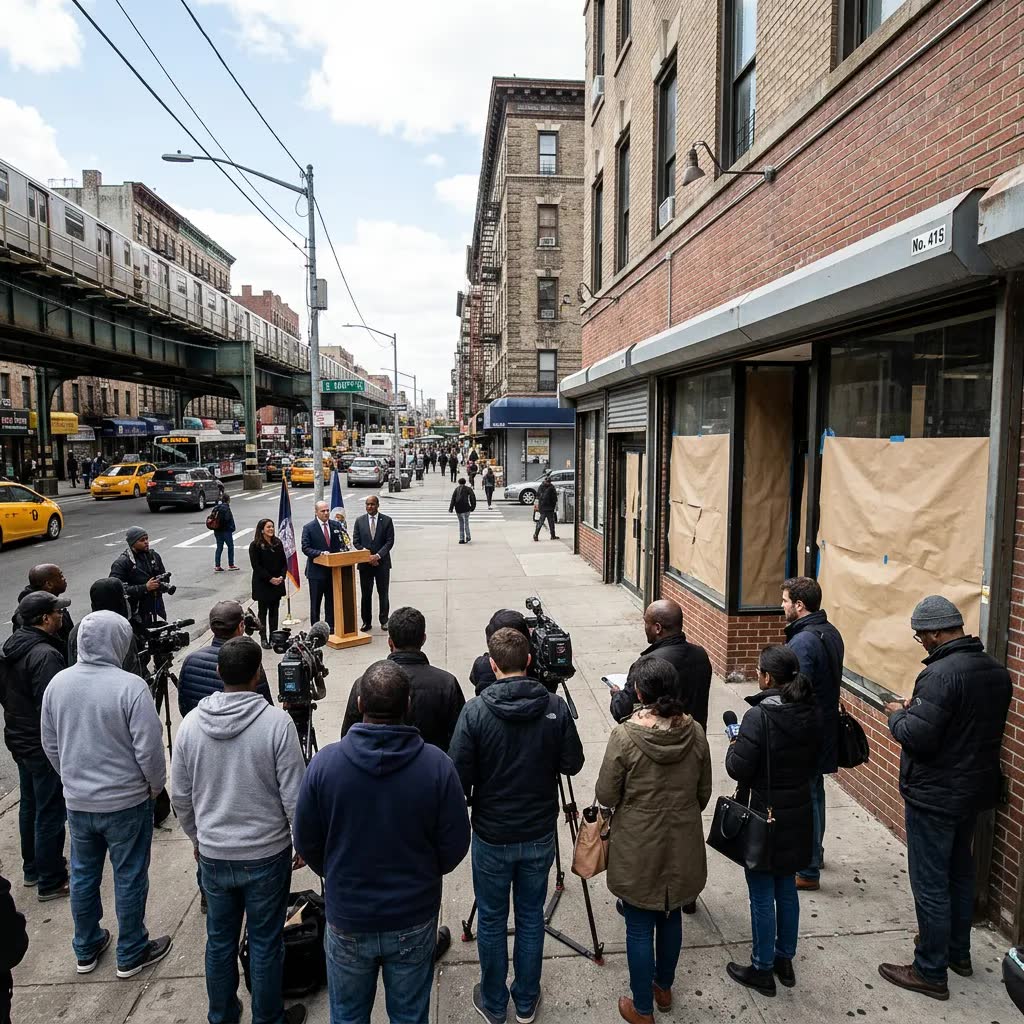
NEW YORK — Standing outside a vacant storefront on Melrose Avenue in the South Bronx, Mayor Zohran Mamdani on Sunday announced the first location of the city-owned grocery store program he made central to his campaign, saying the pilot would sell milk, produce, canned goods, and household staples at prices he estimated to be about 20 percent below those of surrounding supermarkets. The roughly 12,000-square-foot space, formerly a discount clothing outlet, will be operated by a new nonprofit municipal corporation and is slated to open its doors in late October, city officials said. Mamdani framed the store as a direct response to what he called an affordability crisis that has pushed basic groceries beyond the reach of thousands of working families in the borough.
"For too long, New Yorkers have been told that a carton of eggs and a bag of rice are simply going to keep getting more expensive, and there is nothing anyone can do about it," Mamdani told a crowd of about 200 residents and reporters. "Today we are saying something different. This city can buy in bulk, cut out the middleman, and pass those savings directly to the people who need them most." He added that the Melrose location was chosen because the neighborhood surrounding it has one of the highest rates of food insecurity in the five boroughs, according to a survey the administration commissioned this spring.
Under the plan outlined by the mayor's office, the pilot will be funded through an initial $18 million allocation drawn from a mix of unspent economic-development funds and a new line item in the coming fiscal year's budget. Officials said the store will operate at cost rather than for profit, keeping margins near zero and relying on the city's purchasing power and rent-free use of a municipally leased building to hold prices down. A spokesperson for the mayor said two additional locations, one in central Brooklyn and one in eastern Queens, are already under review and could open by the middle of 2027 if the Bronx store meets internal benchmarks for foot traffic and cost recovery.
Reaction on Melrose Avenue on Sunday was largely enthusiastic. Rosa Delgado, a home health aide who said she walks nearly a mile to reach an affordable supermarket, called the announcement "the first thing in years that actually sounds like it's for us." Others were more cautious. A retired transit worker who gave only his first name, Emmanuel, said he welcomed lower prices but wanted to know whether the store would stock fresh produce reliably or become "another government office where the shelves are half empty by noon." City officials said the store will receive daily deliveries from a regional distribution hub and will accept SNAP benefits alongside cash and card payments.
Critics moved quickly to question both the economics and the precedent of the program. A coalition of independent grocers warned that a subsidized public competitor could undercut family-owned bodegas and supermarkets that already operate on razor-thin margins, potentially forcing some to close. "You cannot compete with a store that pays no rent and answers to no bottom line," said Harold Ostrow, a spokesperson for a neighborhood retailers' association, who argued the city should instead expand tax relief for existing shops. Several Republican members of the City Council also questioned whether taxpayers would ultimately absorb losses if the store failed to break even.
Economists offered a split verdict. Some cautioned that municipal grocery ventures in other American cities have struggled with spoilage, staffing, and thin demand, while others said New York's density and scale could make the model more viable than past experiments elsewhere. Mamdani, for his part, pledged full transparency, promising to publish quarterly reports on the store's sales, prices, and losses. "We are not asking anyone to take this on faith," he said. "We are going to show our work, month after month, and let the results speak." The administration says construction and hiring will begin within weeks, with roughly 40 unionized positions expected at the Bronx location.