Mamdani Cracks Down on Retailers Selling Overpowered E-Bikes Across NYC
Mayor Mamdani issued cease-and-desist orders to 42 online retailers demanding they stop selling e-bikes and scooters that exceed New York City's legal limits, with civil penalties up to $2,000 per sale and a compliance deadline of August 18.
By Aspen Yang · August 10, 2026 · 4 min read

Corporation Counsel Steve Banks warns of potential lawsuits if 42 tech and retail giants fail to halt non-compliant sales by August 18.
NEW YORK, Aug. 10, 2026 — New York City has issued cease-and-desist orders to 42 online retailers, demanding they stop selling motorized two-wheeled devices that exceed the city's legal limits on speed, weight and safety. Retailers have until August 18 to comply. Those that continue face civil penalties of up to $2,000 per illegal sale, and non-compliant devices found on city streets may be impounded.
Mayor Zohran Mamdani announced the action on August 5 at City Hall. The orders were issued by Corporation Counsel Steve Banks, who said the city would weigh litigation if companies do not comply by the deadline, including suits over advertising that leads buyers to believe a device is street-legal. The companies have also been asked to meet with the Department of Transportation, the Police Department and the Law Department to agree on measures to keep non-compliant vehicles out of the city.
“The burden of whether or not the bike they buy is safe and legal should not fall on working New Yorkers who are simply looking for a quick and low-cost mode of transportation,” Mamdani said. “It is the responsibility of retailers to only sell the vehicles permissible under New York law in our city.”
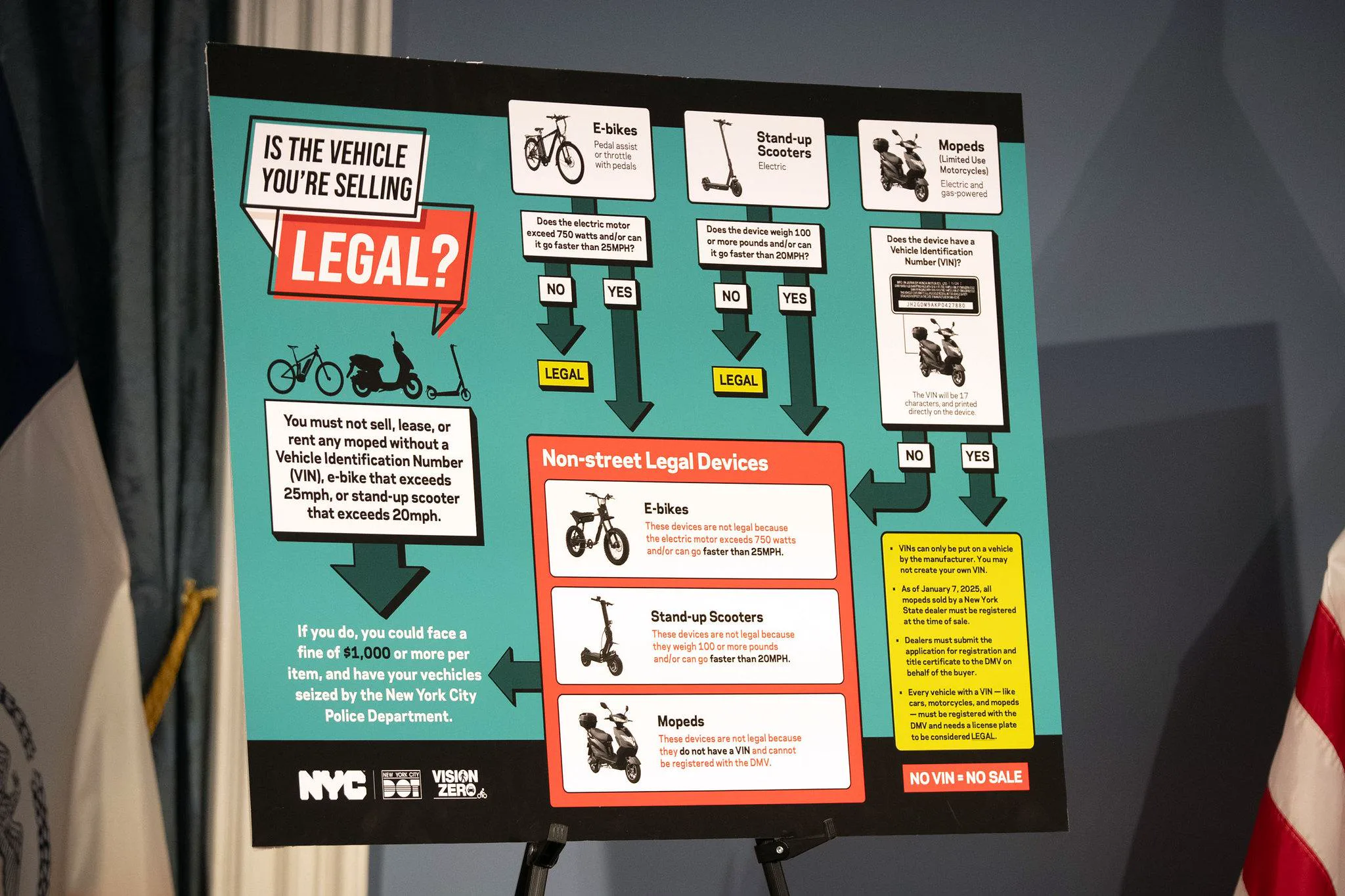
Under city law, e-bikes may not exceed 750 watts of motor power or 25 mph of assisted speed. Stand-up scooters over 100 pounds or capable of more than 20 mph are barred, as are seated mopeds without a valid VIN. A separate rule governs how the devices are ridden: the operating speed limit on city streets is 15 mph regardless of what a device is capable of, so a legally sold e-bike ridden at 22 mph is still being ridden illegally — a distinction that has caused persistent confusion among riders.
City figures show that between 2017 and 2025, 45 riders died on illegal e-bikes capable of exceeding 25 mph, 54 percent of all e-bike rider deaths in that period; 14 died on illegal stand-up scooters, 52 percent of that category. In both, more than half of those killed were riding devices that should never have been sold. Two-wheeled electric vehicles were involved in about 1 percent of all collisions citywide this year, even as incidents involving the devices themselves have risen sharply.
The orders followed the July 29 death of Gabriel Nacato, 17, killed near Chambers Street after descending from the Brooklyn Bridge and merging into traffic, where he collided with an SUV. He was not wearing a helmet and was outside the protected bike lane; the driver was questioned by police and not immediately charged. The Department of Transportation identified his device as a Deepower e-moto rated at 1,500 watts with a top speed of 30 mph — double the legal power limit, and unregistered. The crash occurred steps from City Hall. Ben Furnas, executive director of Transportation Alternatives, noted that the manufacturer's website carries instructions for removing the speed limiter, calling the practice unacceptable.
An Amazon spokesperson told PIX11 that the company is reviewing the products in question, said safety is a priority, and that it requires e-bikes sold in its store to meet applicable safety standards and Amazon policy. Target, Temu, Walmart and Wayfair had not issued public responses as of publication. Banks said the city's response after August 18 would depend on compliance; Mamdani said the best outcome would be collecting no penalties at all, because all 42 companies had complied.
The orders target sellers, not owners. Riders who already own non-compliant devices are not made legal by the deadline, and the city has not publicly explained how it will monitor whether platforms actually delist the products. Ligia Guallpa of the Worker's Justice Project, co-founder of Los Deliveristas Unidos, said delivery workers rely on these vehicles to earn a living in one of the city's most dangerous industries, navigating a chaotic market with little support from app companies, and that illegal devices are often the cheapest and easiest to obtain; keeping them from being sold in the first place, she said, is what street safety requires. For riders who have already bought one, how to verify a device's rating, what happens if it is impounded and what a compliant replacement costs all remain open.
The City Council has scheduled a hearing on 17 related bills for September 30, among them proposals to bar the sale and rental of Class 3 e-bikes, to require delivery platforms to obtain licenses from the Department of Consumer and Worker Protection, and to create a trade-in program allowing riders to exchange non-compliant vehicles for legal ones. State Attorney General Letitia James's office has issued an advisory to businesses and consumers about these vehicles and has voiced support for the city's action.