Robotic Labs on the East Side Speed the Hunt for New Drugs
A cluster of Manhattan biotech startups is automating the grind of laboratory experiments, running thousands of tests a day with barely a human hand.
By Priya Nair · July 31, 2026 · 5 min read
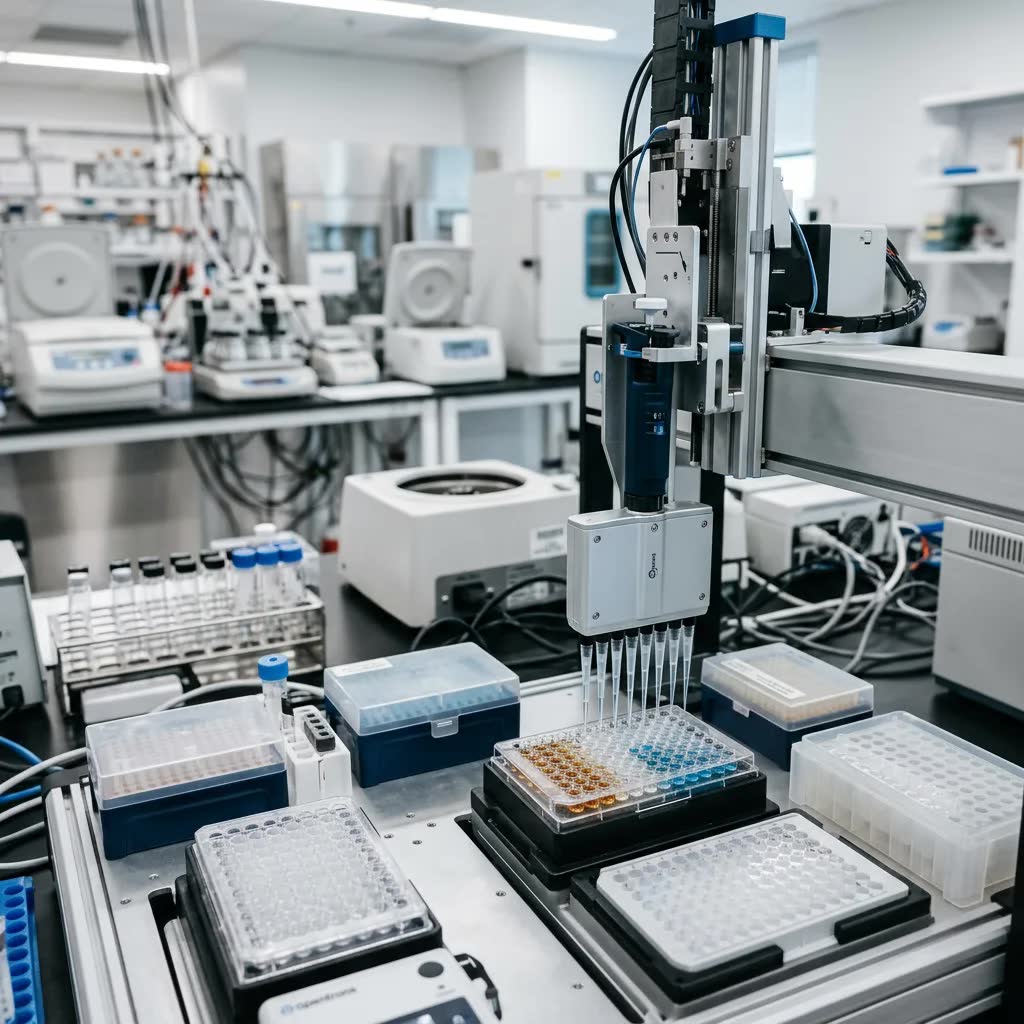
NEW YORK — Behind a nondescript door in a Manhattan life-sciences building, robotic arms pipette liquids into thousands of tiny wells, cameras record the results, and software decides what experiment to run next — all with only a handful of scientists in the room. The setup belongs to one of a growing cluster of New York biotech startups betting that automating the repetitive, error-prone labor of the laboratory can dramatically accelerate the search for new medicines.
Drug discovery has long been bottlenecked by the sheer slowness of wet-lab work, where experiments must be run by hand, one careful step at a time, and where subtle inconsistencies between researchers can muddy results. Automation promises to run experiments faster, more reproducibly, and around the clock. "A robot doesn't get tired at 2 a.m. and doesn't pipette differently on a Monday than a Friday," one company scientist said, describing consistency as almost as valuable as speed.
The approach pairs the robotic labs with artificial intelligence that analyzes each round of results and proposes the next batch of experiments, creating a loop in which the machines steadily narrow in on promising compounds. Proponents argue this closed loop can explore far more of the vast space of possible molecules than traditional methods, potentially surfacing candidates that human intuition might overlook. Skeptics caution that biology remains stubbornly complex and that automation cannot substitute for deep scientific insight.
New York has worked for years to grow a life-sciences sector to rival its finance and media industries, pouring public money into lab space and incentives. The city's dense concentration of hospitals and research universities gives startups access to talent and clinical partners, and the automated-lab companies say that ecosystem is part of why they set up here rather than in more established biotech hubs. "The scientists we need are already in this city," one founder said.
The economics remain daunting. Building and running robotic labs is expensive, and drug discovery is famously unforgiving, with the overwhelming majority of candidates failing somewhere on the long road to approval. Investors have poured money into the space on the promise of faster, cheaper discovery, but returns remain largely theoretical. "We're selling a shorter path through a very long tunnel," one executive acknowledged. "Nobody's out the other side yet."
For the scientists who work alongside the machines, the shift has changed the texture of the job, trading hours at the bench for time spent designing experiments and interpreting torrents of data. Some miss the hands-on craft; others say they finally get to spend their time thinking rather than pipetting. "I went to school to ask good questions," one researcher said, watching a robotic arm move down a row of vials. "Now I actually have time to."