Manhattan Chinatown's Cantonese Opera Troupes Fight for Survival
Aging performers and neighborhood advocates are pressing for funding and rehearsal space as Cantonese opera faces dwindling audiences in Lower Manhattan.
By Sofia Martell · March 8, 2026 · 4 min read
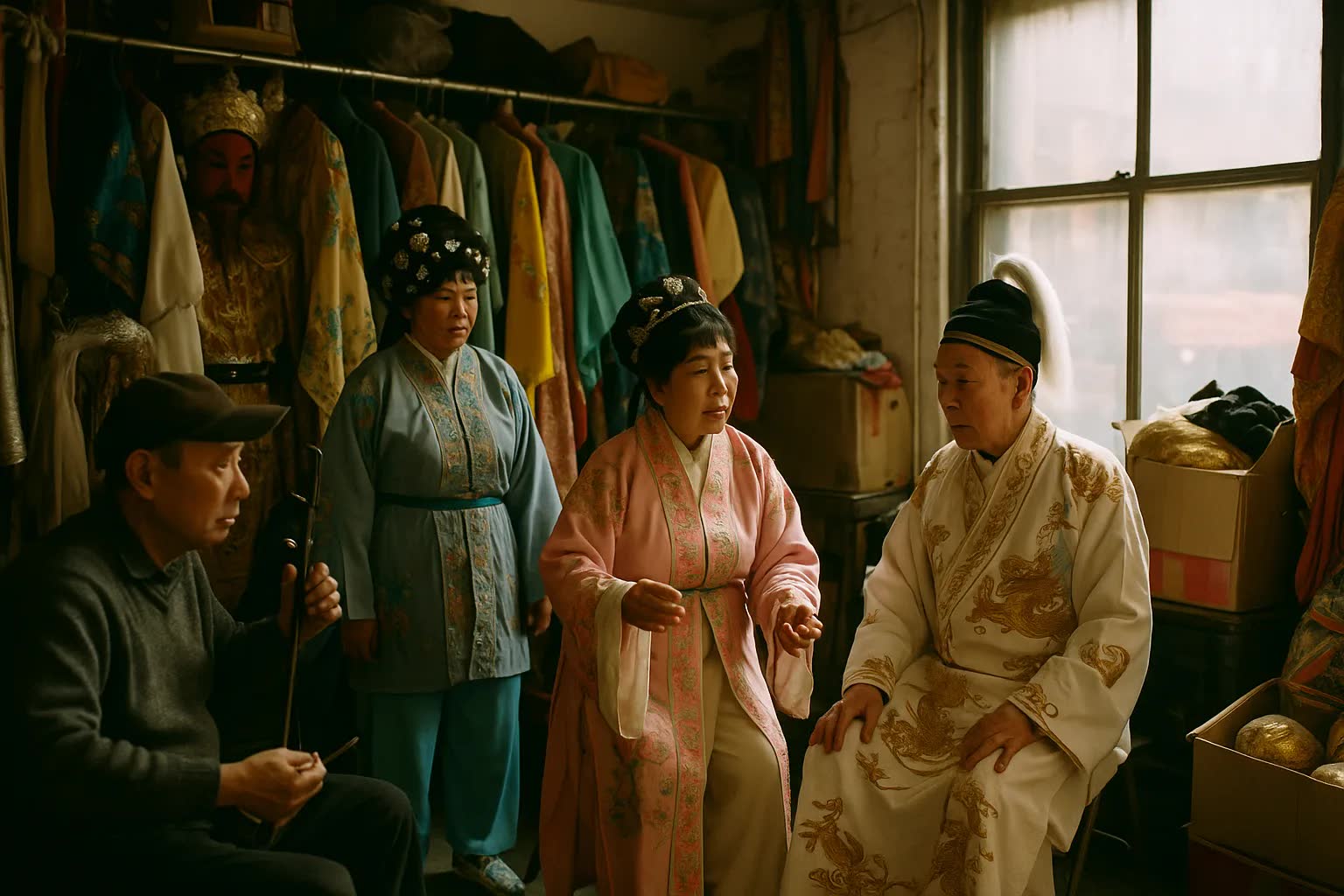
On a frost-hinged morning in early March, the smell of soy and the echo of gongs still rise from the blocks around Canal Street and Mott Street, but the voices that shaped those sounds for generations feel threadbare. Manhattan's Chinatown, long a home for Cantonese opera troupes that turned storefronts and public plazas into stages, is confronting an existential squeeze: aging performers, evaporating rehearsal space and shrinking audiences are forcing some of the neighborhood's oldest companies to either adapt fast or fold entirely.
Cantonese opera — a blend of music, martial arts, stylized movement and elaborate costume — has run in fractured cycles across Lower Manhattan since the first waves of Cantonese-speaking immigrants settled on the Two Bridges and Doyers Street in the early 20th century. For decades, Lunar New Year shows spilled from Columbus Park to the main thoroughfares, and midweek matinees at community halls on East Broadway drew audiences who came for story as much as social contact. The art has long functioned as both entertainment and communal memory for a neighborhood that has been continually reshaped by waves of development.
Today the pressures are many. Rising commercial rents have claimed rehearsal rooms above dim sum houses and traditional joss houses. Residential conversions and boutique retail make nightly parking and late rehearsals harder to manage, and younger Cantonese speakers are less likely to sit through three-hour sung narratives. Several troupes now operate with skeleton crews, relying on traveling masters in their seventies to teach roles they are desperate to pass on to anyone willing to learn.
Concrete numbers underline the trend. In 2005 there were an estimated 12 active Cantonese opera troupes based in Manhattan Chinatown; a 2025 survey by the Chinatown Cultural Lab found that number down to five, with two of them reporting fewer than eight regular paid performers each. The median age of senior performers in those troupes is 67, and rehearsal-appropriate storefronts within a half-mile radius of Canal and Mott have declined by an estimated 42 percent since 2016. City grants for Chinese-language performing arts in the five-year period ending 2025 fell by roughly 38 percent in inflation-adjusted dollars, while the cost to convert a raw ground-floor space into a humidity- and sound-controlled rehearsal studio runs between $150,000 and $400,000, according to the lab's estimates.
Mei Lin Chen, artistic director of the New Pearl Cantonese Opera Troupe, said the pressure is immediate and personal. "We have singers who have sung here since they were teenagers; now they are in their seventies and we have no space to teach the young ones the breathing, the stylized steps, the voice placement," she said. Chen described late-night rehearsals in borrowed community centers and a recurring fear that some of the most intricate pieces of technique will simply disappear if there is no secure place to work.
Neighborhood advocates have been pushing back with proposals that mix preservation and practicality. "If Chinatown loses its opera, it loses a living archive of language, history and social practice," said David Wong, executive director of the Chinatown Preservation Alliance. Wong's group has lobbied the city's Cultural Affairs office and a coalition of neighborhood groups to reserve underused municipal space for a shared rehearsal hub, arguing that a single, secure site would reduce costs and help foster apprenticeship programs that reach younger immigrants and second-generation residents.
Cultural historians and educators say the threat is not only spatial but generational. "Cantonese opera is not a museum piece; it is living language and memory, carried in the gestures as much as the lyrics," said Joanna Lau, an independent cultural historian who teaches Asian performing arts at a community college on the Lower East Side. Lau pointed out that many children in Chinatown now attend schools where Mandarin, not Cantonese, is the dominant Chinese language taught and that the opera's apprenticeship model — long dependent on informal mentorship — is ill-suited to transient modern work patterns.
The day-to-day adaptations are visible on the streets. At 6 a.m. in a church basement on Division Street, members of the Golden Lotus troupe warm up with scales while schlepping portable lights and a foldable bamboo set used for quick street performances. On weekends, small-scale productions are staged in the community room of a social service agency on Eldridge Street, where the troupe pays a fraction of commercial rent but must dismantle sets each night to make room for senior exercise classes the next morning. The Jade Theater on East Broadway, once a regular venue for touring opera companies, has been shuttered for years, its marquee gone and its lobbies parceled into storage lockers.
Funding strategies now mix private donations, crowdfunding and targeted grant applications. The Chinatown Cultural Lab has a seed proposal to create a shared rehearsal hub requiring an initial $75,000 for lease guarantees and $300,000 for build-out; several troupes are also pursuing a consortium application for a larger multi-year cultural preservation grant. Local foundations have made modest commitments, and small benefit concerts staged in community churches have raised sums in the low tens of thousands, but organizers say those amounts fall far short of what is needed for sustainable operations and to fund a paid apprenticeship pipeline.
Despite the hurdles, there are signs of a forward path. A pilot residency being negotiated for late 2026 would place two troupes in a city-owned storefront on Canal Street for six weeks of intensive public rehearsals and workshops with students from neighborhood schools; organizers hope the visibility will rekindle interest among younger audiences and attract new funding partners. As troupes and advocates press to secure space and formalize training, the neighborhood waits to see if these age-old voices will continue to resonate from the storefronts and plazas that helped shape Chinatown's sonic identity, or if a critical thread of the city's immigrant cultural life will go silent.