Mayor and State Clash Over Policing of Planned Protests
City officials say state trooper deployments amount to overreach as both sides prepare for high-profile demonstrations this month.
By Aisha Bello · March 22, 2026 · 4 min read
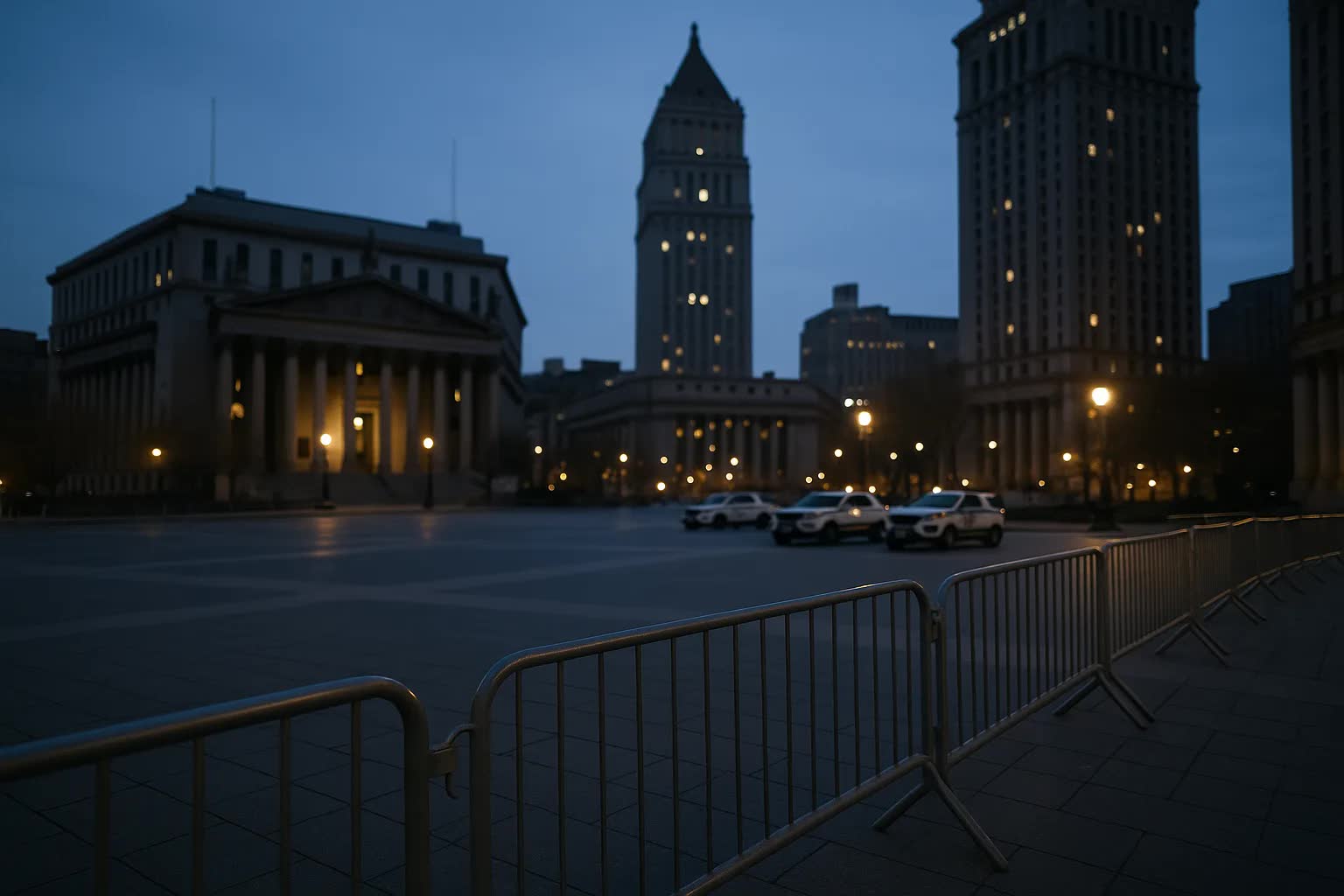
NEW YORK — Tensions between City Hall and state law enforcement boiled over Sunday as Mayor Elena Marquez accused a surge of state troopers deployed across Manhattan and Brooklyn of amounting to an overreach ahead of two high-profile demonstrations scheduled this month, setting the stage for a jurisdictional and political showdown on streets that include Foley Square, Canal Street and the approaches to the Brooklyn Bridge.
Marquez, in a letter to the State Division of Public Safety and in remarks outside City Hall, said the unannounced positioning of troopers and armored vehicles around civic centers and transit hubs had unnerved residents and local business owners and risked escalating confrontations during what city officials expect will be largely peaceful protests. “We welcome peaceful expression, but we will not accept a shadow security force that undermines civic control of our public spaces,” Marquez said, identifying the deployments as an intrusion on municipal authority.
State police leaders have defended the deployments as precautionary measures in response to intelligence about possible coordinated disruptions around multiple demonstrations, arguing they are prepared to assist if violence or traffic-stopping tactics threaten public safety. “Our responsibility is to keep people safe on roads, bridges and in public places,” said State Police Superintendent Daniel Rowe. “We are not here to take over municipal policing; we are here to provide capability where credible threats exist.” Rowe declined to disclose specific intelligence publicly, citing ongoing investigations.
City officials and the state offered differing tallies of personnel and equipment. The State Division of Public Safety notified the city this week that some 850 state troopers and 24 tactical vehicles would be positioned in the metropolitan area over the next three weeks, with 420 assigned to Manhattan, 240 to Brooklyn, 110 to Queens and the remainder staged on Long Island and at major channel crossings; the city’s Office of Emergency Management put the projected overtime costs to state accounts at roughly $3.6 million for that period. Last year’s largest demonstration-related policing surge resulted in 128 arrests citywide and 42 reported injuries, according to a city tally.
Transit operators and small-business owners across neighborhoods that have seen early deployments said they were scrambling to adapt. A senior MTA planner who requested anonymity because of the sensitivity of security talks said the authority had prepared contingency plans to reroute BMT and IND services in the event protest activity closed major corridors, pointing to potential reroutes on Canal Street and Bedford Avenue and temporary suspensions at Broadway–Lafayette if demonstrators moved through SoHo and the Lower East Side. “Our main concern is keeping anyone trying to get to work or school from being caught in the middle of a tactical plan,” the planner said.
Legal authorities and civic leaders have sketched out how control over policing responsibilities is meant to work, but the dispute has exposed gray areas. The city issues permits for demonstrations in parks and plazas and the Parks Department has barred the use of amplified sound in several planned events; the state notes that it has jurisdiction over highways, the approaches to bridges and the Penn Station complex outside municipal permit systems. City lawyers have warned that unilateral state deployment in neighborhoods without coordination could trigger litigation on constitutional and administrative grounds, while state attorneys point to statutes permitting temporary assistance in the interest of public safety.
Organizers representing at least three of the largest planned demonstrations said the state posture had already altered their plans. A coalition that intends to march from Foley Square to Barclays Center has announced a new, staggered timetable and legal observers along the route to document interactions with officers from differing agencies; a separate group planning to hold a civil-disobedience action on the Brooklyn Bridge said it had filed a court notice to preserve the right to assemble. “We are preparing for large numbers and we’re making sure people know their rights,” said Mariah Chen, an organizer with the Downtown Rights Network, who added that the extra law enforcement presence had prompted her group to increase volunteer marshals and medical teams.
Community organizations in neighborhoods singled out for heavy state patrols voiced concern about what they said was an appearance of militarization. Sonia Alvarez, president of the Chinatown Merchant Alliance, said store owners on Canal and Mott streets were already seeing foot traffic decline and feared escalation when uniformly dressed troopers appeared in rows. “Our small businesses are fragile; they don’t need a show of force at their doorsteps,” Alvarez said, noting that many merchants depend on weekday lunch crowds and tourist traffic around the Manhattan Bridge corridor.
As both sides dug in, officials said they would continue to talk even as lawyers readied possible challenges and organizers adjusted tactics. Marquez’s office scheduled an interagency meeting this week at the mayoral residence to press for an agreed-upon rules-of-engagement document; the state said its commanders would remain flexible and withdraw assets if the demonstrations proceed without incidents. With two weekends of major demonstrations and several smaller, targeted actions set through the end of the month, city leaders and state troopers said they were planning for a range of scenarios, leaving residents and businesses braced for more disruptions but hopeful that coordination will prevent the very confrontations that have most alarmed neighborhoods.