Micro-Apartments Surge in Jersey City as Young Professionals Seek Transit-Accessible Housing
Developers are converting old office and warehouse floors into compact units with shared amenity spaces to meet demand near PATH stops.
By Mei Lin · January 27, 2026 · 4 min read
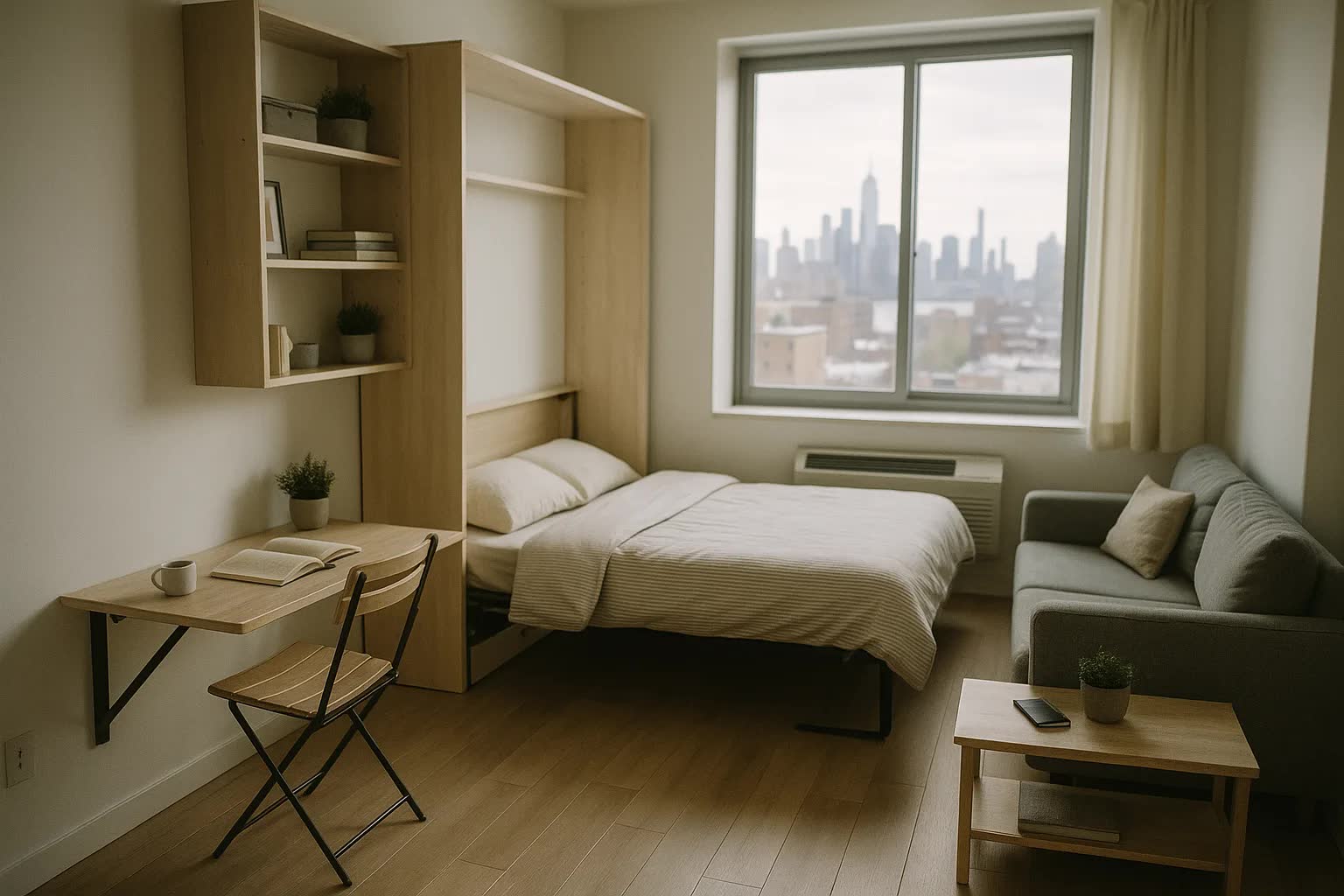
For many young professionals who once competed for cramped studios in Manhattan, the easiest commute now starts in Jersey City, where developers are rapidly converting old office floors and warehouses into micro-apartments clustered near PATH stops. The trend is reshaping neighborhoods from Journal Square to Exchange Place and Grove Street, as compact units of 250 to 400 square feet are marketed as transit-first housing for people who value a short ride to the West Village, Midtown or the World Trade Center over extra living space.
Across the waterfront in Pavonia-Newport, HarborWorks Development last month opened The Strand, a 12-story conversion of a 1980s office box at 200 Marin Boulevard that contains 212 micro-studios, a co‑working lab, communal rooftop garden and a public ground‑floor cafe. Interiors are tight — fold‑away beds, compact kitchens and European‑style bathrooms — but the building's advertising emphasizes shared amenity areas and a 10-minute PATH commute to Manhattan's World Trade Center station as a selling point.
"We hear from applicants every day that proximity to transit is the number one filter," said Leah Morales, director of development at Riverline Partners, which has three conversions in the pipeline around Journal Square and McGinley Square. "People trade square footage for access — to job markets, nightlife and the subway system. These buildings are designed to be extensions of the apartment, not replacements for the neighborhood."
Designers have leaned into the communal model, turning former loading decks into lounges, converting underused rooftops into shared gardens and outfitting basements with soundproofed studios for remote work or music practice. On Montgomery Street near Grove Street PATH, a converted knitwear warehouse now offers residents laundry pods, a bike maintenance room and a 24/7 package concierge, with the developer noting that the usable private space per unit deliberately keeps costs down while fostering social life in semi-public spaces.
"This is transit-oriented development in the most literal sense," said Carlos Vega, a senior MTA planner who requested anonymity, acknowledging internal concerns over capacity on peak PATH trains. "We welcome density near stations, but infrastructure has to keep pace. If dozens of conversions go online in the same corridor without signal upgrades or more cars, riders will notice the difference. We're working to coordinate timelines, but it requires both capital and political will."
The numbers tell a brisk story. Since 2022, Jersey City has issued permits converting an estimated 1.8 million square feet of commercial space into residential use, producing roughly 3,400 micro-units across 18 certified projects; the median new unit size is 330 square feet and average monthly rents for recent leases are hovering around $2,150. City planning reports estimate that 62 percent of new occupants are between 24 and 34 years old, and municipal data show a 47 percent increase in conversion applications between 2023 and 2025. PATH weekday boardings into Manhattan have climbed about 8 percent year over year through mid-2025, according to an internal transit summary obtained by NYDailyWatch.
Residents interviewed in the Newport and Exchange Place corridors say the trade-offs feel worth it. "My studio is small, but I'm three stops from where I work and I can bike to the waterfront in five minutes," said Aisha Khan, 27, a marketing associate who moved into a 330‑square‑foot unit off Montgomery Street two months ago. "I spend money on experiences — restaurants, shows, travel — not square footage. The shared rooftop and lobby co‑op make it feel like an extension of my living room."
Not everyone is enthusiastic. Neighborhood groups in McGinley Square and parts of Journal Square have raised concerns about parking pressure, noise and the loss of light from denser conversions. "We're not anti-density, but the pace and the scale are outstripping services — street cleaning, public school seats and local health clinics," said Rafael Ortega, president of the McGinley Square Neighborhood Alliance. Urban planners warn that without careful zoning guardrails, a monoculture of one‑bedroom plus micro units could hollow out family‑oriented housing stock in corridors that historically included small multi‑family homes.
Officials in Jersey City acknowledge the tensions and say they're trying to balance growth with neighborhood character. Mayor Elias Romano's office introduced a pilot program in late 2025 that fast-tracks conversions that include community amenity contributions — money earmarked for streetscape improvements, PATH station access upgrades and expanded after-school programming — and the city council is considering an amendment that would require a percentage of larger units in new projects to be family-sized. Developers say incentives, not mandates, have driven most deals but that they are open to negotiated public‑benefit packages.
Looking ahead, the micro-apartment phenomenon is likely to shape both the built environment and transit planning for years to come: developers in Jersey City's pipeline have proposed another 2,100 compact units within a half-mile of PATH stations, and transit managers are preparing for incremental capacity investments to handle denser ridership patterns. For young urbanites, the formula of smaller private spaces offset by shared amenities and a reliable 10- to 20-minute ride to Manhattan seems to be a permanent feature of the metropolitan housing market — but whether the surrounding neighborhoods, schools and transit systems can adapt at the same speed remains the central question as the conversions continue.