Midtown Shops Bet on Later Hours as Evening Foot Traffic Returns
Independent retailers near major office corridors are keeping the lights on later, hoping a gradual shift in commuting habits can restore the after-work sales window. Merchants say the added revenue must still outweigh staffing and security costs.
By Elena Park · August 24, 2026 · 5 min read
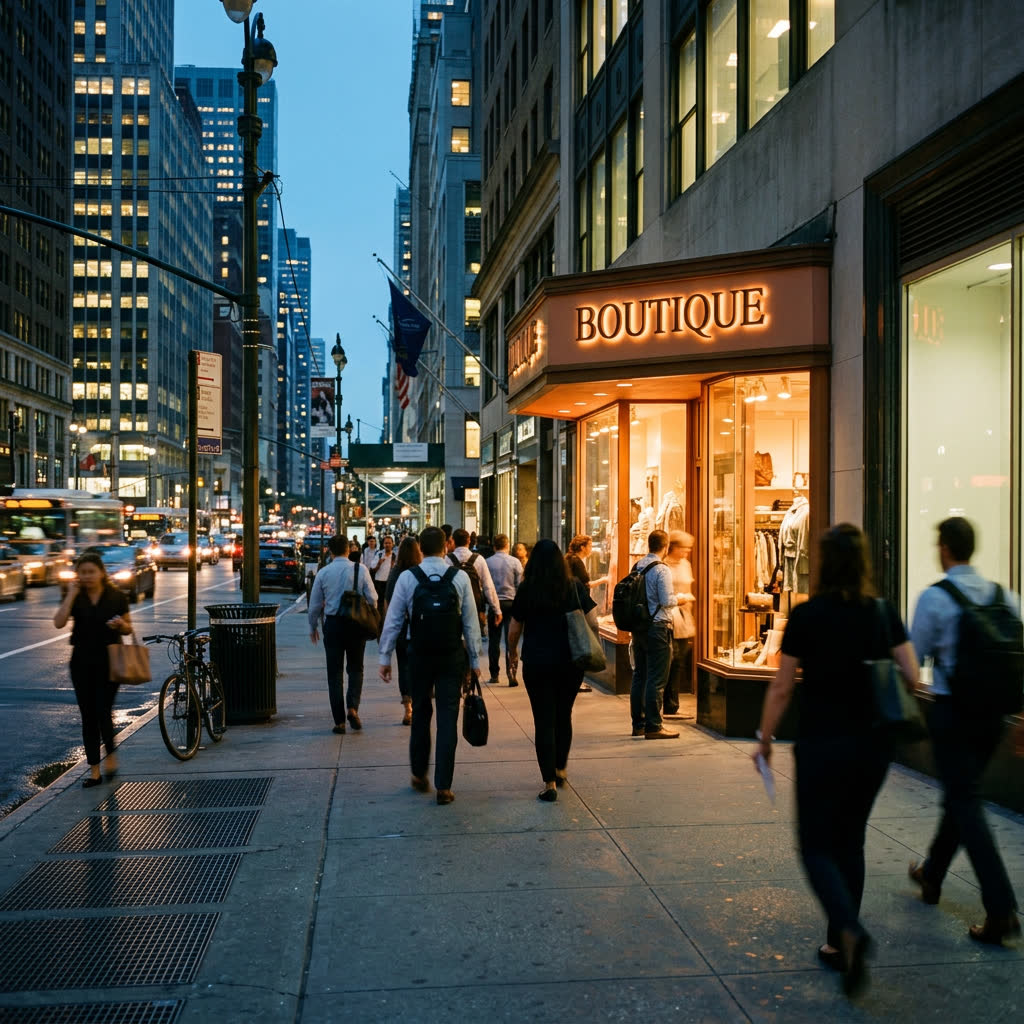
NEW YORK — At 7:15 Monday evening, the narrow aisles of Alder & Pine, a fictional home-goods shop on West 39th Street, held more customers than they had at lunchtime. Office workers examined ceramic bowls, picked up last-minute gifts and waited at a register that once closed before many nearby employees left their desks. Owner Lena Rios began testing an 8 p.m. closing time in June, one of a growing number of Midtown merchants wagering that the after-work shopping hour is returning in a different, less predictable form.
The shift is not a return to the old five-day office rhythm. Shopkeepers describe a week concentrated from Tuesday through Thursday, with Monday improving and Friday remaining uneven. A July canvass of 64 independent stores by the fictional Midtown Merchants Exchange found that 27 had extended evening hours since spring. Nearly two-thirds of those businesses reported higher sales after 6 p.m., though fewer than half said the increase had yet covered all additional labor and operating expenses.
Retailers are responding with short, targeted extensions rather than a blanket move back to late-night schedules. Some stores are staying open an extra hour only on the three busiest office days, while others are scheduling appointments or small product demonstrations immediately after work. At Alder & Pine, Rios overlaps two daytime shifts for 90 minutes instead of adding a full evening crew. She said the approach lets the store capture commuters without committing to payroll during the quietest late hours.
The renewed activity follows changes in how nearby office tenants organize in-person work. Building managers and local business groups say more employers are anchoring team meetings in the middle of the week, creating pronounced surges at sidewalks, food counters and subway entrances. That pattern can benefit shops when workers linger, but it also produces abrupt valleys. A rainy Wednesday or a holiday-shortened week can erase much of the traffic merchants expected when they set schedules days earlier.
The economics remain tight. Store owners cited hourly wages, cooling costs and the expense of keeping a second employee on site as the main obstacles to later closing. Nadia Coleman, who runs the fictional Paper Harbor stationery store near Bryant Park, said an extra hour needs to produce more than a handful of small purchases. She now pairs late hours with online order pickup, allowing staff to fill digital purchases during slow stretches and giving customers another reason to stop on their commute.
Restaurants and service businesses nearby are watching the experiment closely because shopping visits can lengthen the time workers spend in the district. Malik Brenner, director of the fictional 40th Street Business Collaborative, said members have begun coordinating promotions so a receipt from a shop can unlock a same-evening discount at a cafe. He said the goal is not to manufacture nightlife but to give commuters enough convenient options to postpone the trip home by 30 or 45 minutes.
Workers interviewed Monday said convenience mattered more than elaborate events. Priya Desai, an insurance analyst who was buying a birthday card, said she rarely has time to shop during lunch and does not want to make a separate weekend trip to Midtown. Another customer, Queens resident Marcus Hale, said he would use later hours for practical purchases but still leaves the area soon after work when subway platforms become crowded.
Rios plans to continue the schedule through October before deciding whether it can survive the slower winter period. She is tracking sales in half-hour blocks and comparing them with labor and utility costs, a calculation other merchants said they were also making. For Midtown's small retailers, the evening's modest bustle offered encouragement rather than certainty: The customers are appearing again, but businesses still have to learn precisely when they will arrive and how long they will stay.