A New Silk Road Story: Marco Polo Drive's Rome-to-Hong Kong Journey Comes Home to New York
After a 43-day, 15,000-kilometer journey from Rome to Hong Kong, the Marco Polo Drive returned to New York with a message about education, diplomacy, and exchange across borders.
By Iris Ye & Lucy Luo · August 29, 2026 · 3 min read
NEW YORK, Aug. 28, 2026 — Professor Jeffrey D. Sachs and Dr. Sonia Sachs arrived back in New York this week, capping off a 43-day, 15,000-kilometer expedition through 11 countries that traced routes once linking Europe and Asia in centuries past. The homecoming drew diplomats, educators, and global leaders eager to discuss the relevance of those ancient corridors in today's world.
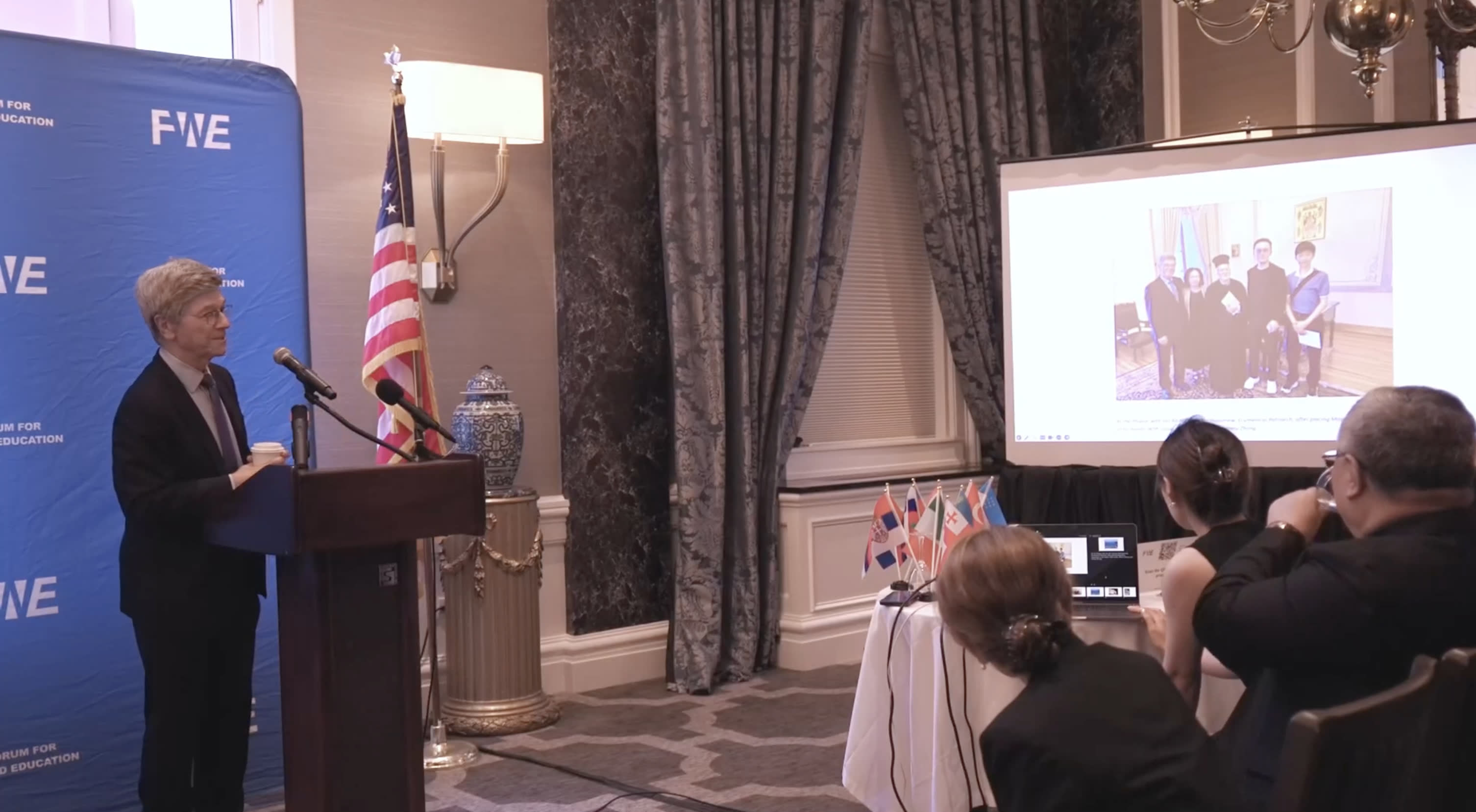
To mark the occasion, the Forum for World Education held a Welcome Home Reception at the Penn Club of New York in celebration of the couple's safe return from the Marco Polo Drive. Drawing inspiration from the historic Silk Road and the legendary travels of Marco Polo, the expedition ran from Rome to Hong Kong, spotlighting themes of peace, intercultural exchange, sustainable development, and grassroots connection across Europe, Central Asia, and China.
Among those in attendance were UN permanent representatives from China, Italy, Kazakhstan, Georgia, Uzbekistan, and Slovenia, joining a broader mix of figures from education, sustainable development, and global affairs. The evening's discussions went beyond framing the journey as a feat of distance and endurance — speakers instead drew connections between the long history of Eurasian exchange and the pressing question of how nations cooperate amid today's deepening divisions.
For FWE President Dr. Cheng Davis, education offered a way to extend that connection beyond the road. She pointed to students, teachers and universities as institutions through which relationships can continue across borders. “When the universities cooperate, they are building bridges,” Davis said. FWE hopes to build on the drive through programs connecting schools, universities, teachers, students and young leaders across the countries along the route, creating new opportunities for exchange in education, science, technology, culture and the humanities.
Fu’s remarks placed the journey within a broader discussion of dialogue, mutual respect and exchange among civilizations. China’s Permanent Representative to the United Nations, Ambassador Fu Cong, looked to the longer history of the Silk Road, where routes linking China with Central Asia, the Middle East and Europe carried not only goods but knowledge, technologies and cultural traditions in multiple directions.
“Equality and mutual respect create favorable conditions for peaceful coexistence,” Fu said. He recalled silk traveling westward while products including spices, grapes and peppers moved eastward, describing those exchanges as part of a process through which civilizations adapted to and enriched one another. Fu also connected that history with China’s support for dialogue among civilizations at the United Nations.
Professor Jeffrey D. Sachs, a Columbia University professor and president of the UN Sustainable Development Solutions Network, brought the audience back to the people who traveled those routes centuries ago. In a wide-ranging account of the Polo family’s journeys, he traced their movements through places including Hormuz and Bukhara and toward the court of Kublai Khan, describing how trade, war and political change repeatedly redirected their path across Eurasia.
“They were obviously remarkable people, and they’re very adventurous,” Sachs said of the Polo family. His retelling also drew on the modern journey itself. Stops such as Bukhara allowed the travelers to encounter places described in historical accounts rather than know them only through texts, turning centuries-old stories into something physically present.
That overlap between history and lived experience gave the reception a contemporary frame. The Silk Road was never simply one road or a one-way movement of goods. It was a network through which commerce, knowledge, beliefs and culture moved among societies. By retracing parts of that geography, the Marco Polo Drive used the past to make a present-day case for direct human contact at a time when political and economic relationships are increasingly strained.
“Let’s also continue the journey, not only by cars and roads, but through education, friendship, and diplomacy,” Davis said.
The cars may have completed their 15,000-kilometer route in Hong Kong, but the conversation continued in New York — shifting from retracing an old path to asking how education, dialogue and diplomacy might help build new ones.