New York’s $87 Million Counterterrorism Fight Tests Federal-State Trust Before 9/11 Anniversary
Hochul and Mamdani say Washington has not completed a promised restoration of security grants; FEMA says New York has substantial unspent money already available.
By Marcus Bell · September 9, 2026 · 5 min read
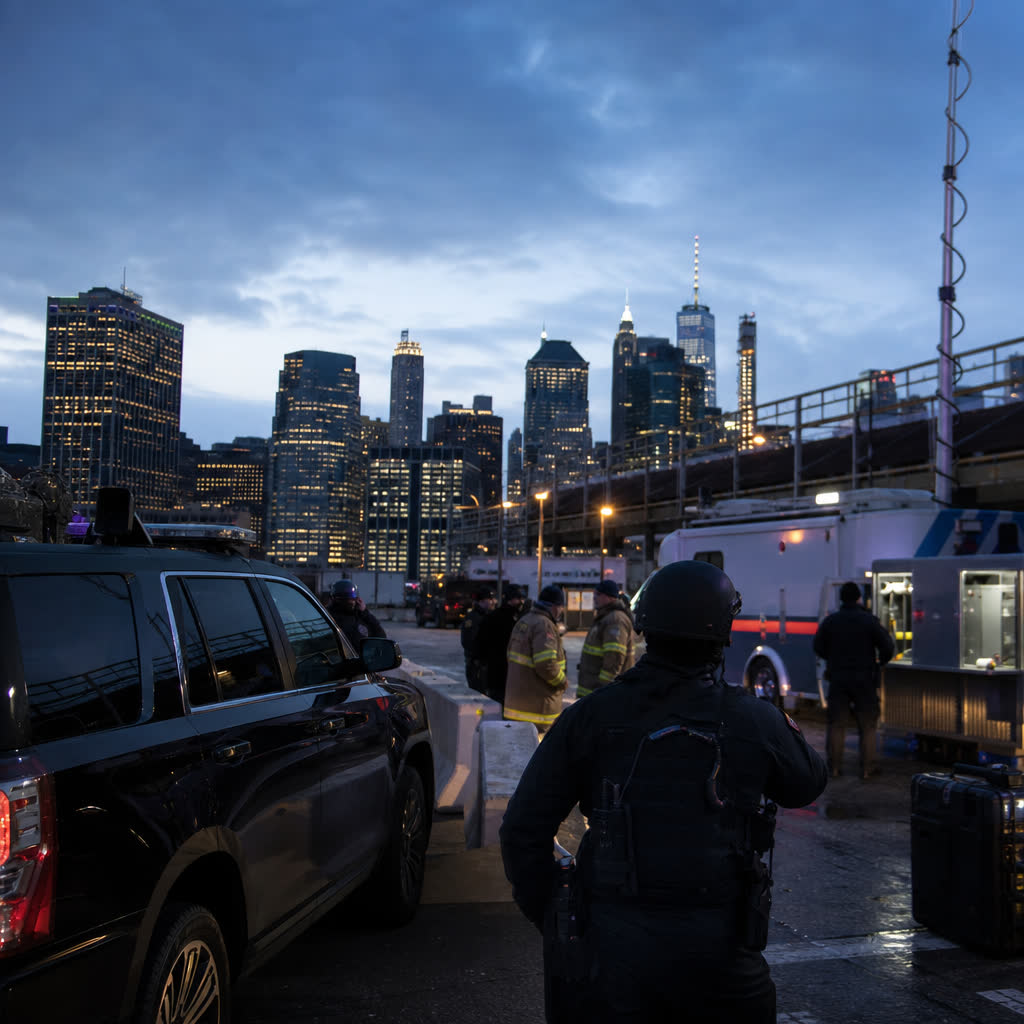
NEW YORK — A week-old dispute over $87 million in federal counterterrorism funding is taking on added urgency as New York approaches the 25th anniversary of the Sept. 11 attacks, with state and city leaders accusing the Trump administration of withholding promised support and federal officials countering that New York has not spent money already in hand.
Gov. Kathy Hochul and Mayor Zohran Mamdani publicly pressed the Department of Homeland Security on Sept. 1 to release what they describe as the unpaid balance of a restored federal grant allocation. The Democratic leaders say the money supports intelligence work, bomb squads, transit security, emergency communications, equipment and training across the state.
The disagreement is not simply over whether counterterrorism is a federal priority. It is over how much Washington owes New York, what prior commitments require and whether delays reflect legitimate grant administration or political punishment.
Hochul’s office says New York’s fiscal 2025 allocation under the Homeland Security Grant Program was initially reduced by $187 million, an 86 percent cut. According to the governor’s account, President Donald Trump later said he had reversed reductions to New York City and state homeland-security funding. New York subsequently received $100 million after a federal judge’s order, Hochul’s office said, leaving $87 million outstanding.
The administration disputes the portrayal of a starved security system. News 12 reported that a Federal Emergency Management Agency spokesperson said New York state and city had more than $300 million in unspent homeland-security funds and were scheduled to receive $200 million connected to hosting the FIFA World Cup. FEMA accused Hochul and Mamdani of manufacturing a crisis and asked why they were seeking additional taxpayer money before spending prior awards.
Those competing assertions address different questions. Unspent prior grants do not, by themselves, establish whether a promised allocation has been fully delivered. At the same time, the existence and availability of earlier funds are relevant to claims that an $87 million delay creates an immediate operational shortfall. Neither side’s public statement supplies a full grant-by-grant accounting that allows New Yorkers to independently reconcile the totals.
The programs involved have concrete missions. FEMA says the Homeland Security Grant Program funds preparedness planning, organization, equipment, training, exercises and administration. Its State Homeland Security Program supports statewide, risk-based security strategies. The Urban Area Security Initiative is directed toward designated high-threat, high-density regions. A third component, Operation Stonegarden, supports cooperation on border security.
Hochul’s office says 80 percent of funding under the state and urban programs goes to local entities, with 20 percent reserved for state projects. It identified the NYPD intelligence and counterterrorism operations, FDNY communications and radiological response, the New York National Guard’s Joint Task Force Empire Shield, 12 certified bomb squads and local training and equipment as beneficiaries of the disputed money.
News 12 separately reported that more than 100 New York City Emergency Management staff members are funded through an Urban Area Security Initiative grant. Mamdani argued that the nation’s largest city should not have to shoulder the security burden alone.
The rhetoric has been unusually pointed. Hochul accused Trump of “defunding the police,” repurposing a phrase Republicans have frequently aimed at Democrats. She said withholding the funds undermines the officers and analysts responsible for preventing attacks. FEMA, in turn, accused New York’s leaders of making false claims while failing to use hundreds of millions of dollars.
That exchange carries an unmistakable electoral dimension. Hochul and Trump are political adversaries, and the governor has cast the grant fight as part of a larger pattern of hostile treatment from Washington. But the proximity of the Sept. 11 anniversary also raises the cost of reducing the matter to campaign messaging. The relevant agencies must plan across election cycles, and their personnel need predictable schedules for hiring, procurement and training.
The funding’s history adds to the need for clarity. The Homeland Security Grant Program was built after Sept. 11 to help state and local governments prevent and respond to terrorist attacks. New York has a singular claim on the national memory behind that policy, but federal grants remain governed by annual appropriations, notices, conditions and reimbursement rules. A presidential social-media statement that cuts were reversed may create a political commitment; agencies still have to translate that commitment into awards that recipients can draw and spend.
The public record cited by both camps leaves key questions for DHS and New York to answer. Federal officials could identify which awards make up the more than $300 million they call unspent, whether those dollars are obligated to ongoing projects and what deadlines govern them. New York could provide a line-item account of the claimed $87 million, explain which operations face delays and distinguish the fiscal 2025 dispute from fiscal 2026 or World Cup-related funding.
Until that accounting is available, the most defensible conclusion is limited: New York’s leaders say a promised restoration remains incomplete, while FEMA says existing and expected resources undermine the charge that Washington is defunding public safety. Resolving that factual divide would do more for confidence than another round of slogans.
Twenty-five years after the attacks that reshaped the city and federal security policy, the argument is a test of intergovernmental trust. Counterterrorism depends on information and resources moving across institutional boundaries. New York and Washington may remain political rivals, but the grant system can function only if both sides show exactly what was promised, what was delivered and what remains available.