New York Passed a Bill to Kill 'Ghost Jobs.' It's Been Sitting in a Drawer Since June.
New York has passed a bill, currently awaiting the governor's signature, to penalize employers for posting fake "ghost jobs," but its effectiveness remains doubtful given its failure to address AI hiring practices and the state's notoriously poor enforcement of similar past laws.
By Aspen Yang · August 21, 2026 · 4 min read

If you have spent this year firing resumes into a void, the state Legislature agrees with you that something is wrong. In June it passed a bill that would make big employers say, in bold capital letters, whether the job they are advertising actually exists. Then nothing happened.
As of Aug. 21, S8877 has not been delivered to Gov. Kathy Hochul. The Senate's tracker still shows it parked at "Passed Senate & Assembly," last action June 2. A spokeswoman for Hochul says she will review it when it reaches her desk. That may be a while: bills tend to travel to the governor in batches late in the year, which is what employment lawyers have been telling New York clients to expect.
Here's what it would do. Sponsored by Sen. Michael Gianaris of Queens, it passed the Senate 39-19 in April and the Assembly on June 2. Any employer with 100 or more workers — plus the job boards themselves — would have to label every listing one of three ways: a real opening to be filled by a specific date; a real opening that won't be filled until no sooner than a specific date; or not an opening at all, just resume collection. Once someone is hired, the ad comes down within two weeks. Miss any of that and it's $2,500 per site the ad ran on, $5,000 if it isn't fixed within a month, then double every 30 days after. The Labor Department could audit employers and take complaints. Government agencies are exempt, and there's no grace period.
Notice what it doesn't touch. The bill regulates when a job will be filled, not what the ad asks for and not how the resume gets read on the other end. It says nothing about the software doing the reading — resume screeners, automated scoring inside applicant tracking systems, video interviews graded on your mannerisms — or about the arms race that software set off, with applicants now using AI to fire off fifty applications in the time it took to tailor one. A Pennsylvania proposal would at least make employers disclose how much AI they use in hiring. New York's would not.
New York City already has a version of that law, and its record is the reason to read S8877's enforcement clause closely. Local Law 144 has required since 2023 that employers using automated hiring tools on city candidates run an annual bias audit, post the results, and tell candidates the tool is in use, with penalties of $500 to $1,500 a day. In December, State Comptroller Thomas DiNapoli's office reported what that looked like in practice from July 2023 through June 2025. The Department of Consumer and Worker Protection got two complaints in two years and never checked whether its complaint pipeline worked. Reviewing 32 companies' sites and audits, DCWP flagged one instance of non-compliance; the comptroller's auditors went through the same 32 and found at least 17 possible violations. A 2024 academic study that sent students to check 391 city employers found 18 with an audit posted.
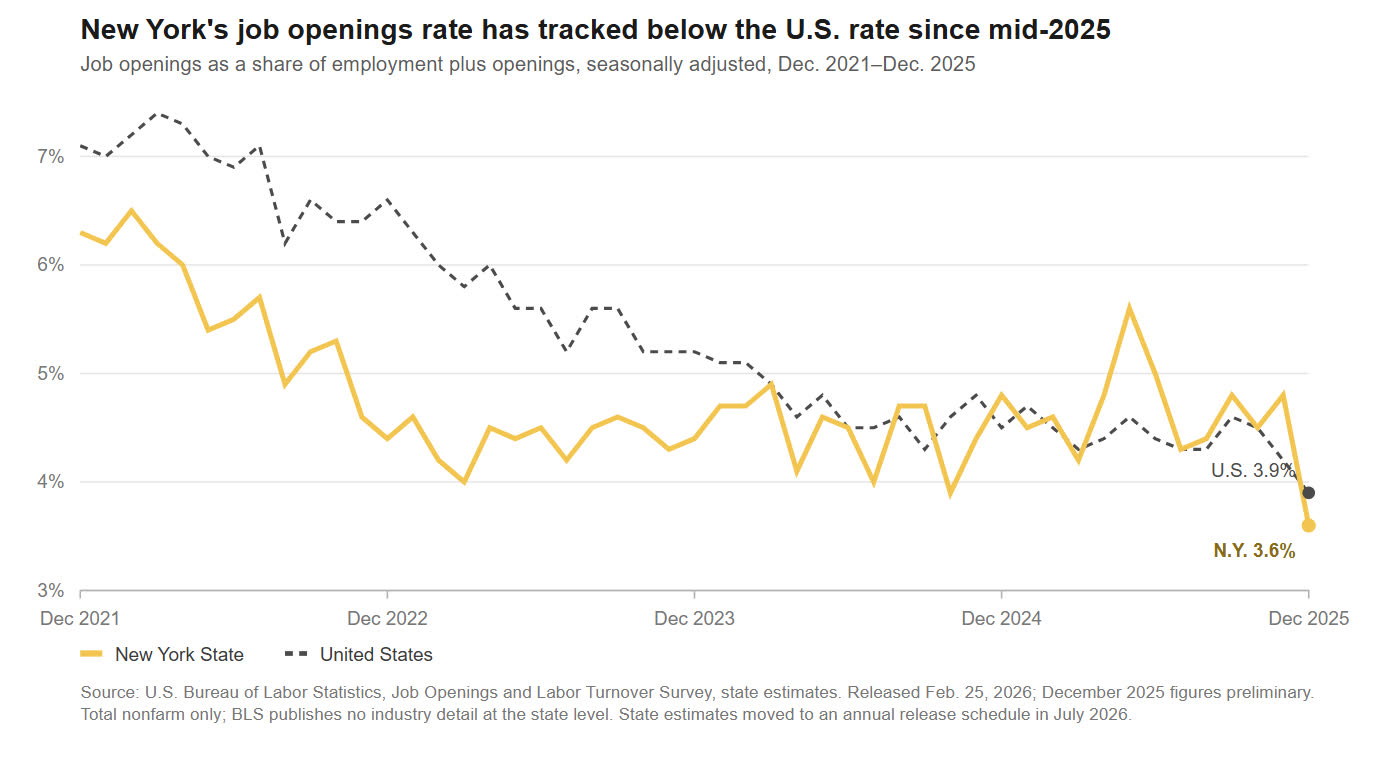
The state's numbers can at least tell you how crowded the door is. New York had 372,000 job openings in December 2025, an openings rate of 3.6 percent, slightly under the national 3.9. Employers made 366,000 hires that month and averaged 317,000 a month across the year. There were 1.2 unemployed New Yorkers for every posted opening, against 1.1 nationally.
What they can't tell you is which industry is wasting your time. The Bureau of Labor Statistics publishes state openings for total employment only, with no sector breakdown, so there's no official answer to whether ghost jobs are a tech problem or an everything problem here. It also got harder to check: February's was the last monthly release, and state figures moved to an annual schedule in July.
Where hiring stopped is measurable. Nearly all of the city's job growth over the year ending in December came from health care and social assistance, the city comptroller's office reported; strip that out and private employment fell by about 38,000. Finance, professional and business services, and information added essentially nothing in 2025. Those are jobs never created, which isn't the same as jobs advertised and never filled — though from the applicant's side of the screen they look identical.
As for how many listings are hollow, no official body knows. Hunter Ng, a Baruch College researcher, put it near 21 percent nationally in a 2024 paper that reads job seekers' interview reviews rather than the listings. The louder numbers come from companies that sell hiring software, and the Congressional Research Service noted last year that those firms disclose little about how they count. Gianaris's own justification memo leans on one — a vendor survey finding 40 percent of companies posted a fake listing in 2024. New York is preparing to attach real fines and an audit power to a problem it has never measured, using an agency nobody has asked about staffing, in a city where the last transparency law of this kind went two years and collected two complaints.