Bus Cameras Now Cover 67 Routes. The Loading Zones Haven't Caught Up
Camera enforcement now covers 67 bus routes and 810 route miles citywide, but the loading zones Flushing and Sunset Park delivery drivers need most are expanding on a far slower schedule.
By Aspen Yang · August 10, 2026 · 3 min read
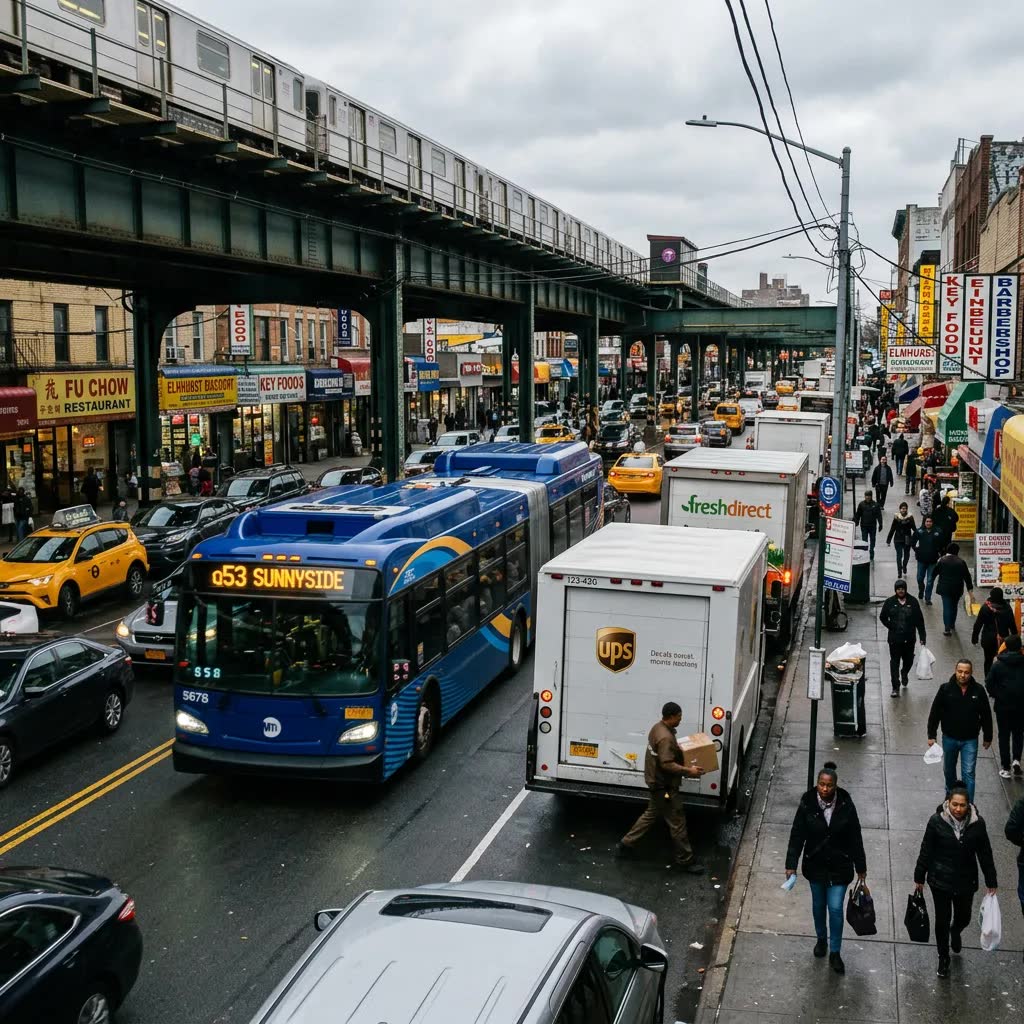
Camera enforcement now covers 67 bus routes and 810 route miles, but the loading zones Flushing and Sunset Park delivery drivers need are arriving on a slower schedule.
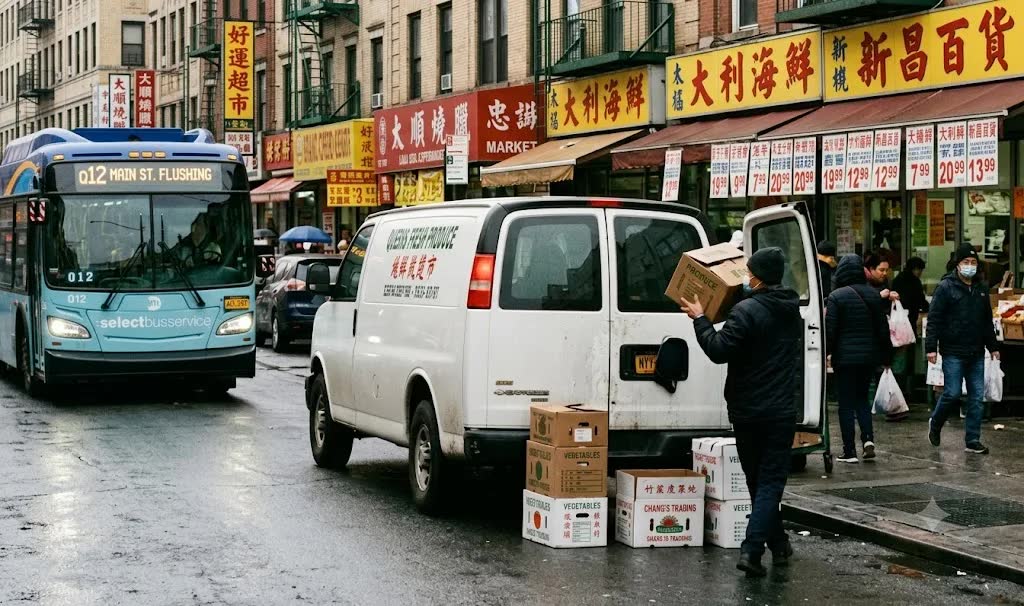
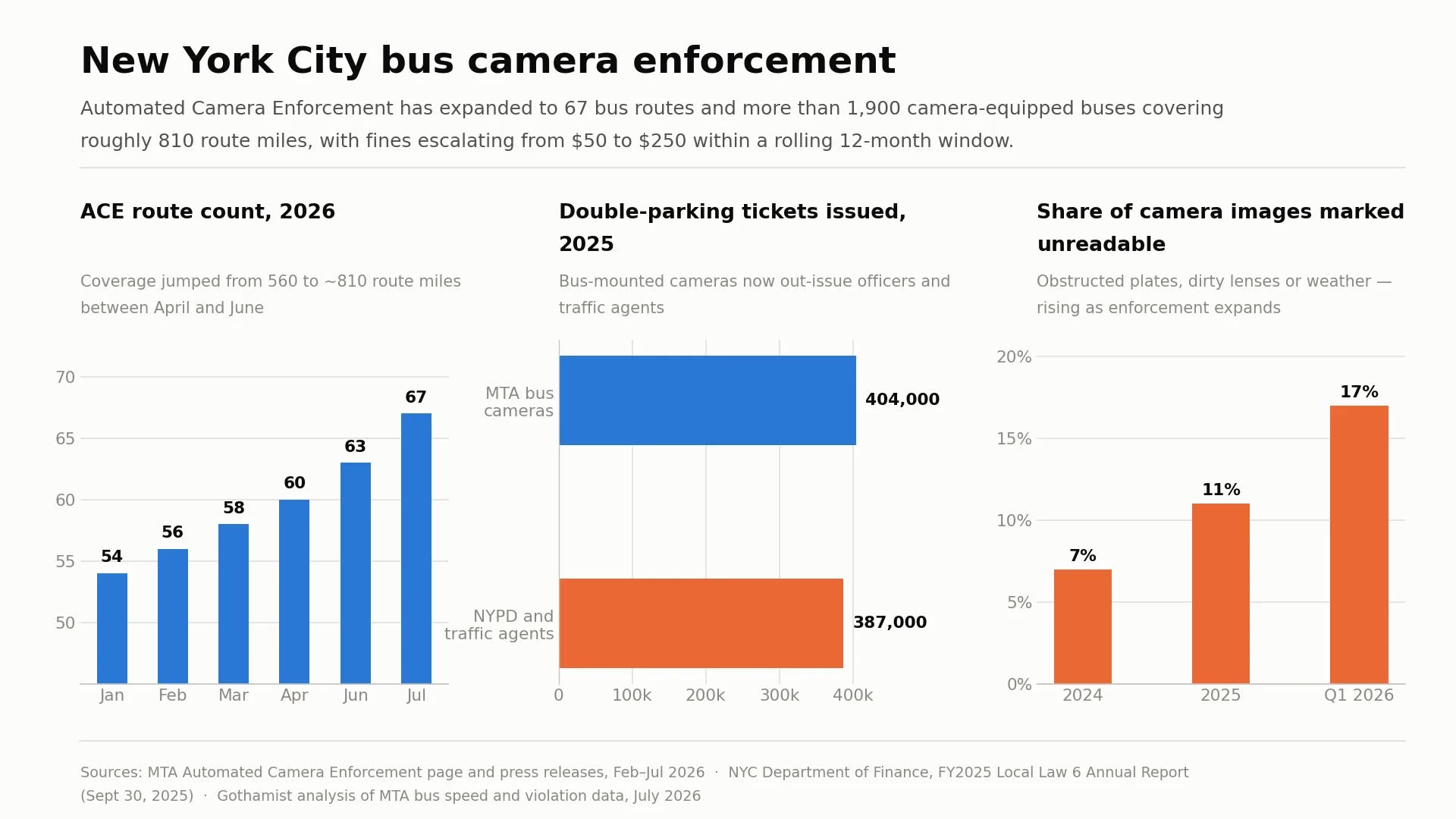
NEW YORK, Aug. 10, 2026 —The MTA now runs Automated Camera Enforcement on 67 bus routes citywide, up from 54 in February, with more than 1,900 camera-equipped buses covering roughly 810 route miles. Fines escalate from $50 to $250 inside a rolling 12-month window. The expansion has reached deep into the commercial corridors of Downtown Flushing and Sunset Park, where the second lane has functioned as a loading dock for decades.
The rollout has been near-monthly, and the financial footprint has grown faster than the route map. The Department of Finance's Fiscal Year 2025 report found that ACE produced a 551 percent increase in MTA camera violations over FY24, part of 16,547,590 tickets and camera violations issued citywide carrying $1.13 billion in penalties. Bus cameras issued roughly 404,000 double-parking tickets in 2025, against about 387,000 from NYPD officers and traffic agents.
The mechanics are narrower than most drivers assume. A vehicle must be seen by two separate buses before a violation issues, and the clocks differ by offense: five minutes for standing in an active bus lane, two and a half minutes for blocking a bus stop or double parking along an ACE route. The same vehicle can be cited once every two hours. Since August 2024, repeat bus-camera violations within twelve months have run $50, $100, $150, $200 and $250. The penalties are civil, touching neither driving records nor insurance rates, and a City employee reviews each one before issuance.
In Flushing, the pressure points are specific: the Q44-SBS along Main Street, the Q17 along Kissena Boulevard, and the Q58 along College Point Boulevard — the arteries carrying wholesale produce, seafood and restaurant supply into the neighborhood's core. The Main Street busway between Northern Boulevard and Sanford Avenue adds a second layer: everyone but buses, trucks and emergency vehicles must turn off at the next corner.
Sunset Park's exposure is less direct but arguably tighter: the B11 on 49th and 50th Streets, the B35 on Church Avenue and 39th Street, the B63 on Fifth Avenue. Eighth Avenue itself is absent, so its curb is enforced by NYPD while every approach into it sits under camera enforcement. For a van running six to eight stops a day across those approaches, a fifth citation in twelve months costs the same $250 as a fiftieth.
This is where the program draws its sharpest criticism. The Department of Finance's own rules acknowledge that commercial loading is sometimes lawful: a listed defense to double parking is loading or unloading for no more than 20 minutes without blocking the only travel lane. But that defense is asserted after a summons arrives, not before. Curb supply is expanding on a separate track — a 2021 law requires DOT to add five loading zones a year in each qualifying neighborhood, and it reported hitting 500 citywide in January 2025. Camera enforcement is running on a schedule the curb redesign does not match.
The MTA's counter-argument is a data argument: speed gains averaging 5 percent, some segments near 30 percent, a 20 percent drop in collisions, a 40 percent drop in blocked bus stops, and a repeat-violation rate around 10 percent. The data is not uniformly favorable. A Gothamist review found speeds fell on at least nine camera-equipped routes, and unreadable images rose from about 7 percent of events in 2024 to 17 percent in early 2026.
Drivers have 30 days to pay or request a hearing; unpaid violations accrue a $25 penalty at 30 days and enter judgment at 75. Hearings can be requested at nyc.gov/disputeticket, through the NYC Pay or Dispute app, by mail or in person at a Finance business center. The strongest defense to a double-parking summons is proof of loading within 20 minutes without blocking the only travel lane: timestamped manifests, signed receipts, dashcam footage.