As the Heat Climbs, a City Hospital System Sends Care to the People Who Can't Come In
A public hospital network has launched a summer program of mobile cooling clinics and door-to-door outreach aimed at the elderly and chronically ill during heat waves.
By Priya Nair · July 25, 2026 · 5 min read
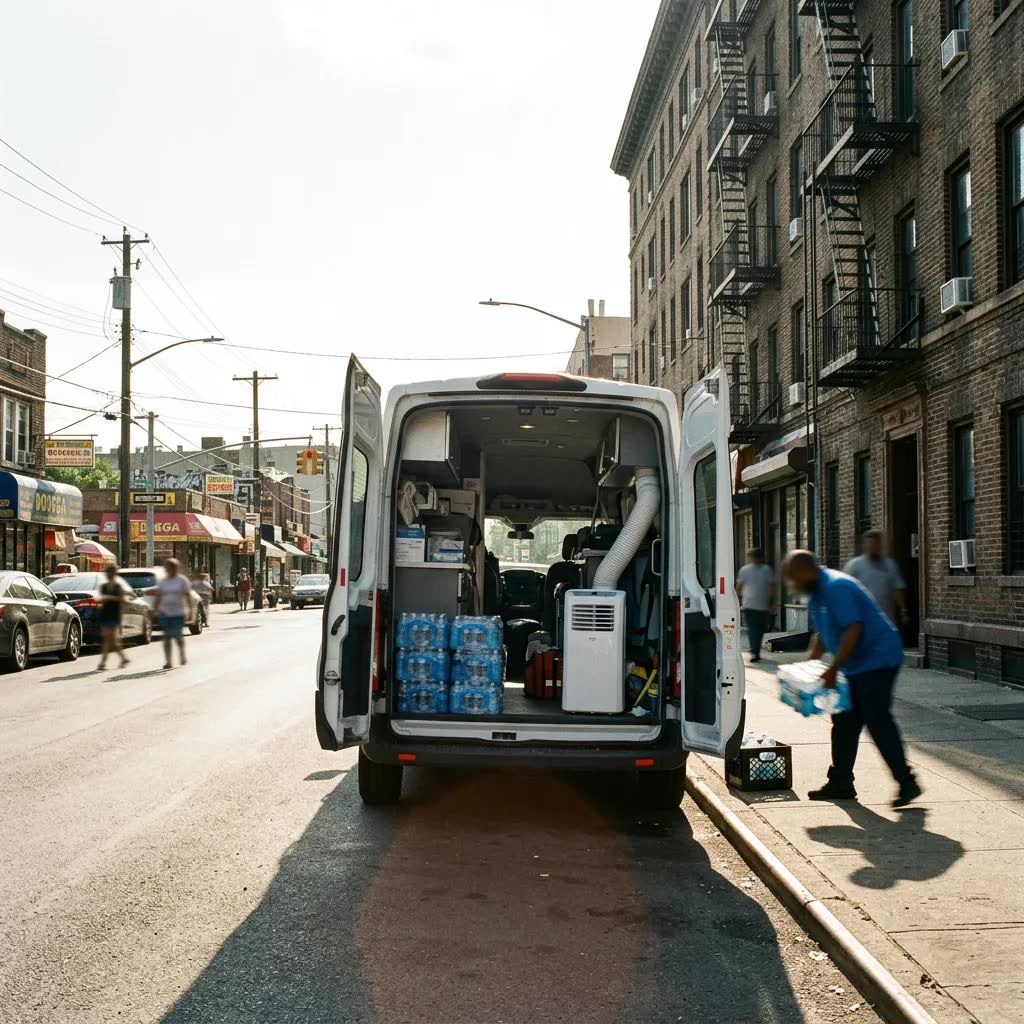
NEW YORK — When the temperature climbed past ninety-five degrees for the third consecutive day last week, a small team from a city public hospital network did not wait for patients to arrive in the emergency room. Instead, they loaded a van with water, blood-pressure cuffs, and a portable air-conditioning unit and set out to knock on the doors of elderly and chronically ill residents in a heat-vulnerable stretch of the Bronx, part of a new summer program built on the premise that the most at-risk patients are often the least able to seek care themselves.
The initiative, launched this summer across several of the network's hospitals, pairs mobile cooling clinics with door-to-door wellness checks during declared heat waves. It grew out of a recognition, hospital administrators say, that extreme heat kills quietly and disproportionately, claiming older people living alone in apartments without air-conditioning far more often than it fills emergency rooms with dramatic collapses. The goal is to reach those residents before a sweltering apartment becomes a medical crisis.
"The people who die in heat waves are usually not the ones calling 911," said a physician helping lead the effort. "They're alone, they're on medications that make heat more dangerous, and they've decided not to bother anyone. By the time we'd normally see them, it's an emergency, or worse. The whole idea here is to get to them a day earlier, while it's still just a hot apartment and not a hospital admission."
The program leans heavily on data, using the network's own patient records to flag individuals whose age, medical conditions, and medications place them at elevated risk, and cross-referencing that with the neighborhoods that heat hardest. During a heat emergency, outreach teams prioritize those patients for calls and home visits, checking that their apartments are survivable, that they are hydrating, and that their medications are being managed safely in the heat. Those found in unsafe conditions can be brought to a cooling clinic or, if necessary, admitted.
The effort is not without its complications. Reaching homebound patients is labor-intensive and expensive, requiring staff and vehicles pulled from other duties during precisely the periods when emergency departments are already straining under heat-related demand. Hospital officials acknowledge the program is, for now, a pilot operating at limited scale, and that expanding it citywide would require sustained funding and a larger commitment of personnel than any single summer's budget provides.
Still, the early results have persuaded the network to press ahead and study the outcomes closely, hoping to build the case that prevention is cheaper and kinder than the emergencies it heads off. "We can keep meeting people in the ER after the damage is done, or we can go find them first," the physician said, climbing back into the van as the afternoon heat shimmered off the pavement. "One of those approaches saves lives, and honestly, it saves money too. We're trying to prove both at once."