NYC Pension Funds Returned 13%. Here’s What Drove the Gains
New York City’s five public pension funds beat their 7% actuarial target as strong equity markets lifted combined assets to $326.3 billion.
By Iris Ye · August 17, 2026 · 4 min read

NEW YORK, Aug. 17, 2026 — New York City’s five public pension funds returned 13% in the fiscal year ended June 30, bringing their combined assets to $326.3 billion and comfortably exceeding the city’s 7% actuarial target, according to the New York City Comptroller’s Office.
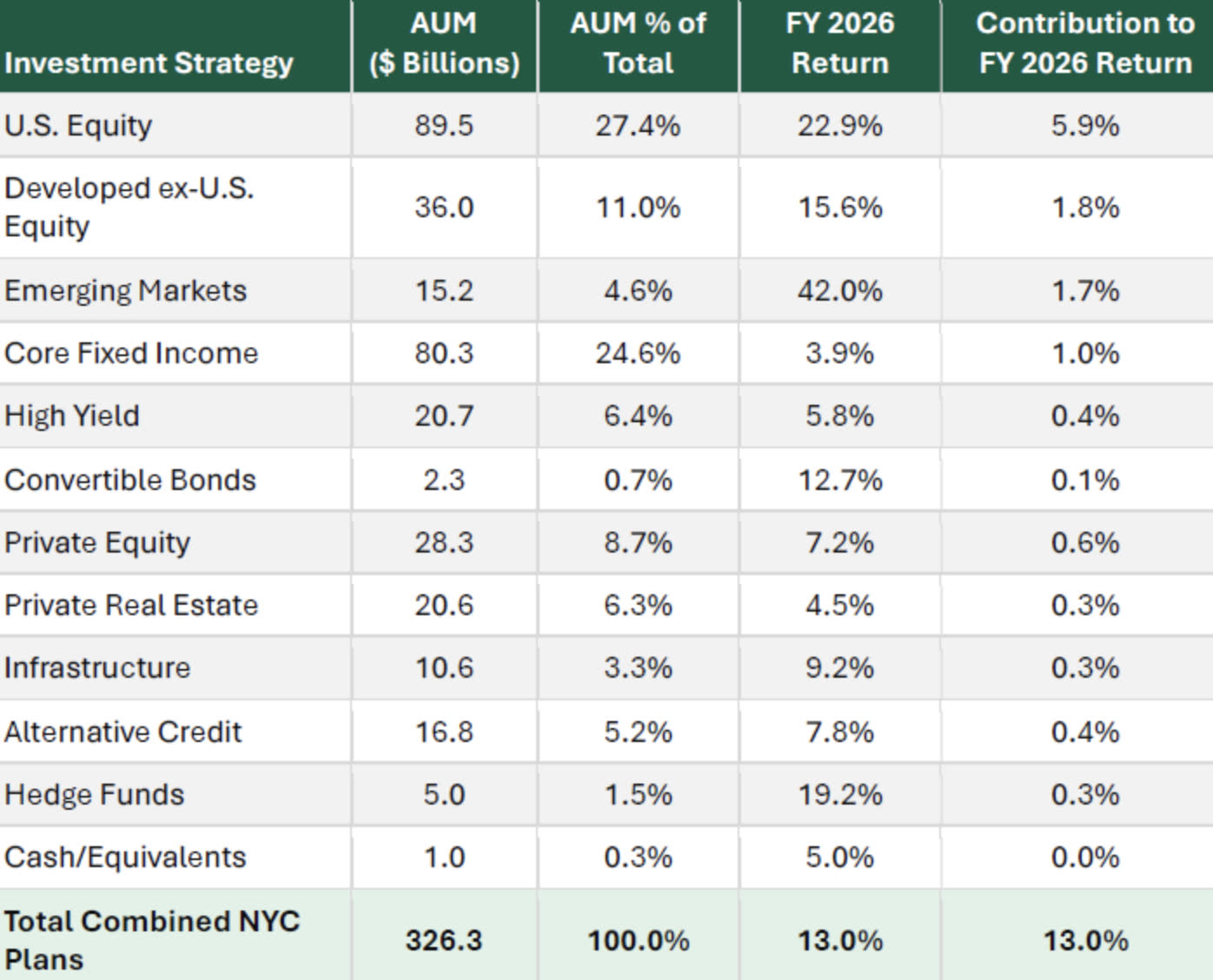
But the headline number hides a more uneven story. Most of the year’s gains came from public stocks, particularly U.S. and emerging-market equities, showing how a portfolio can be broadly diversified in what it owns while still drawing much of one year’s return from a narrower part of the market.
The stakes extend well beyond an investment report. The Comptroller’s Office manages the assets with the pension systems on behalf of more than 750,000 current and retired public servants, including teachers, firefighters, police officers and other city employees. How those assets perform connects global financial markets to both retirement security and New York City’s finances.
The Comptroller’s fiscal 2026 report shows just how important equities were. U.S. stocks, with $89.5 billion invested, returned 22.9% and contributed 5.9 percentage points to the overall result. Developed-market equities outside the United States added another 1.8 points, while emerging-market stocks returned 42% and contributed 1.7 points. Together, those three categories generated about 9.4 percentage points of the portfolio’s 13% return.
Technology was a common thread. The report said emerging-market information technology stocks rose more than 160%, supported by demand for advanced computing and memory chips. Taiwan Semiconductor Manufacturing Company, Samsung Electronics and SK hynix together represented more than 30% of the benchmark index. Technology also led gains in developed overseas equities and was among the strongest sectors in the United States.
That connection shows how far a global investment cycle can travel. Spending on artificial intelligence infrastructure and advanced chips may begin with technology companies, data centers and semiconductor manufacturers, but through global stock markets its effects can reach institutions that appear far removed from the technology sector — including a municipal pension system supporting the retirement benefits of New York’s public workers.
Other parts of the portfolio tell a quieter story. The Comptroller’s figures show that core fixed income, nearly a quarter of total assets, returned 3.9%, while private equity gained 7.2%, private real estate 4.5% and infrastructure 9.2%.
Their more modest returns do not necessarily make them less important. Diversification is not designed to make every investment perform equally well each year. Part of its purpose is to reduce reliance on the same source of returns across different market environments. The assets that contributed less during a strong year for equities may play a larger role when today’s market leaders are no longer leading.
The 13% return also carries consequences beyond the portfolio itself. Because it exceeded the city’s 7% actuarial assumption, the Comptroller’s Office estimates that New York’s required pension contributions will be reduced by approximately $6.3 billion over the five fiscal years beginning in FY2028.
That does not mean the city receives a $6.3 billion investment windfall. Instead, stronger-than-assumed returns reduce the amount the city is projected to contribute to the pension systems in future budgets. A market cycle driven partly by technology stocks and global equities can therefore travel another step — from investment portfolios into the city’s longer-term fiscal planning.
Still, pension investing runs on a much longer clock than a single strong year. Official figures put the 13% return in perspective: the combined funds earned an annualized 11.1% over three years and 8.9% over 10 years, while the five-year annualized return was lower at 6.2%.
For a system built to pay benefits decades into the future, the real test is not whether it can repeat a 13% return every year. It is whether a diversified portfolio can continue meeting long-term obligations as the sources of market growth change.
This year’s result offers a snapshot of that challenge. Behind one headline number is a chain linking global technology demand, financial markets, the retirement security of hundreds of thousands of New Yorkers and, ultimately, the finances of the city they serve.