NYCHA Launches Mesh Wi‑Fi Pilot to Bridge Digital Divide
A city-backed program will equip dozens of public‑housing developments across the Bronx and Brooklyn with low‑cost community Wi‑Fi and local support centers.
By Amina El-Sayed · March 12, 2026 · 4 min read
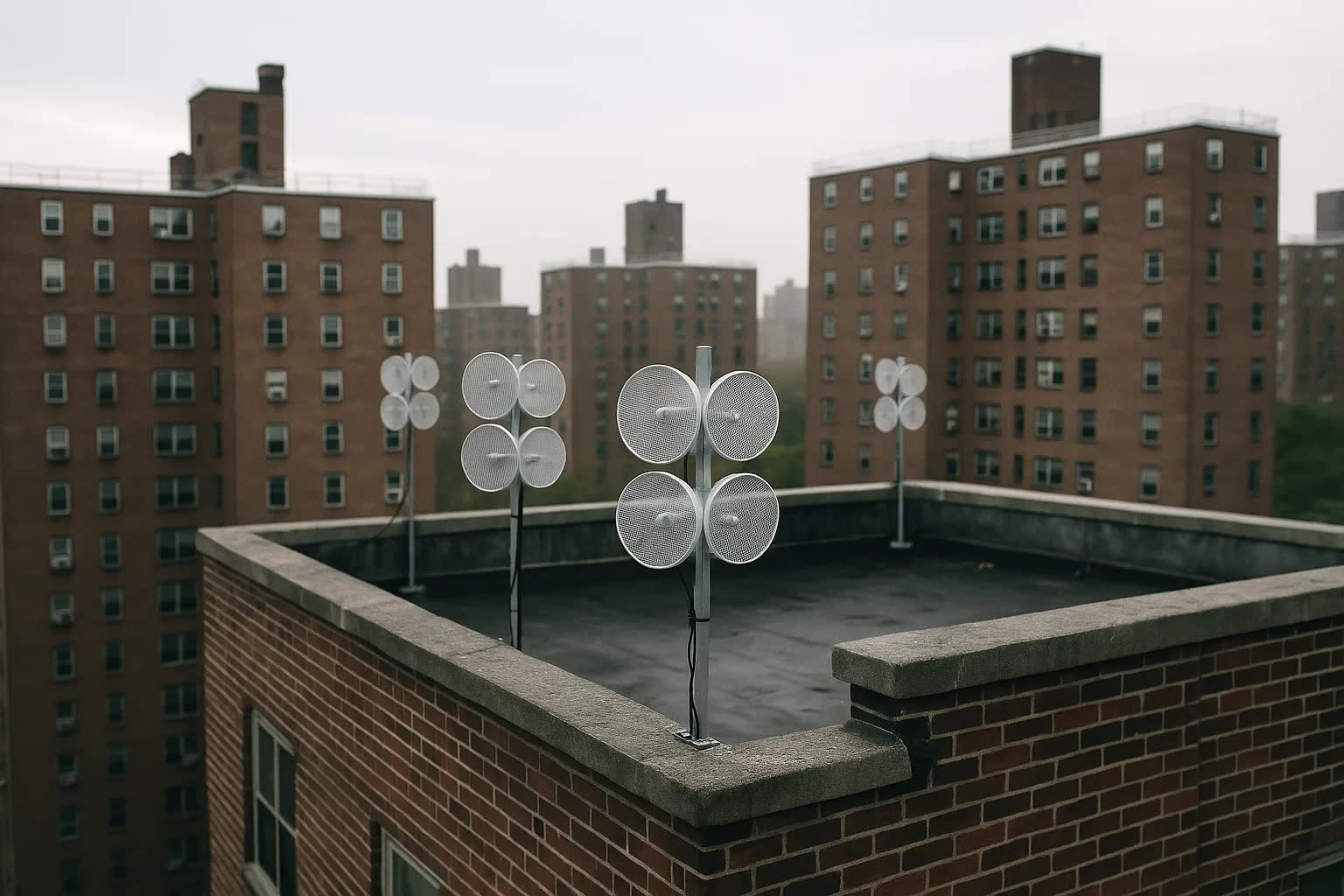
NEW YORK — New York City Housing Authority officials on Thursday unveiled a mesh Wi‑Fi pilot that will bring low‑cost community internet and neighborhood support centers to dozens of public‑housing developments in the Bronx and Brooklyn, a bid city leaders say is designed to close a digital gap that has left many residents relying on expensive commercial plans or patchy mobile service for work, school and health care.
The program, branded internally as Connected Communities, will install interconnected wireless nodes across courtyards, rooftops and lobby areas in targeted developments in neighborhoods such as Soundview, Hunts Point, Brownsville and Bedford‑Stuyvesant, and will pair the hardware with staffed “connect centers” that offer device support and digital‑skills classes. The effort is a collaboration among NYCHA, a consortium of local nonprofits and a private infrastructure partner, BridgeTech Labs, and is supported by city seed funding as well as philanthropic grants.
“For too long, being a NYCHA resident has meant being on the wrong side of a modern infrastructure,” said Rosa Medina, NYCHA director of digital inclusion, at a press event outside a community room near Allerton Avenue in the Bronx. “This pilot is about building reliable, affordable access on the ground and making sure residents have the human support to use it.” Medina said technicians will be hired from within the affected communities and that lessons from the pilot will shape longer‑term policy.
Residents who attended neighborhood meetings in Brownsville and along Atlantic Avenue in Brooklyn said the lack of dependable home broadband has had tangible consequences. “My kids would finish homework on the stoop because the apartment Wi‑Fi drops whenever the washing machine runs,” said Marcus Rivera, president of the East Newton Tenants Association. “If the service is steady and they can get help at a local center when a device breaks, that changes daily life — not a flashy promise, but real help.”
Officials provided concrete figures for the initial phase: the pilot will serve 40 developments — 22 in the Bronx and 18 in Brooklyn — encompassing roughly 16,200 apartments and an estimated 46,000 residents. The hardware plan calls for about 1,200 mesh nodes and 40 staffed connect centers, with peak household throughput targeted at 100–150 megabits per second. The city has budgeted $12 million for the 18‑month pilot: $8 million from municipal connectivity funds, $3 million from philanthropies, and $1 million in contributed services and equipment from BridgeTech Labs. Eligible households at or below 200 percent of the federal poverty level will pay no more than $5 a month for premium support.
Technically the mesh system will couple fiber backhaul where available with a mix of fixed wireless point‑to‑point links to minimize construction in sensitive buildings, NYCHA said. Nodes will be mounted to existing infrastructure wherever feasible to avoid adding towers, and each connect center will host an uplinked console where residents can report outages in real time. BridgeTech Labs engineers demonstrated a prototype in a Bushwick community lab, showing automatic rerouting if a node is disabled, and emphasized end‑to‑end encryption and on‑device parental controls as standard features.
Not everyone embraced the plan without reservation. “Community Wi‑Fi can be a powerful tool, but it carries risks around data privacy, surveillance and vendor lock‑in if safeguards aren’t explicit and enforceable,” said Leah Song, director of OpenCity Connect, a digital‑rights nonprofit that has reviewed the pilot proposal. Song urged binding transparency requirements around traffic data retention, third‑party analytics and how the city will audit system performance over time.
NYCHA and partners say the pilot specifically responds to those concerns: the contracting terms include limits on metadata retention and prohibit the resale of resident data, while the connect centers will offer privacy workshops and one‑to‑one support. The rollout also includes a workforce development component run by LocalWorks, a nonprofit training provider, which will certify 120 local residents as “connect technicians” over the 18‑month period. “We aren’t parachuting in expertise — we’re building local capacity,” said Imani Brooks, director of training at LocalWorks.
Community groups and borough offices greeted the announcement with cautious optimism, noting that past city broadband promises have sometimes sputtered in execution. “This project reflects community input, and that’s essential,” said Darnell Hughes, communications director for the Bronx borough office, adding that borough staff would monitor metrics such as uptake among seniors and student access during after‑school hours. Several tenant leaders said they wanted clearer timelines for repairs and an independent grievance mechanism if service fell short.
City officials said the pilot will be evaluated on adoption, reliability, digital‑skills uptake and measurable impacts on education and telehealth access, with an 18‑month review scheduled to determine whether to expand citywide. If the pilot meets benchmarks, NYCHA officials said the city could scale the model to another 80 to 100 developments within three years, refine contracts to strengthen resident protections and seek sustainable recurring funding — an outcome that NYCHA leaders and neighborhood advocates said would be critical to turning a short‑term experiment into lasting infrastructure improvement for thousands of New Yorkers.