NYCHA Tenants Mobilize Against Privatization Plan in East Harlem
Residents say a proposed privatization agreement would lead to rent hikes and diminished services at a large East Harlem development.
By Noah Fitzgerald · April 19, 2026 · 5 min read
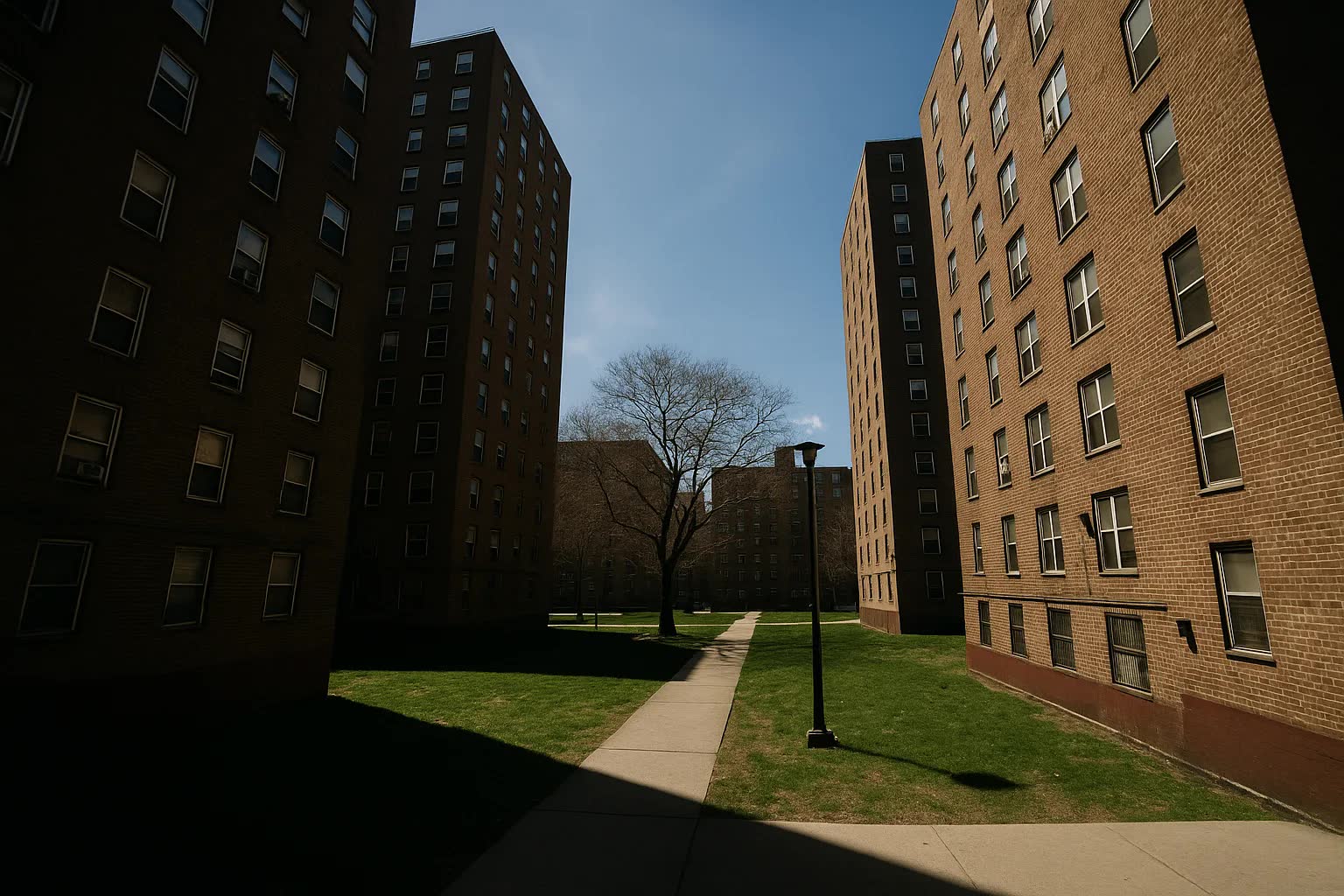
Hundreds of tenants at the Riverbend Houses in East Harlem converged Tuesday on the small brick NYCHA management office on East 116th Street, arguing that a proposed privatization agreement would saddle long-time residents with higher rents and weaker services at one of the borough’s largest public housing developments. The protest — held under a gray spring sky near the FDR Drive and just blocks from the Metropolitan Hospital Center — unfolded as NYCHA moves toward a tentative deal with a private equity partner that tenants and advocates say prioritizes capital investment over tenant protections.
The draft agreement, first circulated in February, would transfer long-term management and certain ownership rights of a majority of Riverbend’s buildings to Harborstone Capital, a privately held firm that has worked on housing projects in the tristate area. NYCHA officials say the arrangement would unlock hundreds of millions for repairs, but residents fear it would change lease terms and ultimately raise what they pay. “We’ve lived here for decades,” said Marisol Reyes, president of the Riverbend Tenants Association and a 42-year resident. “This is not about repairs alone; it’s about protecting our homes and our budgets.”
NYCHA’s privatization program director, Daniel Cho, defended the framework at a community meeting last week, saying the authority lacks the funds to fix crumbling infrastructure across its portfolio. “We are negotiating legally enforceable covenants to preserve affordability, and the private partner brings the capital and project management to deliver roofs, boilers and elevators that have been deferred for decades,” Cho said. He added that any changes to tenant rent calculations would have to follow federal and local law and that the agency is seeking to include tenant protections in the final agreement.
Tenants said those protections proposed so far fall short. At an afternoon strategy session in a nearby church basement on Park Avenue, residents parsed draft contract language and highlighted clauses that could allow rents to rise for tenants who no longer qualify under tighter income recertification rules, or for units that the private partner reclassifies as market-rate after rehabilitation. “You could fix an elevator and suddenly find the unit 'no longer eligible' for the same subsidy,” said Carlos Mendez, a 24-year resident and retired school janitor. “That’s displacement by another name.”
The numbers in the deal underscore why anxiety has spread through the neighborhood. Riverbend Houses comprises roughly 1,080 apartments across 10 mid- and high-rise buildings, housing about 3,000 residents; authorities say 68 percent of households earn less than 50 percent of the area median income. Under the current draft, Harborstone would assume a 99-year ground lease for 720 units, with the firm committing $300 million in upfront repairs and NYCHA contributing $120 million in federal and city subsidies; projected capital needs for the campus total $420 million over 20 years. The proposal would convert 360 units to a mixed funding model tied to tax credits, and independent estimates presented to residents suggest average monthly housing costs for about 40 percent of households could rise by roughly $200 to $300 over a decade if subsidy rules are tightened.
The Riverbend campus already bears the scars of deferred maintenance that advocates point to in arguing for immediate capital—stained linoleum in hallways off East 118th Street, malfunctioning intercom systems near the playground on Second Avenue, and elevators that sometimes stop for hours in the towers. But tenants say the real threat is a future in which corporate management prioritizes cost-cutting over day-to-day services. “I’m not against repairs, but I’m against losing my home,” said Aisha Thompson, a tenant organizer who has lived in Riverbend since 1999. “If they bring in private management and then subcontract everything, our building will feel less safe, not better.”
Proponents of the plan point to the scale of NYCHA’s maintenance backlog across the city and note that public funds alone have not closed the gap. Dr. Lila Anand, director of the Urban Policy Center at a local university, said privatization can work when paired with stringent oversight. “In principle, private capital is a tool to deliver repairs at speed, but it must be coupled with clear, enforceable affordability covenants, resident governance rights and transparent performance metrics,” Anand said. She cautioned that without those elements, deals can reproduce the same inequities they aim to solve.
The debate has already rippled through East Harlem’s small-business corridors on 116th and 125th streets, where bodegas and laundromats said customers come to demand answers. Local civic groups have rallied with tenants, and a coalition of legal aid organizations is vetting potential challenges. A City Council oversight hearing on public-private models is scheduled for next month, and several council members who represent Upper Manhattan have expressed concern about the pace and transparency of NYCHA negotiations, according to people familiar with the calls who declined to be named to discuss internal deliberations.
Legal and regulatory hurdles could further complicate the timeline. Any final agreement will require board approval at NYCHA, a review by the U.S. Department of Housing and Urban Development if federal subsidies are altered, and financing commitments from lenders that underwrite tax-credit allocations. Tenants’ groups say they are prepared to seek injunctions and press for state-level protections if necessary; they have already filed a demand for a full environmental and displacement impact study before any vote. NYCHA spokespeople say the agency is open to amendments but needs a path to fund repairs that have been postponed for years.
With a NYCHA board vote tentatively set for late May, organizers said they plan more rallies, a letter campaign to City Hall and a possible lawsuit aimed at pausing the negotiations. For many Riverbend residents, the fight is about more than mechanics and money: it is about the future of East Harlem as a neighborhood where families can afford to stay. “We will be at that board meeting,” Reyes said. “We’re not going away until our rights and our homes are secured.” The coming weeks will test whether the agency’s search for capital can be reconciled with the community’s demand for durable tenant protections and a say in how their homes are run.