Outer Boroughs Grapple with EV Charging Deserts on Residential Streets
Residents without driveways face long waits and zoning headaches as municipalities try to balance curb space, parking rules and equity for EV access.
By Aaron Feldman · December 6, 2025 · 4 min read
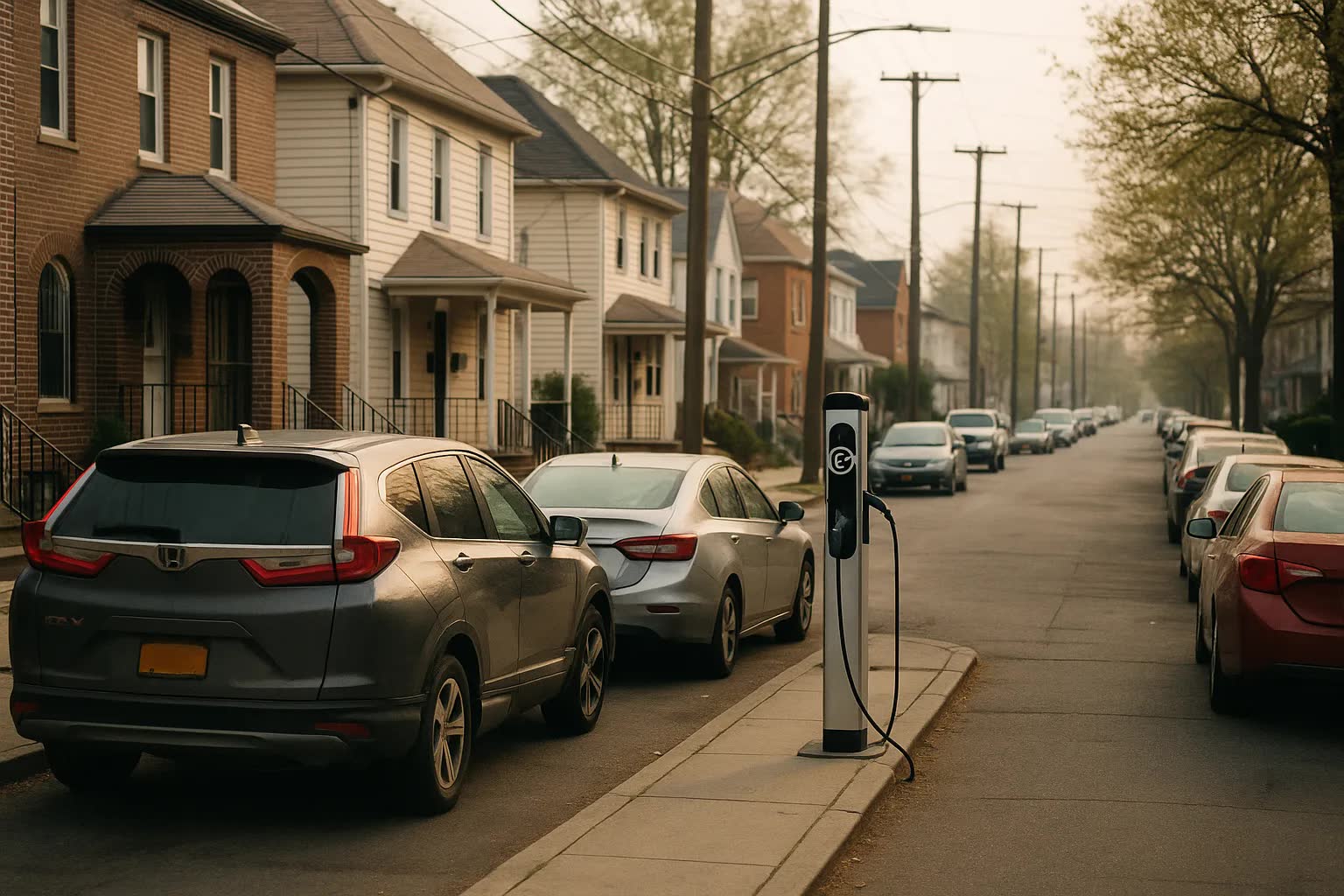
NEW YORK — In neighborhoods from Jackson Heights to East New York and Stapleton on Staten Island, residents who do not own private driveways are finding themselves at the back of the city's electric vehicle transition, with curbside charging scarce, waitlists long and municipal rules that seem designed for rowhouses with garages. As New York moves toward cleaner transportation, the outer boroughs are grappling with a tangle of zoning restrictions, parking rules and utility upgrades that make adding a single charger to a residential block a months-long, often prohibitively expensive undertaking, leaving many drivers reliant on distant fast chargers or costly private garages.
City planners and community leaders say the pattern is the product of competing priorities: preserving curb space for deliveries, keeping metered parking revenue, and meeting the grid's physical limits while trying to distribute chargers equitably. The Department of Transportation, the Department of Buildings and the city's utilities must all sign off on curb installations, and local community boards and block associations are frequently consulted, a process that can stretch approvals into the next calendar year. Pilot programs have concentrated chargers along commercial corridors — Queens Boulevard, Fordham Road, Fourth Avenue in Brooklyn — rather than on narrower residential streets where most car-owning households park overnight.
For people who live on those streets, the result is practical and emotional frustration. "Charging felt like an urban amenity that was being sold to downtown Manhattan and Midtown Brooklyn," said Maya Singh, co-director of the Queens EV Equity Project, who has helped organize community petitions in Jackson Heights and Elmhurst. "We have families, older residents and drivers who deliver for a living who simply can't access reliable overnight charging. The map of chargers looks like a painting of value, not a plan for transportation equity."
Concrete numbers underscore the imbalance. As of November 2025 the city's public dashboard listed 4,800 curbside charging points installed by municipalities and contracted vendors, with roughly 3,650 — or 76% — concentrated in Manhattan and northwest Brooklyn; Queens had 650, the Bronx 300 and Staten Island 200. The Department of Transportation also reported a municipal waitlist of about 22,000 households seeking curbside chargers for their blocks, and utility companies estimate that bringing a single curbside fast charger online can cost between $15,000 and $30,000 when trenching and transformer upgrades are required. An estimated 1.1 million households across the five boroughs lack private off-street parking, disproportionately clustered in the outer borough neighborhoods now vying for scarce curb access.
Local politics and neighborhood character often shape who gets a charger. In Bay Ridge and parts of Bensonhurst, block associations have pushed back on curb conversions that would eliminate metered spots and guest parking, raising fears about visitors and long-term street use. "We're not against EVs," said Darnell Price, president of the Bay Ridge Tenants Association. "But residents on 86th Street and Third Avenue worry that a charging kiosk will mean fewer spots for grandparents visiting for the day. These fights over one or two spaces add months to a permit process that should be driven by citywide goals, not individual block preferences."
City and vendor pilots are trying to bridge gaps with a mix of technological and policy experiments. The DOT has trialed lamppost-integrated chargers on Northern Boulevard and modular curb units on Staten Island, while a private contractor ran a pop-up fast-charge trailer near the Flatbush Junction transit hub during the summer. "We can't simply blanket the city with chargers without addressing transformer capacity and neighborhood traffic needs," said a senior DOT planner who requested anonymity because the person was not authorized to speak publicly. "But we can be more strategic: shared charging zones, prioritized residential hours, and streamlined permits would shave weeks off project timelines."
Small-business owners and drivers who work on app platforms say current options are impractical. Hamid Alvi, who drives for a ride-hail service and lives in Flatbush, estimates he spends an extra two hours a week seeking a charger that fits his schedule. "I'm not going to sit in a charging lot for the night when I can be working," he said. Building-level solutions are uneven: some new condo developments in Williamsburg and Long Island City include dedicated parking and charging infrastructure, but older walk-up buildings in the Bronx and Queens often have no realistic path to add tenant chargers without major, costly electrical upgrades.
Advocates and municipal staff point to a handful of equity-oriented fixes: dedicating a percentage of new curbside charger permits to low-income Census tracts, offering subsidies to co-op boards and landlords for electrical upgrades, and creating shared-charging hubs in municipal lots within a half-mile of high-density residential blocks. Nonprofit coalitions in Fordham and East New York have piloted neighborhood charging hubs in underutilized municipal parking lots, with early data showing 40 to 60 percent weekday occupancy and strong evening demand, but scaling those sites requires capital and agreements with utilities to upgrade local transformers and meters.
Looking ahead, city officials plan to publish a revised curbside charging strategy in spring 2026 that will outline funding priorities, streamlined permitting and a target for geographic distribution, while private vendors are experimenting with lower-cost, 'plug-and-play' curb units that avoid deep street excavation. Technology shifts — vehicle-to-grid systems that allow cars to act as distributed batteries, and faster, lower-power chargers designed for overnight topping up — may ease pressure on the distribution network in coming years. For residents in Jackson Heights, Bay Ridge and Stapleton, the promise of equitable access to EV charging hinges on whether those technical fixes are matched by clear rules and money to bring chargers to the blocks where most New Yorkers park.