City Council Passes Landmark Tenant Bill of Rights Amid Surging Rents Across the Five Boroughs
The sweeping package caps annual rent increases, mandates lease renewal for all renters, and establishes a new Office of Tenant Advocacy — but a legal challenge is expected within days.
By Sarah Chen · August 16, 2026 · 5 min read
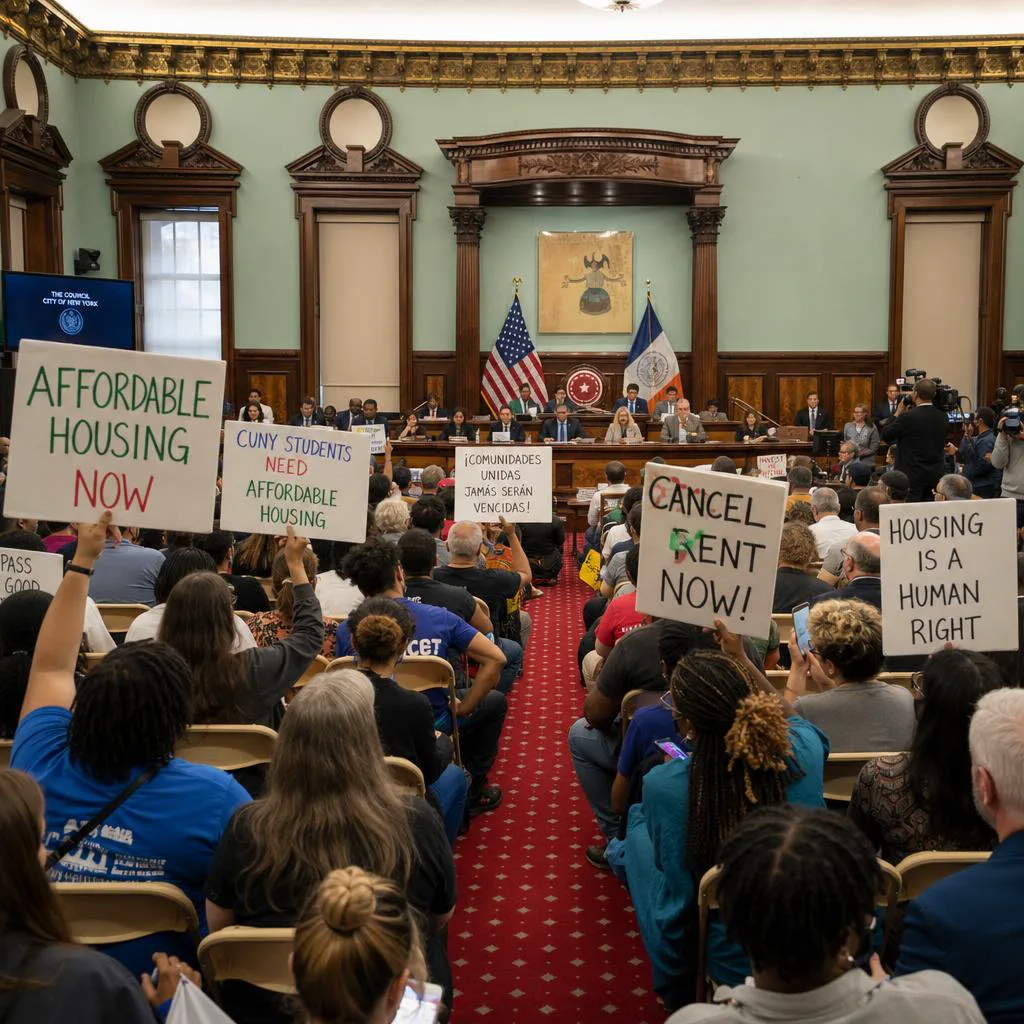
The New York City Council voted 38 to 11 on Friday to pass the most expansive tenant-protection legislation the city has seen in a generation, a sweeping package of bills that caps annual rent increases for market-rate apartments, requires landlords to offer lease renewals to any tenant in good standing, and creates a new Office of Tenant Advocacy empowered to investigate complaints and levy fines.
Mayor Zellnor Myrie, who championed the legislation during his campaign last year, said he would sign the package into law by end of week. "For too long, the deck has been stacked against the people who actually make this city run," Myrie said at a City Hall press conference flanked by housing advocates and several council members who had pushed for even stronger measures. "Today we begin to rebalance it."
The centerpiece measure, known as Intro 1142, limits annual rent increases for unregulated apartments to the lesser of five percent or the regional Consumer Price Index plus two percentage points. The restriction would apply to apartments that have been rented for at least one year, covering an estimated 800,000 units that were previously outside any rent stabilization framework. A second bill mandates that landlords notify tenants of their right to renew at least 120 days before a lease expires and prohibits non-renewal except on specific grounds such as non-payment or owner occupancy.
The Real Estate Board of New York moved swiftly to signal its opposition, calling the legislation "constitutionally infirm" and pledging to file a court challenge in State Supreme Court within days. "These bills will chill investment in new housing at exactly the moment when New York needs more of it, not less," said REBNY president Jacqueline James. "We respect the council's intent but cannot allow an unconstitutional taking of property rights to stand unchallenged."
Legal scholars were divided on the question of constitutionality. Several housing law experts said the package was carefully drafted to track precedents set by the city's rent stabilization system, which has survived repeated court challenges over five decades. Others pointed to a 2024 Supreme Court ruling on regulatory takings as a potential vulnerability.
For tenants like Maria Gutierrez, a home health aide who has rented the same apartment in the Fordham section of the Bronx for eleven years, the vote was the culmination of years of organizing. Gutierrez, 54, said her landlord had raised her rent by 22 percent over the past two years after her building was sold to a private equity firm. "I have lived here my whole life," she said outside City Hall after the vote. "I should not have to be afraid every time my lease comes up."
The package also establishes right-to-counsel for tenants facing eviction proceedings in housing court and appropriates $45 million annually for legal services organizations to carry out that mandate. A separate bill requires landlords of buildings with more than six units to accept rental payments via electronic transfer at no cost to the tenant.
Mayor Zohran Mamdani, who made affordable housing a defining issue of his mayoral campaign, praised the council but said the fight was far from over. "Passing a law is one thing. Making sure it is enforced, that tenants actually know their rights, that the Office of Tenant Advocacy has teeth — that is the work that starts Monday morning," he said.